

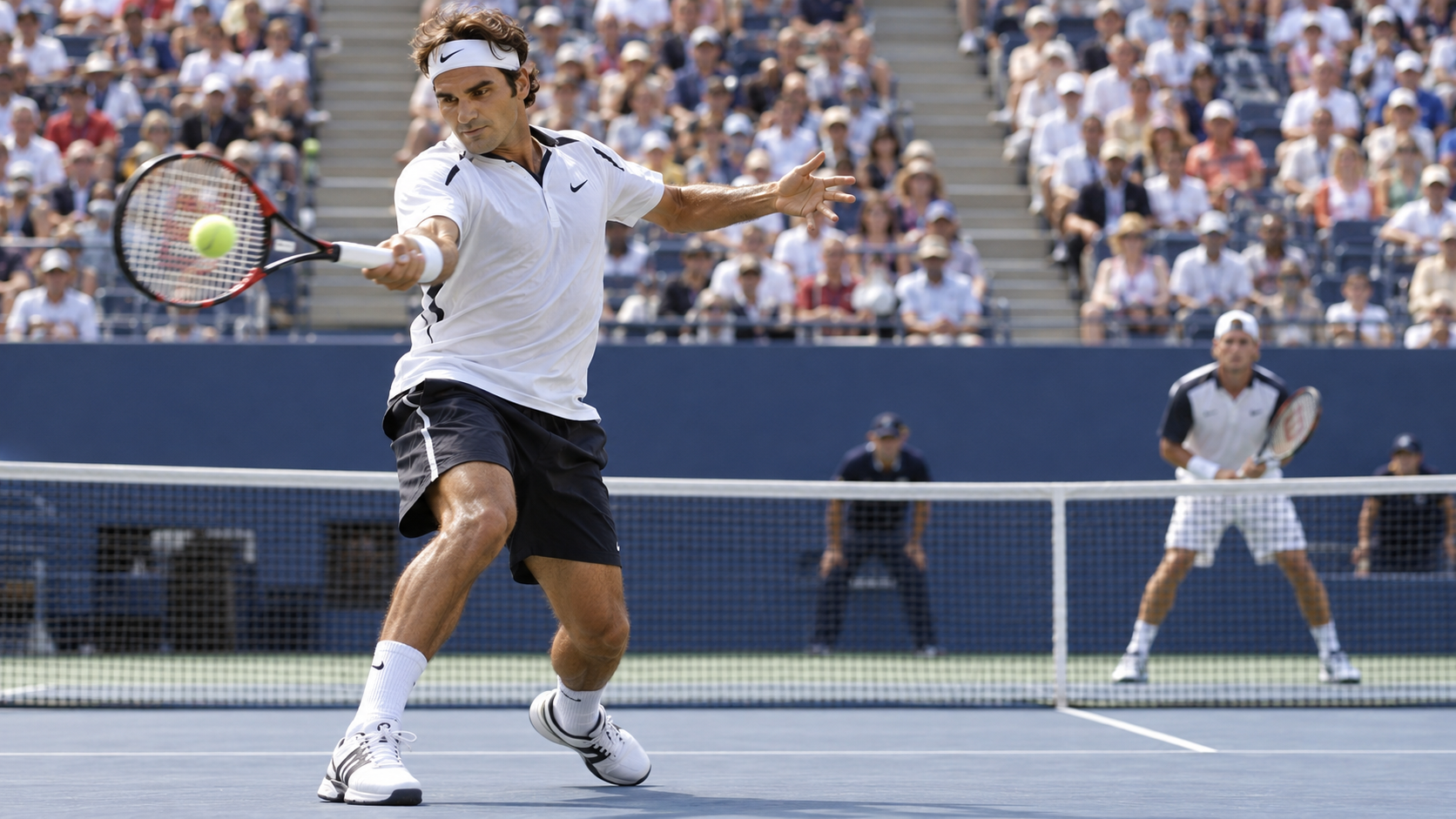
On This Day in Sports: September 12, 2004
On September 12, 2004, Roger Federer defeated Lleyton Hewitt in the men’s final at Arthur Ashe Stadium to win his first US Open title. The world No. 1 won 6-0, 7-6, 6-0, delivering two love sets in a Grand Slam final and claiming his third major championship of the 2004 season. Federer won 6-0, 7-6, 6-0. Hewitt had won the 2001 US Open. Those details establish the result and its setting, but the day’s importance came from the larger historical pressure surrounding the competition and the people who carried it through.
Federer had already won the Australian Open and Wimbledon that year, but he had never advanced beyond the fourth round in New York. Hewitt arrived as a former champion and elite counterpuncher who had won the title in 2001. The final was played at Arthur Ashe Stadium. It was Federer’s third major of 2004. Together, those points show how preparation, rules, institutions and public expectations shaped the circumstances before the decisive action began. They also separate the documented background from later legend and retrospective interpretation.
Federer attacked immediately, controlling the first set with serving and forehand pressure. Hewitt forced a second-set tiebreak, but Federer won it and then accelerated again, closing the final without dropping a game in the third set. He won his first US Open at age 23. Federer captured five straight New York titles. The immediate result therefore involved more than a single score or statistic: it changed a record, championship, career or institution and gave contemporary audiences a clear reason to understand that the moment was unusual.
The victory began a run of five consecutive US Open titles through 2008, a feat unmatched in the tournament’s modern era. It also confirmed Federer’s transition from gifted contender to the dominant player of his generation. Seen from today, the event remains useful because it connects a measurable sports outcome with the systems around it—teammates, opponents, officials, venues, media and rules. The outcome was not inevitable, and its meaning did not end when play stopped. Preserving the exact date and qualifications helps explain why later generations still return to it. It also prevents a famous image or headline from replacing the fuller story of what actually happened. The best sports history holds achievement and limitation together, showing both the performance itself and the conditions that made it possible. That broader view preserves context without taking attention away from the people who performed under pressure. In that sense, September 12, 2004 still offers a focused view of how athletic excellence, public memory and institutional change can meet in a single day.
Federer won 6-0, 7-6, 6-0.
Hewitt had won the 2001 US Open.
The final was played at Arthur Ashe Stadium.
It was Federer's third major of 2004.
He won his first US Open at age 23.
Federer captured five straight New York titles.
Explore more "On This Day in Sports"
Discover more landmark games, records, championships, and turning points from sports history. Each day revisits the athletes, teams, and moments that shaped competition and culture.