

On This Day in Science: January 9, 1992
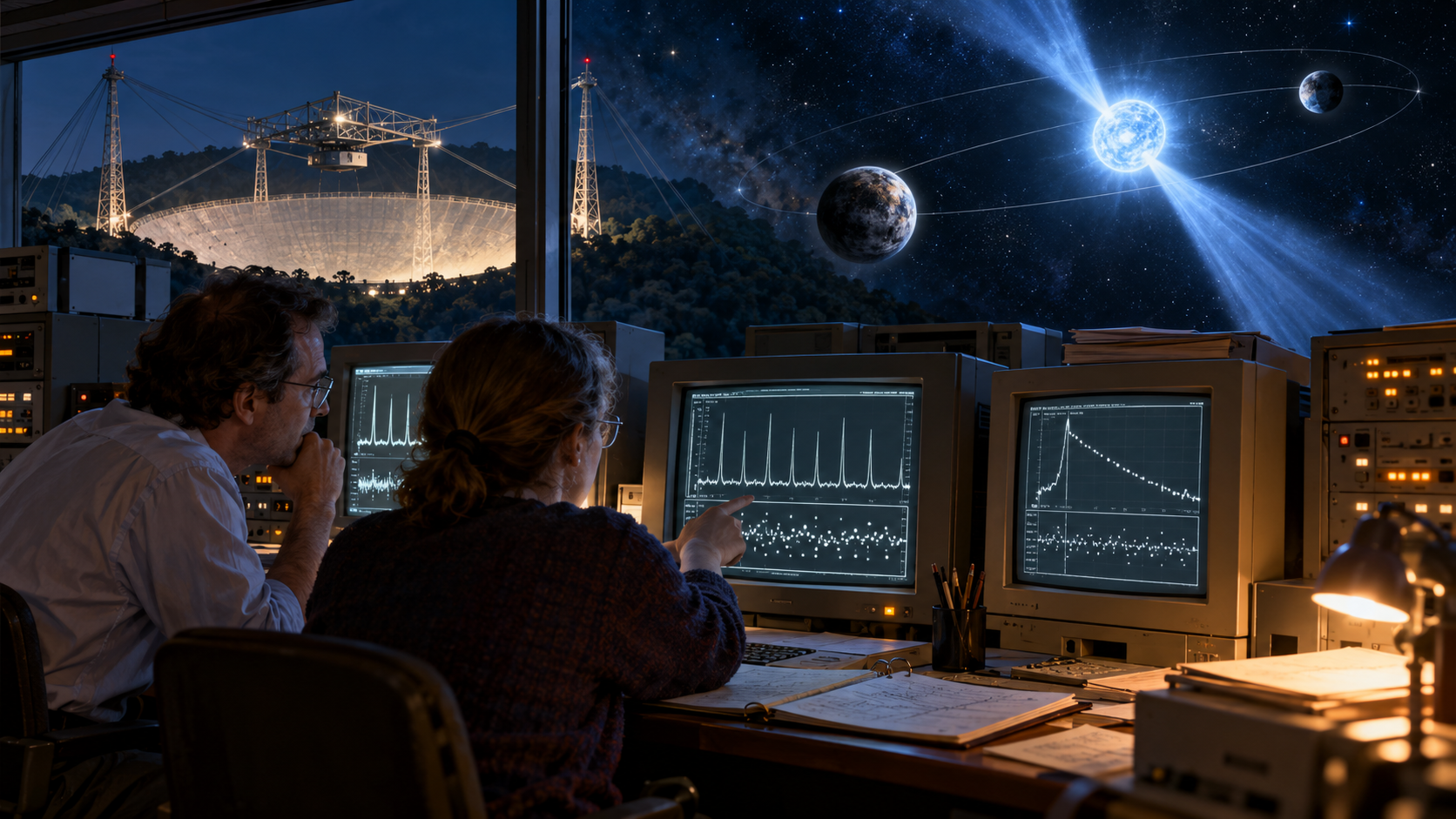
On January 9, 1992, Nature published Aleksander Wolszczan and Dale Frail’s report of a planetary system around the millisecond pulsar PSR B1257+12. Their evidence came not from a photograph but from exquisitely timed radio pulses measured with the Arecibo Observatory in Puerto Rico. A pulsar is the compact, rapidly spinning remnant of a massive star. Its beam sweeps past Earth with clocklike regularity. When the arrival times of those pulses shifted in repeating patterns, the astronomers found that the pulsar itself was moving slightly under the gravitational pull of orbiting bodies.
The timing variations indicated at least two planets with masses comparable to Earth, circling the pulsar in roughly 67 and 98 days. A third, smaller planet was confirmed later. The system was astonishing: these were not worlds around a Sun-like star but planets orbiting a neutron star only about twenty kilometers wide, the aftermath of a stellar explosion. Earlier exoplanet claims had been announced and withdrawn, so Wolszczan and Frail tested whether instrumental errors, Earth’s motion, or irregularities in the pulsar could mimic the signals. The repeated timing pattern and the planets’ gravitational interaction made the case unusually strong.
The discovery expanded the range of environments in which planets could exist. The original planets may have survived the star’s violent transformation, or material left after the supernova may have assembled into a new disk and formed a second generation of worlds. The data did not show friendly Earth analogs; the pulsar bathes its surroundings in intense radiation. It did show that planet formation was not confined to calm copies of the solar system. Radio timing could also detect relatively small bodies because a pulsar’s pulses provide a more stable reference than the visible position of an ordinary star.
More than three decades of exoplanet research followed, using stellar wobble, transits, microlensing, direct imaging, and other techniques to reveal thousands of worlds. The pulsar planets retain a special place because they were the first confirmed planets beyond the solar system and because they arrived in such an unexpected setting. Their January 9 publication changed a philosophical question into an observational field. Astronomers no longer had to ask only whether other planetary systems existed; they could begin measuring how often nature builds them, how varied their architectures are, and how planets survive extreme histories. The result also rewarded a method based on precision over spectacle: a few milliseconds of timing variation revealed bodies that no telescope could resolve directly.
The planets were detected through small, repeating changes in the arrival time of the pulsar's radio pulses.
Those shifts recorded the pulsar's motion around the shared center of mass of the system.
PSR B1257+12 is a neutron star, not a Sun-like star, making the planetary system far more extreme than researchers expected.
The worlds may have survived the supernova or formed later from material surrounding the stellar remnant.
Earlier claims had failed, but the repeatable timing pattern and gravitational interactions made this detection convincing.
The result opened a field that has since cataloged thousands of planets with many complementary methods.
Explore more of "On This Day ..."
Discover more events from the same date across news, politics, technology, sports, and other fields. Each link highlights significant moments that shaped history on different fronts.