

On This Day in Science: January 26, 1978
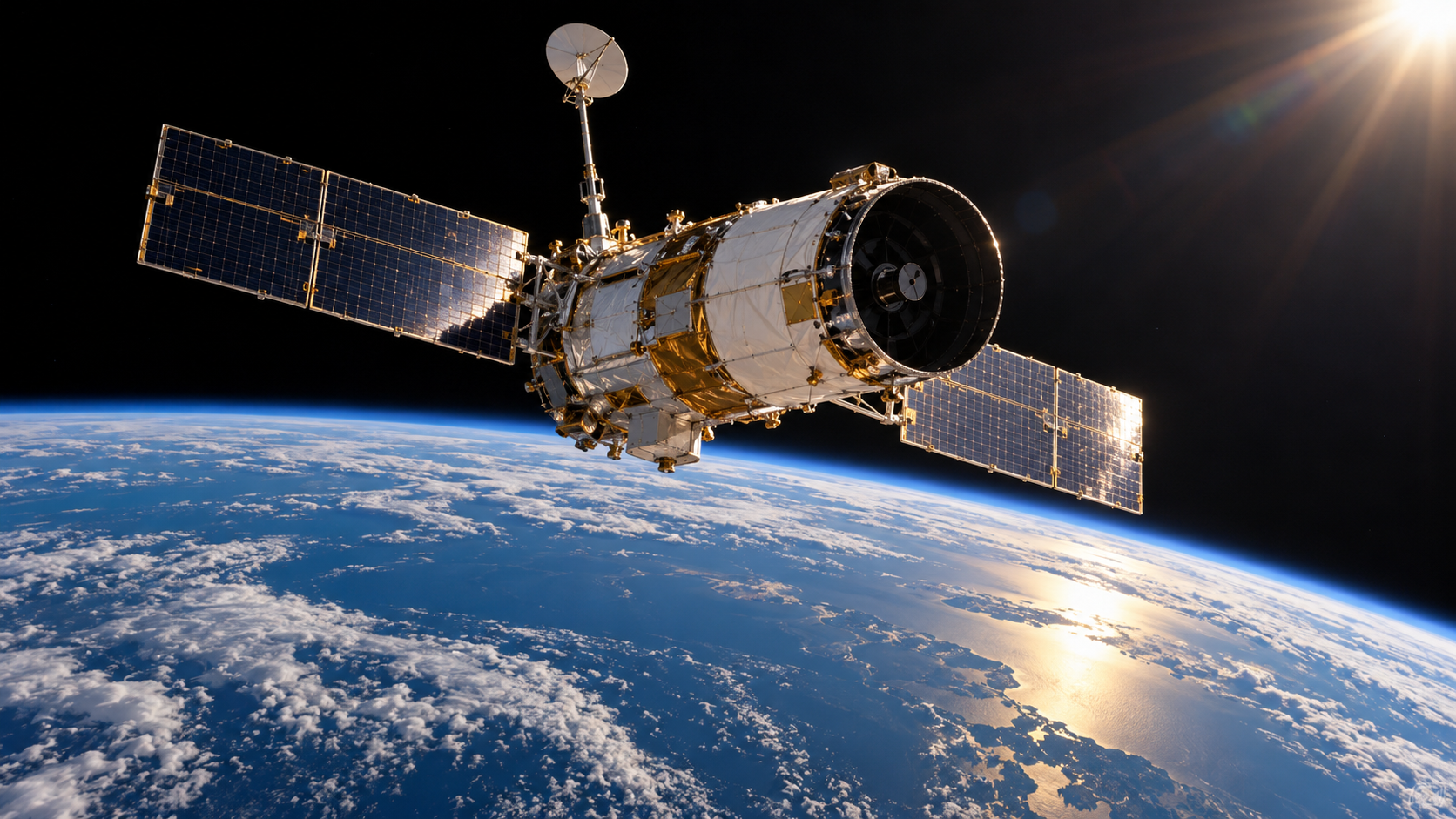
On January 26, 1978, the International Ultraviolet Explorer launched from Cape Canaveral into an elliptical geosynchronous orbit. Known as IUE, the observatory was a collaboration among NASA, the United Kingdom, and the European Space Agency. Its telescope fed two spectrographs covering ultraviolet wavelengths from about 115 to 325 nanometers, much of which Earth’s atmosphere blocks. Unlike many spacecraft that followed fixed observing programs, IUE was operated much like a ground observatory, with guest astronomers directing targets in near real time from control centers in Maryland and Spain.
Ultraviolet spectroscopy separates light into wavelengths that reveal temperature, composition, density, and motion in energetic objects. IUE observed hot stars, stellar winds, novae, supernovae, active galaxies, planets, and comets. Astronomers could respond quickly to transient events, including the explosion of Supernova 1987A, and compare ultraviolet measurements with observations from the ground. The high orbit kept the spacecraft visible to its control stations for long periods, allowing continuous sessions and rapid delivery of data to researchers.
The mission was designed for at least three years with a goal of five, but it operated for eighteen years and nine months. Engineers managed aging batteries, gyroscopes, detectors, and communications while preserving useful performance. By the time operations ended on September 30, 1996, IUE had taken more than 100,000 spectra of thousands of objects. Its archive became as important as individual discoveries because consistent measurements across many years let astronomers study changes and compare entire classes of stars and galaxies.
IUE changed both ultraviolet astronomy and the way shared space observatories were run. A broad international community could propose observations, sit with operators, and receive calibrated data quickly, foreshadowing later guest-observer missions. Hubble and other telescopes eventually surpassed its sensitivity and resolution, but IUE’s long baseline remains valuable for time-domain studies. The January 26 launch put an inaccessible part of the spectrum into routine service. Rather than a short demonstration, the small observatory became an enduring laboratory whose open archive continued producing science after the spacecraft was shut down. Its two control regions also made international operations part of the daily design instead of a ceremonial partnership. Standard calibration and rapid archiving turned individual observations into a coherent collection that later researchers could compare across nearly two decades. That consistency is especially valuable when a star or galaxy changes too slowly for one observing campaign to capture. Long archives transform endurance into a scientific instrument of its own.
Ultraviolet spectra reveal hot gas, energetic stars, chemical signatures, and motions that visible light may not show.
Because Earth's atmosphere blocks most of the band, a space telescope was necessary for consistent observations.
Guest astronomers worked with control centers in the United States and Spain to select targets and receive data quickly.
That operating style made the spacecraft responsive to novae, comets, and other events that changed on short notice.
IUE lasted more than six times its minimum design life and collected over 100,000 ultraviolet spectra.
Its long, uniform archive still supports studies of objects that vary across years and decades.
Explore more of "On This Day ..."
Discover more events from the same date across news, politics, technology, sports, and other fields. Each link highlights significant moments that shaped history on different fronts.