

On This Day in Science: February 17, 1996
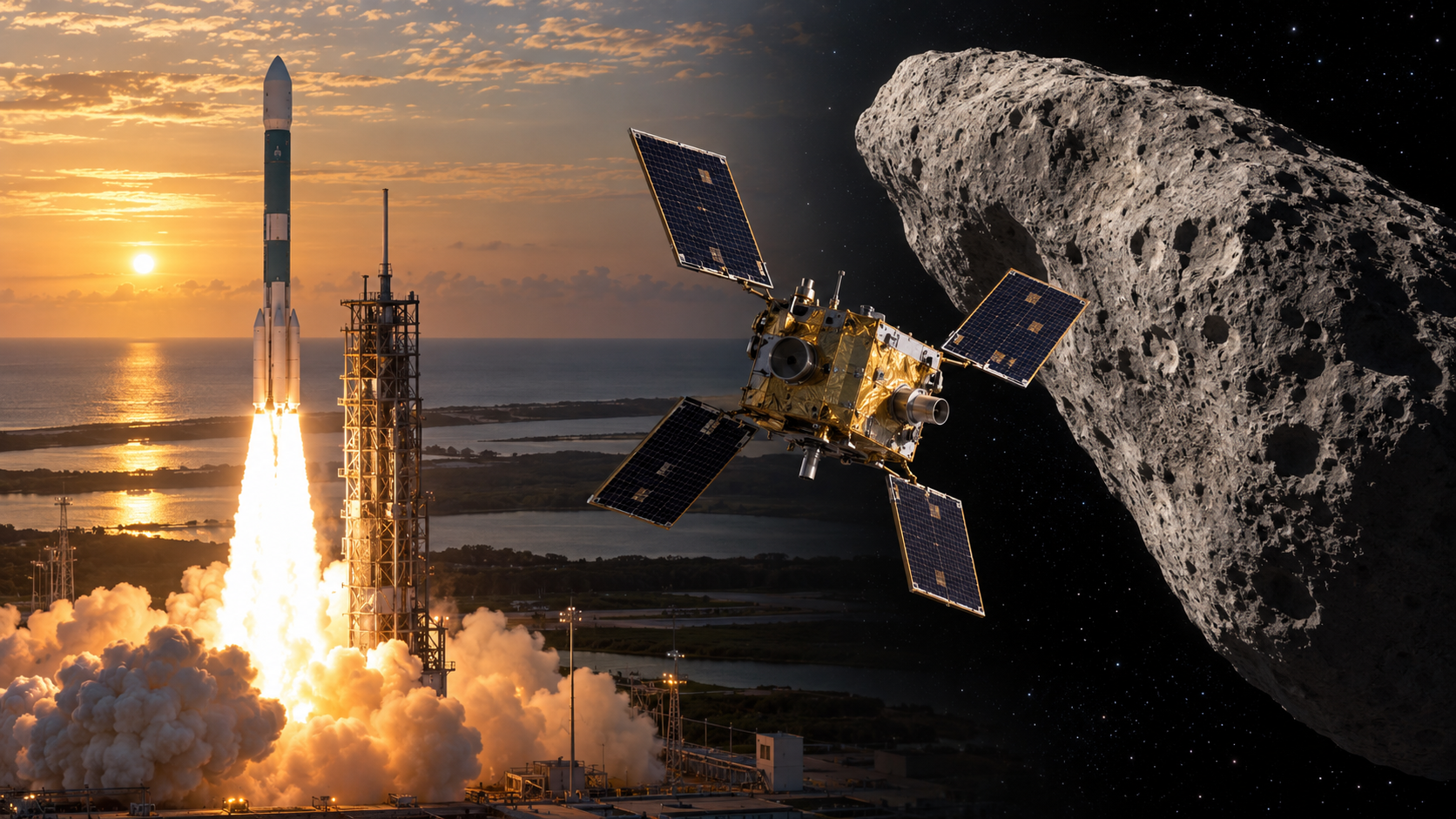
On February 17, 1996, NASA’s Near Earth Asteroid Rendezvous spacecraft launched from Cape Canaveral aboard a Delta II rocket. Known first as NEAR and later as NEAR Shoemaker, it was the inaugural mission in NASA’s Discovery Program, which sought focused planetary missions with tighter budgets and schedules. Its destination was 433 Eros, a near-Earth asteroid roughly thirty-three kilometers long. Scientists wanted to measure the object’s shape, mass, composition, geology, and internal structure, evidence that could connect asteroids with meteorites and the early building materials of the planets.
The spacecraft carried a multispectral camera, near-infrared spectrometer, X-ray and gamma-ray spectrometers, a laser rangefinder, and a magnetometer. Radio tracking would map Eros’s gravity. Before reaching its main target, NEAR flew past the dark asteroid Mathilde in 1997 and returned the first close views of its enormous craters. An Earth gravity assist then reshaped the trajectory. A failed main-engine burn in December 1998 prevented the original orbital insertion, forcing controllers to redesign the mission around a flyby and a later rendezvous.
NEAR finally entered orbit around Eros on February 14, 2000, becoming the first spacecraft to orbit an asteroid. For a year it moved through a sequence of orbits, sometimes only a few kilometers above the irregular surface. Its measurements showed that Eros had a broadly uniform composition similar to ordinary chondrite meteorites and revealed boulders, grooves, craters, and ponds of fine material. Precise tracking also determined mass and density, helping researchers infer that the asteroid was a battered but coherent body rather than a loosely separated cloud.
At the end of the mission, controllers guided the spacecraft toward the surface even though it had not been designed as a lander. NEAR touched down on February 12, 2001, survived, and transmitted data for about two more weeks. The landing turned an already historic mission into the first soft arrival on an asteroid. Its success began with the February 1996 launch, but the fuller lesson came from recovery after the missed engine burn. Flexible navigation, careful fuel management, and patient operations converted a major setback into a series of firsts and a detailed scientific portrait of a small world. For science history, the episode is also a case study in how evidence moves from an observation or engineered test into a durable body of knowledge. Instruments supplied measurements, specialists debated interpretation, and later work refined what the first result could mean. Archives preserve the early record while new methods let researchers ask different questions of it. That continuing revision is not a weakness in the original achievement; it is the process through which a dated milestone remains scientifically useful.
NEAR was built as a focused, lower-cost planetary mission to study the asteroid 433 Eros.
Its instruments mapped composition, shape, gravity, magnetism, and surface geology.
A failed engine burn prevented the original 1999 rendezvous, so controllers planned a later arrival.
The revised route succeeded, and NEAR entered orbit around Eros in February 2000.
The spacecraft became the first to orbit an asteroid and surveyed Eros from changing distances for a year.
It later survived a controlled touchdown despite never having been designed with landing gear.
Explore more of "On This Day ..."
Discover more events from the same date across news, politics, technology, sports, and other fields. Each link highlights significant moments that shaped history on different fronts.