

On This Day in Pop: November 15, 1956
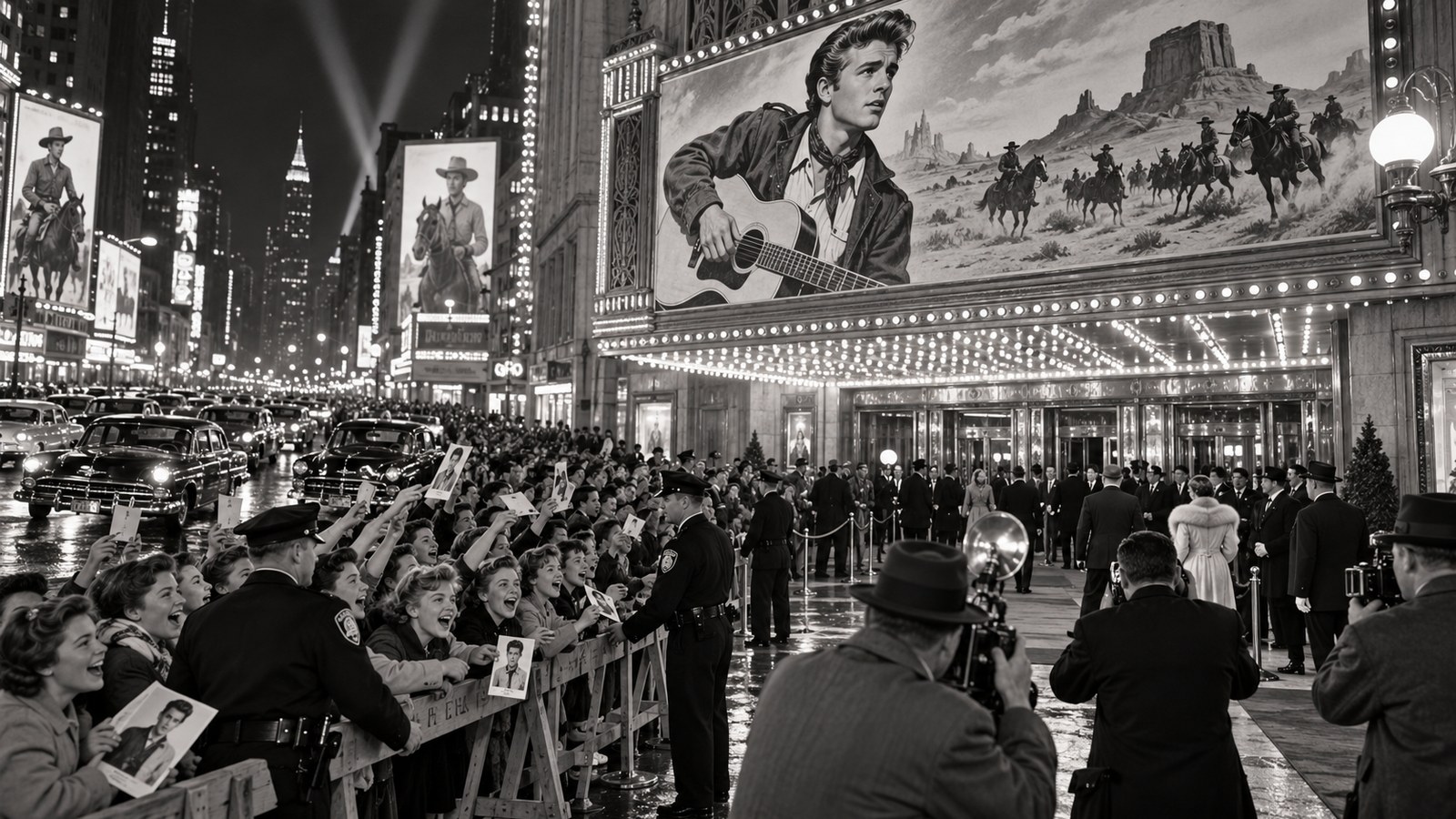
On November 15, 1956, Love Me Tender premiered at New York’s Paramount Theatre and introduced Elvis Presley as a film actor. Thousands of fans filled Times Square around a towering display for the black-and-white Civil War drama. Presley played Clint Reno and performed four songs, while Richard Egan and Debra Paget held the leading dramatic roles. The project began as The Reno Brothers without a musical star, but Presley’s rapidly growing fame changed the title, advertising and soundtrack. The title ballad had already reached number one before the film opened. The date captures the event before later reputation made its consequences look inevitable, when audiences encountered a new release, performance or institution with only the expectations available at the time.
The premiere tested whether rock-and-roll celebrity could move into feature films. Marketing emphasized Presley beyond his actual role, revealing how quickly a new youth audience could reorganize studio priorities and public space. Popular culture is never made by a famous name alone. Writers, performers, producers, technicians, broadcasters, retailers, venues and audiences shape what becomes visible and what survives. Their collaboration also determines which experiments reach the public and which disappear before they can build momentum. Looking at those conditions turns an anniversary from a list entry into a record of choices, limits and competing interests.
The film succeeded commercially and began a screen career that ultimately included thirty-one narrative features. Formulaic musicals later limited Presley’s dramatic ambitions even as their soundtracks kept him continuously visible. That afterlife matters because influence does not move in a straight line. Reruns, reissues, new technology, criticism and community memory can change the meaning of a work long after its first appearance. Durable pop history therefore holds creative achievement beside questions of labor, access, power and representation.
Opening night established the movie star as a second version of the recording star. The crowd’s intensity demonstrated that cinema could package an existing musical relationship, even when the story belonged to another genre. Returning to this November date means separating what participants knew then from what later audiences added. Recordings, photographs, broadcasts and recollections keep the moment active, but they also select and reshape it. That distinction protects against hindsight: a chart position, premiere, publication, concert or opening may become a neat milestone later, but the people present still faced uncertainty. Reading the moment in both directions—through its original conditions and its accumulated meanings—keeps celebration from replacing history. The distance between the immediate event and its continuing interpretation is what makes this episode worth revisiting.
The New York opening was November 15, 1956.
On November 15, 1956, Love Me Tender premiered at New York's Paramount Theatre and introduced Elvis Presley as a film actor. Thousands of fans filled Times Square around a towering display for the black-and-white Civil War drama.
The film marked Presley's acting debut.
The premiere tested whether rock-and-roll celebrity could move into feature films. Marketing emphasized Presley beyond his actual role, revealing how quickly a new youth audience could reorganize studio priorities and public space.
Twentieth Century-Fox had originally called it The Reno Brothers.
The film succeeded commercially and began a screen career that ultimately included thirty-one narrative features. Formulaic musicals later limited Presley's dramatic ambitions even as their soundtracks kept him continuously visible.
Explore more of "On This Day ..."
Discover more events from the same date across news, politics, technology, sports, and other fields. Each link highlights significant moments that shaped history on different fronts.