

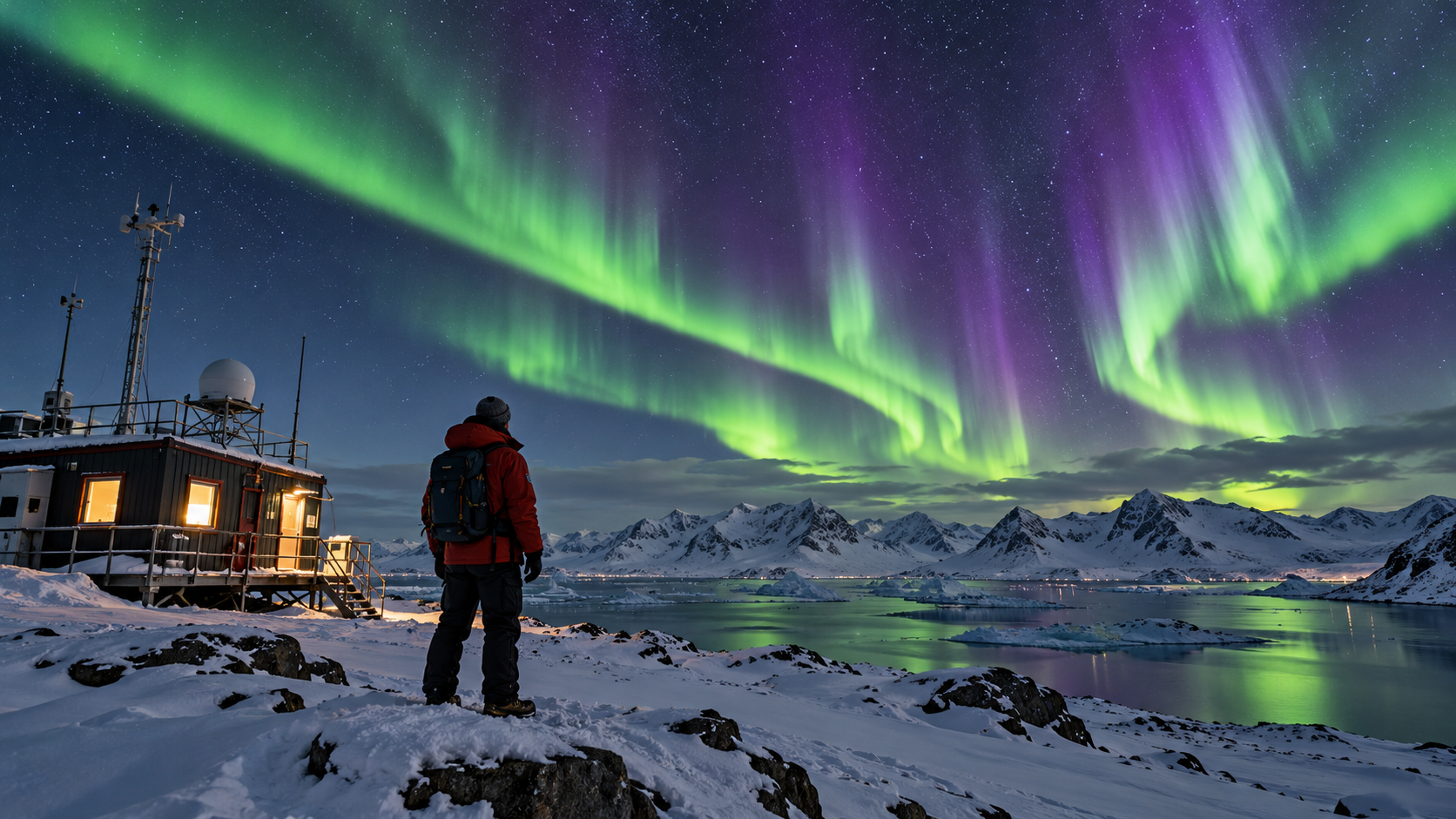
How Auroras Light the Polar Sky Explainer
Auroras begin with charged particles from the Sun. The solar wind continuously carries electrons and ions through space, and eruptions such as coronal mass ejections can send denser, faster clouds toward Earth. Most of those particles do not plunge straight into the atmosphere. Earth’s magnetic field deflects much of the flow and forms a protective region called the magnetosphere.
The solar wind can transfer energy into the magnetosphere, especially when its magnetic field aligns favorably with Earth’s. That energy stretches and disturbs magnetic fields on the nightside of the planet. When the system rearranges, particles already trapped in the magnetosphere can be accelerated along magnetic field lines toward the upper atmosphere. The field funnels them most efficiently into oval-shaped regions around the magnetic poles.
At altitudes of roughly 100 kilometers and above, energetic electrons collide with oxygen and nitrogen atoms and molecules. A collision can lift an atmospheric particle into an excited energy state. The excited particle soon returns toward a lower-energy state and releases the difference as a photon. Countless emissions together produce visible arcs, rays, and curtains across the sky.
Color depends on the gas, altitude, energy, and timing of the transition. Atomic oxygen commonly produces green light at lower auroral altitudes and can produce deep red light higher up, where collisions are less frequent. Molecular nitrogen and ionized nitrogen contribute blue, violet, and reddish colors. The eye often sees faint auroras as gray-green because human color vision is weak in low light.
Auroral forms move because the incoming particles and magnetic fields are changing. Thin arcs may brighten, fold, split, or expand rapidly during a geomagnetic substorm. Strong solar disturbances can enlarge the auroral ovals toward lower latitudes. Similar processes occur on other magnetized planets, although their atmospheres, magnetic fields, and particle sources produce different appearances.
The aurora is not sunlight reflecting from polar ice, and the glowing material is far above ordinary weather. It is a visible marker of energy moving through the connected Sun-Earth system. Space-weather monitoring matters because the same disturbances that intensify auroras can affect satellites, radio communication, navigation, electrical grids, and astronauts beyond Earth’s densest atmospheric shielding.
Charged particles from the Sun interact with Earth's magnetosphere. Magnetic disturbances accelerate some particles toward the upper atmosphere near the poles.
Earth's field guides particles into auroral ovals rather than sending them uniformly across the planet.
Collisions excite oxygen and nitrogen. When those particles return to lower-energy states, they emit photons that form the visible aurora.
Green and red often come from atomic oxygen, while nitrogen contributes blue, violet, and reddish emissions. Altitude and collision rate affect the result.
Changing magnetic fields and particle streams make auroral arcs ripple, brighten, and expand. Major solar eruptions can push displays toward lower latitudes.
Auroras occur well above weather clouds. They are beautiful evidence of space weather that can also disrupt technology.
Explore more "Explainers"
Discover additional explainers across politics, science, business, technology, and other fields. Each explainer breaks down a complex idea into clear, everyday language—helping you better understand how major concepts, systems, and debates shape the world around us.