

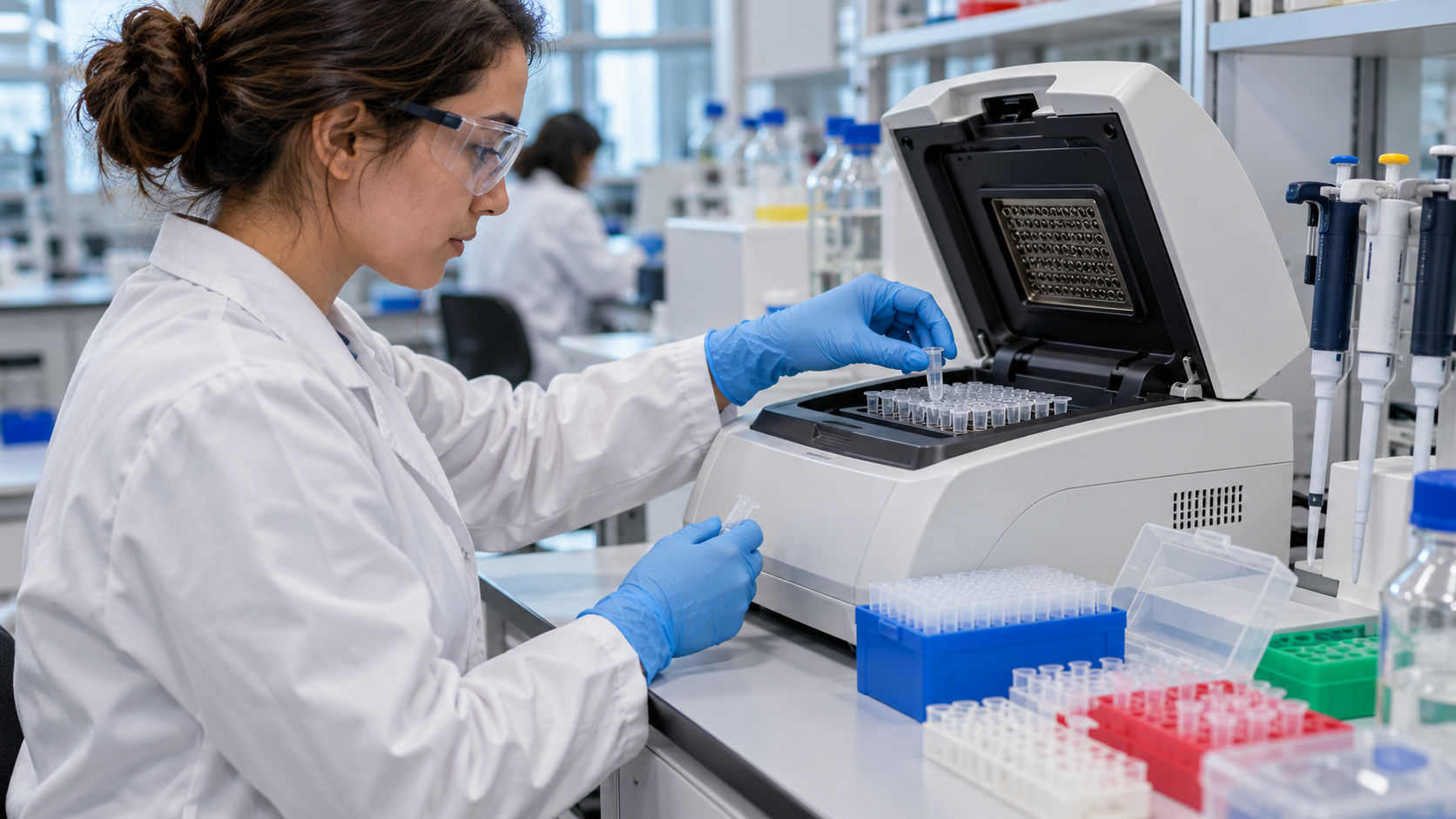
How PCR Amplifies DNA Explainer
The polymerase chain reaction, or PCR, makes many copies of a selected DNA region. A sample may begin with too little target DNA to detect directly. Researchers combine the sample with short DNA primers, individual nucleotide building blocks, a heat-stable DNA polymerase, salts, and a buffer. The mixture then enters a thermal cycler that changes temperature according to a programmed sequence.
The first step, denaturation, heats the mixture enough to separate the two strands of the DNA double helix. Cooling begins the annealing step. Primers bind to complementary sequences on opposite strands at the boundaries of the intended target. Their sequences determine what section will be copied, so primer design is central to specificity and to avoiding unwanted products.
During extension, the temperature is adjusted for the polymerase. Starting at each primer, the enzyme adds nucleotides that are complementary to the template strand and builds new DNA. A commonly used enzyme is Taq polymerase, originally isolated from a heat-loving bacterium. Its heat stability allows it to survive repeated denaturation steps that would disable many ordinary enzymes.
The cycle repeats. Newly made molecules become templates in later rounds, so the target can approximately double during each efficient cycle. That exponential pattern can turn a small starting amount into millions or billions of copies after several dozen cycles. In practice, reagents become limiting and efficiency varies, so amplification eventually slows rather than doubling forever.
Conventional PCR products can be analyzed after cycling, often by separating DNA fragments according to size. Real-time quantitative PCR adds fluorescent chemistry so an instrument tracks amplification during the run. Reverse-transcription PCR begins with RNA: an enzyme first makes complementary DNA, which PCR then amplifies. These related methods support medical testing, genetics, forensics, ecology, and basic research.
PCR does not copy an entire genome automatically, and a positive signal must be interpreted in context. Contamination can introduce stray DNA, poorly designed primers can bind unintended sequences, and inhibitors can cause false negatives. Controls, clean technique, validated primers, and appropriate thresholds are essential. PCR is powerful because it selectively amplifies molecular evidence, not because it independently explains where that evidence came from.
PCR combines template DNA, two primers, nucleotides, buffer, and a heat-stable polymerase. A thermal cycler repeatedly changes the reaction temperature.
Primers mark the boundaries of the desired target. Their sequences largely determine which DNA region is amplified.
Heat separates the strands, cooling lets primers bind, and polymerase extends new strands. The products can serve as templates in the next cycle.
Efficient cycling creates exponential amplification at first, although real reactions eventually slow as reagents and enzyme performance become limiting.
Quantitative PCR monitors fluorescence during amplification, while reverse-transcription PCR converts RNA into complementary DNA before cycling.
Contamination, inhibitors, and nonspecific primers can mislead. Positive and negative controls are necessary for trustworthy interpretation.
Explore more "Explainers"
Discover additional explainers across politics, science, business, technology, and other fields. Each explainer breaks down a complex idea into clear, everyday language—helping you better understand how major concepts, systems, and debates shape the world around us.