

How Carbon Dating Estimates Organic Age Explainer
Cosmic rays striking the upper atmosphere help convert nitrogen atoms into radioactive carbon-14. That isotope mixes with ordinary carbon dioxide and enters plants through photosynthesis. Animals acquire it by eating plants or other animals. While an organism is alive, continued exchange keeps its carbon-14 proportion linked to the environment, alongside the stable isotopes carbon-12 and carbon-13.
After death, carbon exchange largely stops. Carbon-14 nuclei continue to decay into nitrogen-14, but no new carbon-14 is replenished. The isotope has a half-life of about 5,730 years, meaning half of an initial population remains after that interval. Measuring the remaining carbon-14 relative to stable carbon provides an estimate of the time since the material stopped exchanging carbon.
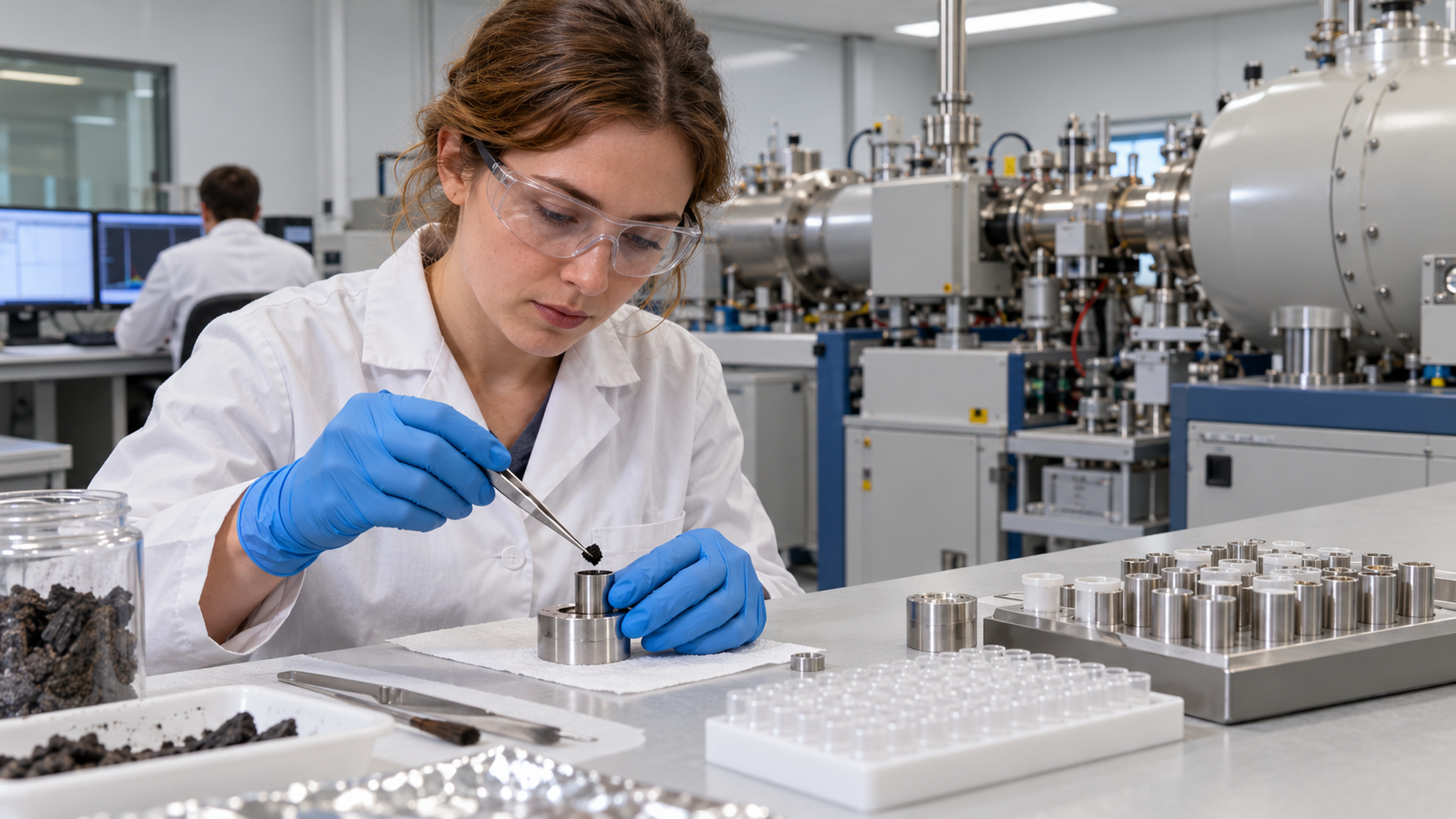
Laboratories carefully clean a sample to remove younger or older contaminants and convert an appropriate fraction into a measurable form. Accelerator mass spectrometry counts carbon isotopes directly and can analyze very small samples. Other methods measure radioactive decays. Each result includes uncertainty from counting statistics, preparation, background, and assumptions about the original material.
Atmospheric carbon-14 has not remained perfectly constant. Solar activity, Earth’s magnetic field, ocean circulation, fossil-fuel emissions, and nuclear testing have changed it. Scientists therefore calibrate radiocarbon ages against independently dated records such as tree rings, corals, and sediments. A measured radiocarbon age may correspond to a range of calendar dates rather than one exact year.
The method works on once-living material such as wood, charcoal, bone collagen, seeds, cloth, and shell when preservation and context are suitable. It generally does not directly date most stone or metal objects, though associated organic material may constrain their age. Marine organisms may appear older because deep ocean carbon has been isolated from the atmosphere, requiring reservoir corrections.
After roughly 50,000 years, so little carbon-14 remains that contamination and background become dominant, making other radiometric methods preferable. A date describes the sampled carbon event, not automatically the age of a building or archaeological layer. Reliable conclusions combine laboratory measurement, calibration, pretreatment, stratigraphy, and a clear account of what the specimen represents.
Living organisms continually exchange carbon. After death, carbon-14 decays without being replenished, so the remaining proportion records elapsed time.
A half-life is the time required for half of a radioactive population to decay. Carbon-14's half-life is about 5,730 years.
Labs remove contamination and measure isotope ratios, often with accelerator mass spectrometry. Every result carries a quantified uncertainty.
Calibration curves convert radiocarbon measurements into calendar-age ranges because atmospheric carbon-14 has varied through time.
Wood, charcoal, bone collagen, seeds, textiles, and other organic materials may be suitable. Most rocks and metals are not directly dated by carbon-14.
Reservoir effects, reused old wood, intrusive roots, conservation chemicals, and poor context can distort interpretation even when the instrument works correctly.
Explore more "Explainers"
Discover additional explainers across politics, science, business, technology, and other fields. Each explainer breaks down a complex idea into clear, everyday language—helping you better understand how major concepts, systems, and debates shape the world around us.