

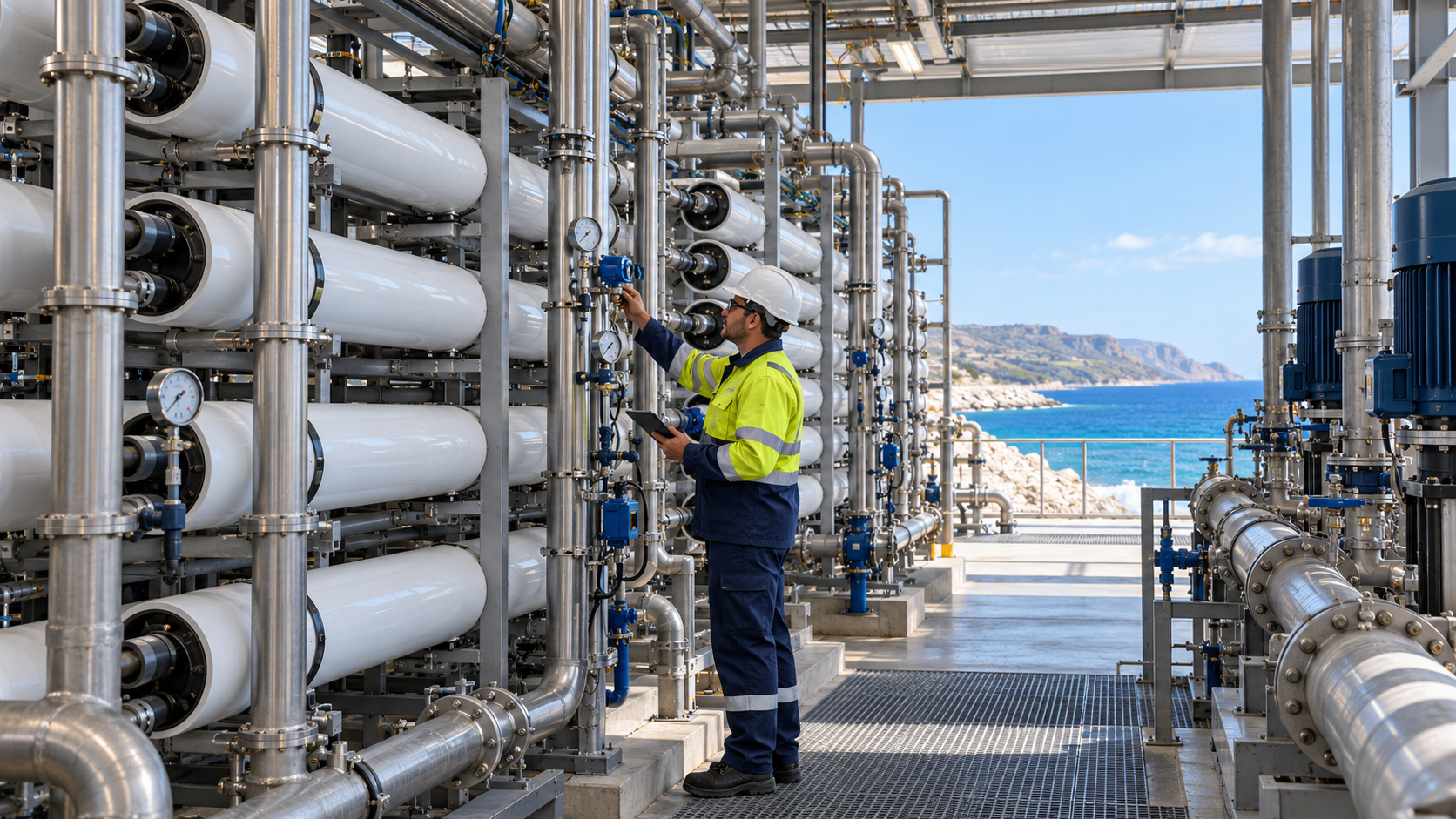
How Desalination Removes Salt from Seawater Explainer
Seawater contains dissolved ions, especially sodium and chloride, that pass through ordinary filters with the water. Desalination requires a process that separates particles at the molecular or ionic scale. Modern plants most often use reverse osmosis, while some facilities use heat to evaporate water and condense the vapor. Both routes produce a freshwater stream and a concentrated salty stream.
Before reverse osmosis, incoming water passes through screens, clarification, and fine filtration to remove organisms, suspended particles, and substances that could clog or damage membranes. Chemicals may control mineral scale and biological growth. Good pretreatment is essential because a thin layer of deposits can raise pressure needs, reduce production, and shorten the useful life of expensive membrane modules.
Osmosis naturally draws water through a semipermeable membrane toward the side with more dissolved material. Reverse osmosis applies pressure greater than the seawater’s osmotic pressure, forcing water molecules in the opposite direction while rejecting most salts. Pumps deliver the pressure, and energy-recovery devices capture part of the pressure remaining in the concentrated brine to reduce electricity use.
One membrane pass does not necessarily produce finished drinking water. Additional stages may remove boron or other remaining constituents. The low-mineral product is commonly stabilized by adding selected minerals and adjusting pH so it tastes acceptable and does not corrode pipes. Disinfection and monitoring then bring the water into a distribution system or an industrial process.
Thermal desalination heats seawater so water vapor separates from salts and later condenses. Multi-stage flash and multiple-effect distillation reuse heat across several stages, often alongside power generation. Thermal systems can handle very salty feeds but usually require more heat than membrane plants. Smaller systems may use electrodialysis for brackish water, where salt concentration is lower.
Desalination creates reliable water independent of rainfall, but it has costs. Energy demand, intake effects on marine life, chemicals, construction, and the discharge of warm or concentrated brine require careful design. Diffusers, blending, subsurface intakes, renewable power, and efficient equipment can reduce impacts. Desalination is one tool within water conservation, reuse, storage, and watershed management—not a source without limits.
Dissolved salts are too small for ordinary screens. Desalination uses membranes, heat, or electrical separation to produce water with far fewer ions.
Pretreatment removes particles and controls scale and biological fouling before seawater reaches sensitive membranes.
High-pressure pumps force water through reverse-osmosis membranes while most dissolved salts remain in a concentrated brine stream.
Energy-recovery devices capture pressure from outgoing brine. Post-treatment restores selected minerals, adjusts pH, and disinfects the product water.
Thermal plants evaporate and condense water, often reusing heat through multiple stages. They are effective but energy intensive.
Marine intake, power supply, chemical use, and brine disposal shape the true environmental and economic cost of a plant.
Explore more "Explainers"
Discover additional explainers across politics, science, business, technology, and other fields. Each explainer breaks down a complex idea into clear, everyday language—helping you better understand how major concepts, systems, and debates shape the world around us.