

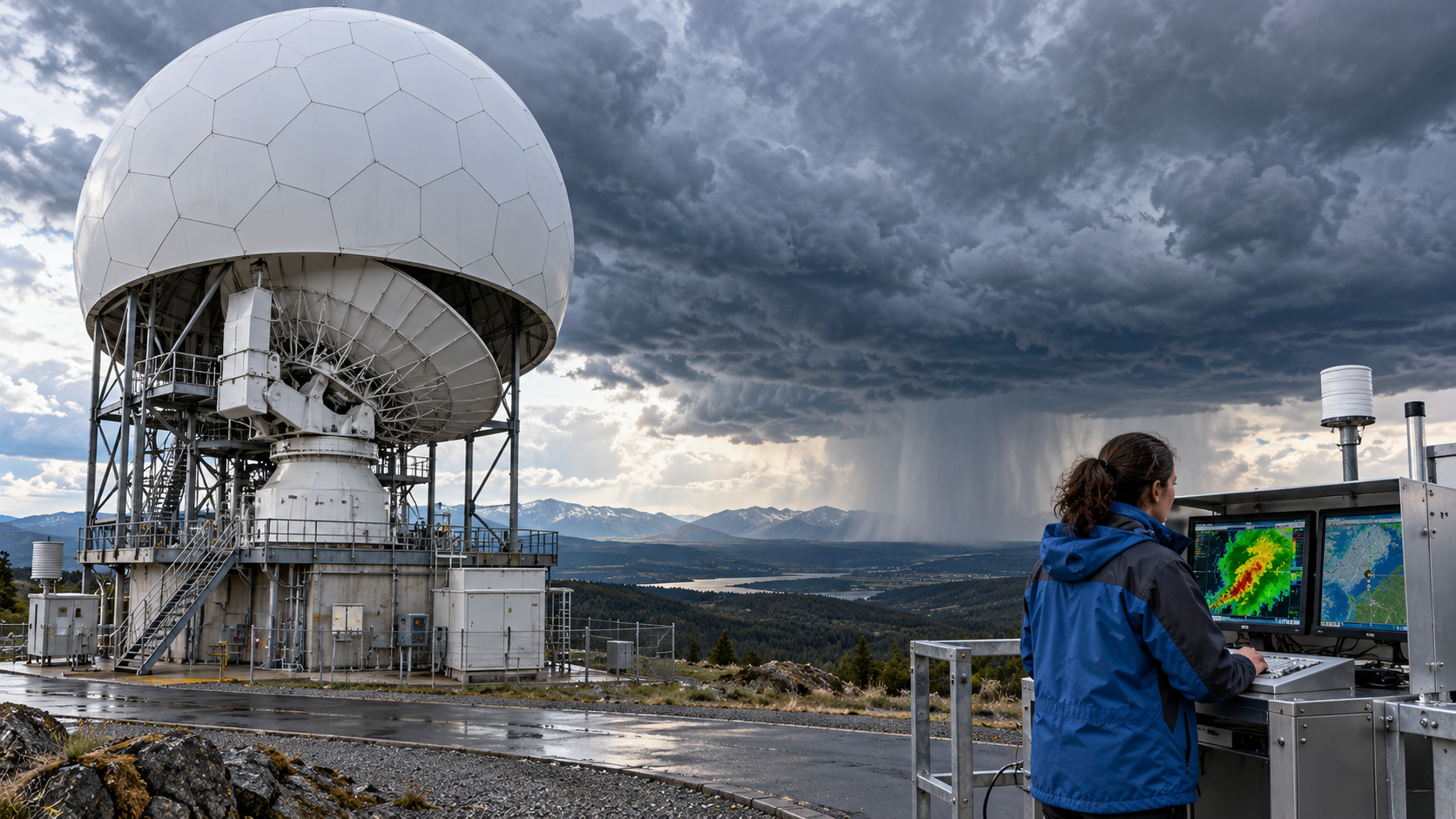
How Radar Detects Distant Objects Explainer
Radar stands for radio detection and ranging. A transmitter produces radio-frequency energy and an antenna directs it into a beam. When the wave encounters an object or a region with different electrical properties, a small fraction of the energy scatters back. The same antenna or a separate receiver collects the echo and converts it into an electrical signal.
Because radio waves travel near the speed of light, the delay between transmission and reception reveals range. The signal travels to the target and back, so the measured round-trip distance is divided by two. Antenna pointing or multiple receiving elements provide direction. Shorter pulses can distinguish targets that are close together in range, while signal processing improves sensitivity and resolution.
Motion along the radar beam changes the returned frequency through the Doppler effect. A target approaching the radar shifts the echo one way, and a receding target shifts it the other. Doppler radar can estimate radial velocity, not the full three-dimensional motion by itself. Weather radars use this information to map winds within precipitation and identify rotation or convergence.
Rain, snow, insects, aircraft, ships, terrain, and even clear-air turbulence can return energy. Echo strength depends on target size, shape, material, orientation, wavelength, range, and atmospheric conditions. Weather radar reflectivity is related to the number and size of hydrometeors, but translating it into rainfall requires assumptions about drop distributions and whether the particles are liquid, frozen, or mixed.
Different frequencies involve tradeoffs. Short wavelengths can detect small particles but are more strongly weakened by heavy rain, while longer wavelengths usually penetrate farther. The horizon and terrain limit low-altitude coverage because radio beams travel mostly in straight or gently refracted paths. Ground clutter, other transmitters, and unusual atmospheric layers can create misleading returns.
Radar does not see objects as a camera does. It measures returned electromagnetic energy and reconstructs position, motion, or structure from timing, phase, frequency, and amplitude. Calibration and interpretation matter. Networks of radar systems support air traffic control, storm warnings, shipping, speed measurement, planetary mapping, and remote sensing by turning faint echoes into actionable measurements.
A radar transmits radio waves and listens for scattered energy. Echo delay gives range because the signal travels outward and back.
Antenna direction and phased arrays locate the echo in angle, while pulse design and processing control detail and sensitivity.
Doppler frequency shifts measure motion toward or away from the radar. They do not directly reveal motion perpendicular to the beam.
Weather radar maps precipitation and wind clues, but rainfall estimates depend on particle size, phase, shape, and calibration.
Wavelength, power, target properties, range, terrain, and atmospheric absorption determine what a radar can detect.
Clutter and propagation effects can imitate targets. Radar products are processed measurements, not ordinary photographs.
Explore more "Explainers"
Discover additional explainers across politics, science, business, technology, and other fields. Each explainer breaks down a complex idea into clear, everyday language—helping you better understand how major concepts, systems, and debates shape the world around us.