

How Radioactive Decay Changes Atomic Nuclei Explainer
An atomic nucleus contains protons and neutrons held together by the strong nuclear force while positively charged protons repel one another. Some combinations of particle number and energy are unstable. Such a radionuclide can spontaneously transform into another nuclear state or a different element. The event is random for one nucleus, but large populations follow reliable statistical patterns.
In alpha decay, a heavy nucleus emits a cluster of two protons and two neutrons. Its atomic number falls by two and mass number by four, producing a different element. Alpha particles lose energy quickly in matter and are stopped by skin or paper, but alpha-emitting material can be hazardous if inhaled or swallowed because the energy is deposited over a short distance.
Beta decay changes the balance of protons and neutrons through the weak interaction. In beta-minus decay, a neutron becomes a proton while an electron and an antineutrino are emitted. Beta-plus decay converts a proton into a neutron and emits a positron and neutrino. Electron capture is a related process in which the nucleus absorbs an inner electron.
Gamma decay releases excess nuclear energy as a high-energy photon without changing the numbers of protons and neutrons. It often follows another decay that leaves the daughter nucleus excited. Gamma rays penetrate more deeply than typical alpha or beta particles, so shielding may require dense material. Penetration and biological effect depend on energy, amount, distance, and exposure route.
A radionuclide’s half-life is the time in which half of a large initial population is expected to decay. It does not tell when one particular nucleus will change, and after one half-life the remaining nuclei do not become overdue. Different isotopes span half-lives from fractions of a second to longer than the age of Earth because their nuclear structures and decay barriers differ.
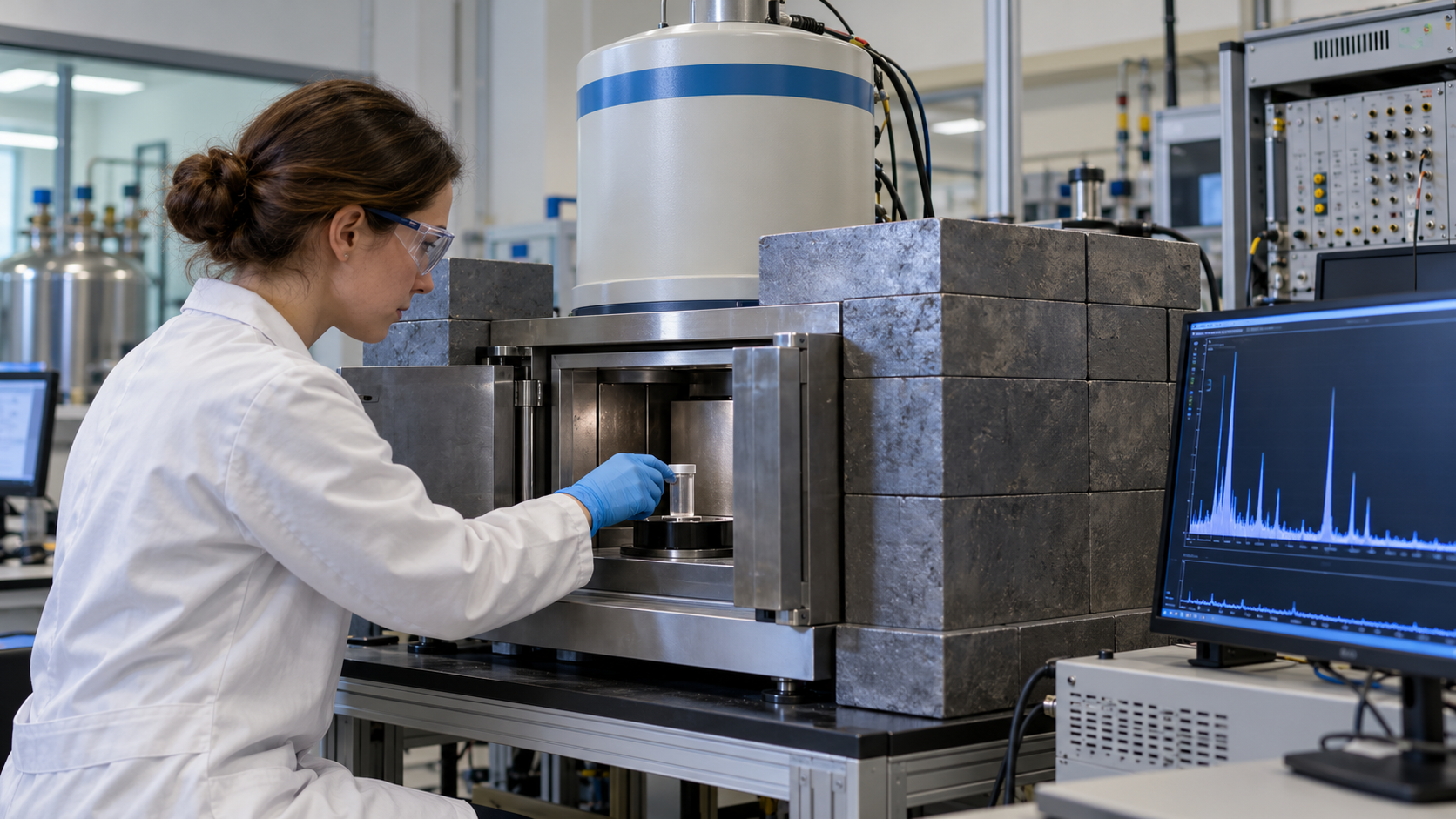
Detectors measure ionization, light flashes, deposited energy, or the identity of decay products. Radioactive decay powers dating methods, medical imaging and therapy, industrial gauges, space probes, and studies of matter. Radiation is not automatically catastrophic or safe; risk depends on type, dose, timing, geometry, and biological context. The transformation follows nuclear physics while practical safety follows exposure.
Unstable nuclei transform spontaneously toward other nuclear states. One event is unpredictable, but a large population decays at a characteristic rate.
Decay can change the element, change the neutron-proton balance, or simply release excess nuclear energy.
Alpha emission removes two protons and two neutrons. Beta processes convert a neutron and proton into one another through the weak interaction.
Gamma emission releases a photon from an excited nucleus without changing its proton or neutron count.
Half-life describes a population, not an appointment for an individual atom. The same fraction decays during each equal interval.
Health effects depend on radiation type, energy, absorbed dose, exposure time, distance, shielding, and whether material enters the body.
Explore more "Explainers"
Discover additional explainers across politics, science, business, technology, and other fields. Each explainer breaks down a complex idea into clear, everyday language—helping you better understand how major concepts, systems, and debates shape the world around us.