

How Tree Rings Record Past Climates Explainer
In many seasonal climates, a tree adds a recognizable layer of wood during each growing year. Early-season cells may be larger and lighter, while later wood is often denser and darker, creating a visible boundary. Ring width, density, cell anatomy, and chemical composition can all respond to environmental conditions, but the response depends on species, age, site, and which resource limits growth.
Dendrochronologists do not simply count rings inward from bark and assume the answer is correct. They cross-date patterns among many trees. A narrow ring caused by a regional drought, for example, may appear in the same calendar year across multiple specimens. Matching sequences identifies missing, false, or locally damaged rings and assigns an exact year to each correctly dated layer.
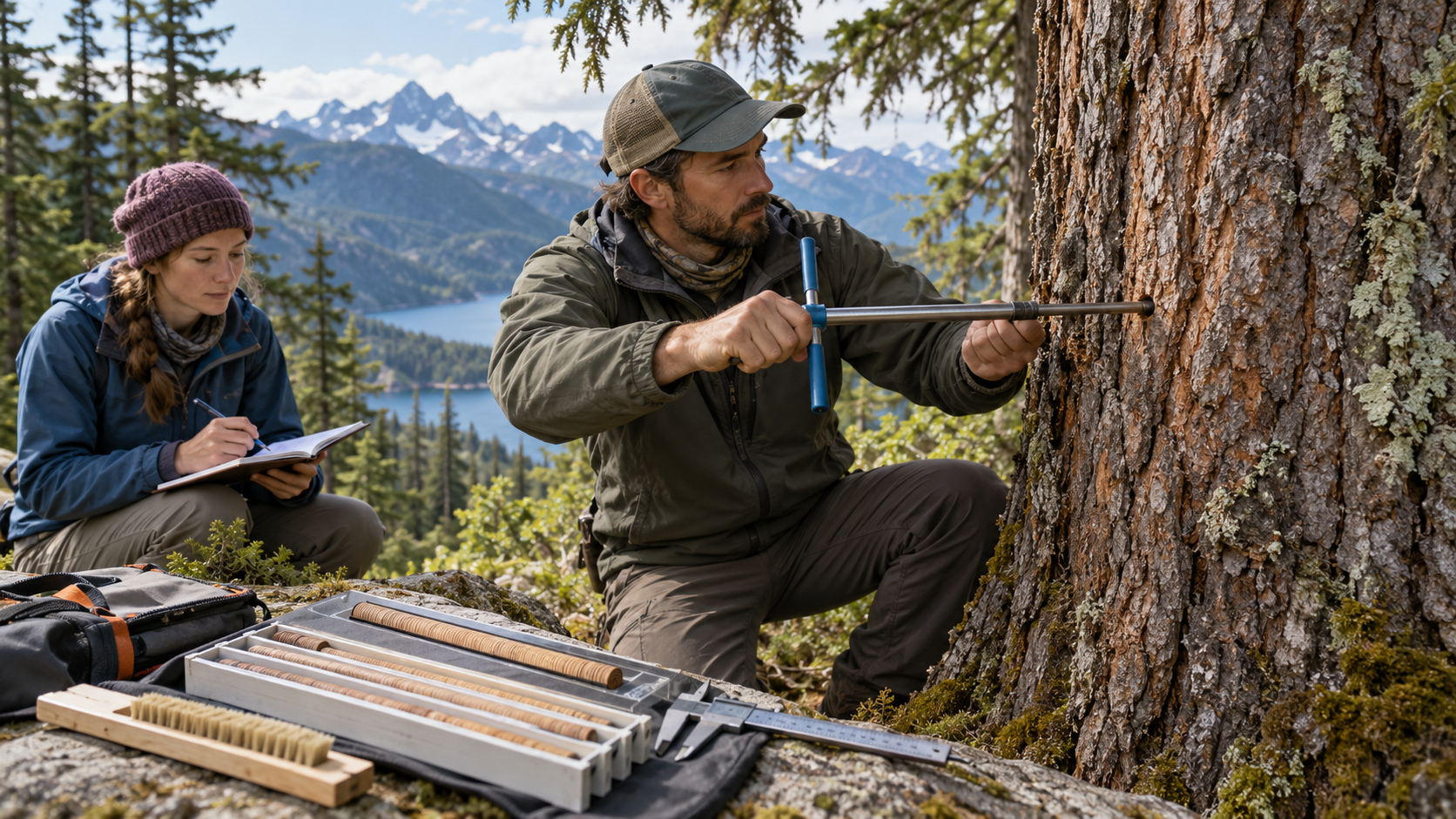
Researchers often take pencil-thin increment cores with a hollow borer, allowing a living tree to seal the small opening. They also study naturally fallen wood, building timbers, and preserved subfossil logs. Overlapping ring patterns from living and dead samples can extend a chronology centuries or millennia beyond the lifespan of one tree.
A climate reconstruction requires calibration. Scientists compare recent ring measurements with nearby instrumental records and build a statistical relationship for the season and variable that most strongly controls growth. Moisture-limited trees may preserve drought signals, while high-elevation or high-latitude trees may respond more to summer temperature. Independent data test whether the relationship holds outside the calibration period.
Trees record more than climate. Fire can leave scars, insect outbreaks can suppress growth, competition can narrow rings, and disturbance can suddenly release a tree from shade. Rising carbon dioxide, pollution, land use, aging, and disease can alter the pattern. Sampling design and statistical detrending help separate long-term biological growth from shared environmental signals without erasing meaningful climate variation.
A tree ring is therefore a dated biological measurement, not a thermometer reading. Reconstructions include uncertainty and are usually strongest for a particular region, season, and climate variable. When many well-dated trees agree and the signal matches other evidence, their rings extend our view far beyond weather stations and reveal past droughts, cool periods, disturbances, and changing climate variability.
Seasonal growth can create one ring per year. Width, density, cell structure, and chemistry reflect both environment and tree biology.
The limiting factor matters: dry-site trees may record moisture, while trees near cold limits may track temperature more strongly.
Cross-dating matches distinctive wide and narrow sequences across trees, finding missing or false rings and assigning exact calendar years.
Overlapping living, historical, and preserved wood extends chronologies far beyond one tree's lifetime.
Instrumental weather records calibrate ring-climate relationships. Fire, insects, competition, age, pollution, and land use can also affect growth.
Reconstructions describe a region and season with uncertainty. Agreement among many samples and independent evidence strengthens confidence.
Explore more "Explainers"
Discover additional explainers across politics, science, business, technology, and other fields. Each explainer breaks down a complex idea into clear, everyday language—helping you better understand how major concepts, systems, and debates shape the world around us.