

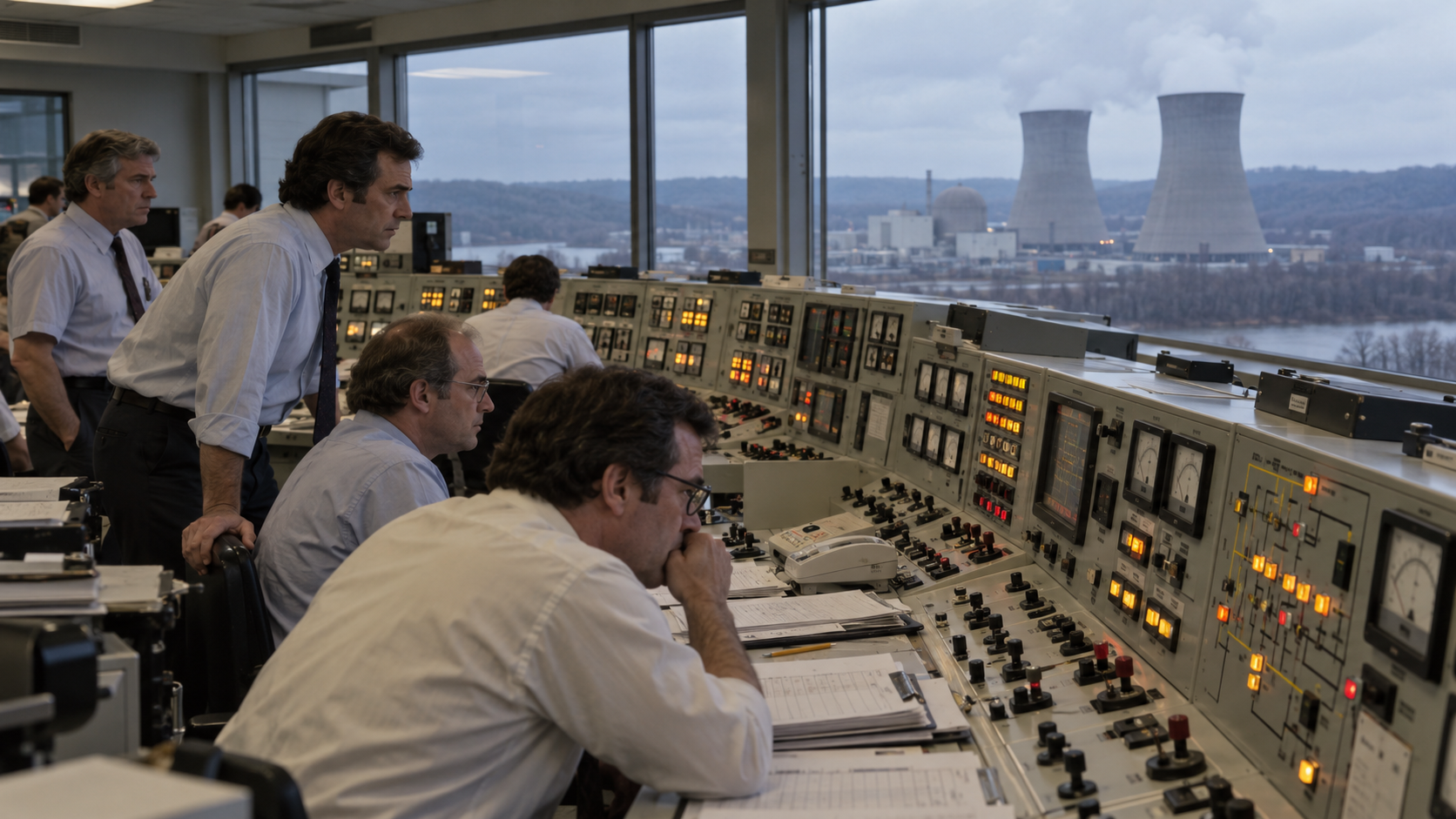
On This Day in Science: March 28, 1979
Early on March 28, 1979, a chain of equipment failures and operator confusion began at Unit 2 of the Three Mile Island nuclear plant near Middletown, Pennsylvania. A malfunction in the secondary cooling system caused the reactor to shut down, but a relief valve stuck open and allowed coolant to escape. Control-room indicators did not clearly show the valve’s physical position, and actions taken under uncertain information worsened the loss of cooling.
As water levels fell, part of the reactor core overheated and melted. Hydrogen formed through chemical reactions inside the vessel, raising concern about further damage. The containment building largely performed its protective role, and subsequent assessments found that offsite radioactive releases were small, with no detectable health effects attributable to the accident. Public communication, however, was inconsistent and fear spread during days of changing technical reports.
Investigations found that the disaster could not be reduced to one failed component or one mistaken action. Instrument design, training, emergency procedures, human factors, maintenance, and organizational assumptions interacted. Operators were flooded with alarms but lacked a direct, understandable picture of the plant’s condition. The event became a classic case in how complex systems fail through linked weaknesses rather than a single dramatic break.
Three Mile Island led to major changes in reactor-operator training, control-room design, emergency planning, inspection, event reporting, and regulatory oversight. It also slowed the growth of commercial nuclear power in the United States and reshaped public trust. The partial meltdown remains a technical and social landmark: a serious accident with limited offsite radiation consequences whose greatest lasting effects came through institutional reform and public perception. Its place on the calendar is therefore useful as an entry point, not an endpoint. The people involved worked with the instruments, assumptions, and social conditions of their time, and later research has both extended and corrected their conclusions. Reconstructing the event carefully means separating what was known that day from what became clear afterward. That distinction protects the history from myth while showing how cumulative evidence turns a memorable episode into lasting scientific knowledge. For science history, the episode is also a case study in how evidence moves from an observation or engineered test into a durable body of knowledge. Instruments supplied measurements, specialists debated interpretation, and later work refined what the first result could mean. Archives preserve the early record while new methods let researchers ask different questions of it. That continuing revision is not a weakness in the original achievement; it is the process through which a dated milestone remains scientifically useful. Seen across a longer timeline, the event also shows that scientific milestones are junctions rather than isolated beginnings. Earlier experiments, tools, and institutions made the work possible, while later teams tested its limits and carried the result into new settings. What survives is more than an anniversary fact: it is a traceable chain of evidence, correction, and application that allows one moment to remain relevant as knowledge and technology continue to change.
A relief valve failed to close while instruments gave operators an incomplete picture of coolant loss.
The interaction of hardware and human response allowed the reactor core to overheat.
Fuel damage occurred inside the reactor vessel, but containment limited offsite radioactive release.
Later health studies found no detectable effects attributable to the accident's radiation.
Investigators emphasized training, interface design, procedures, communication, and organization.
The reforms influenced nuclear operations and emergency planning far beyond one plant.
Explore more of "On This Day ..."
Discover more events from the same date across news, politics, technology, sports, and other fields. Each link highlights significant moments that shaped history on different fronts.