

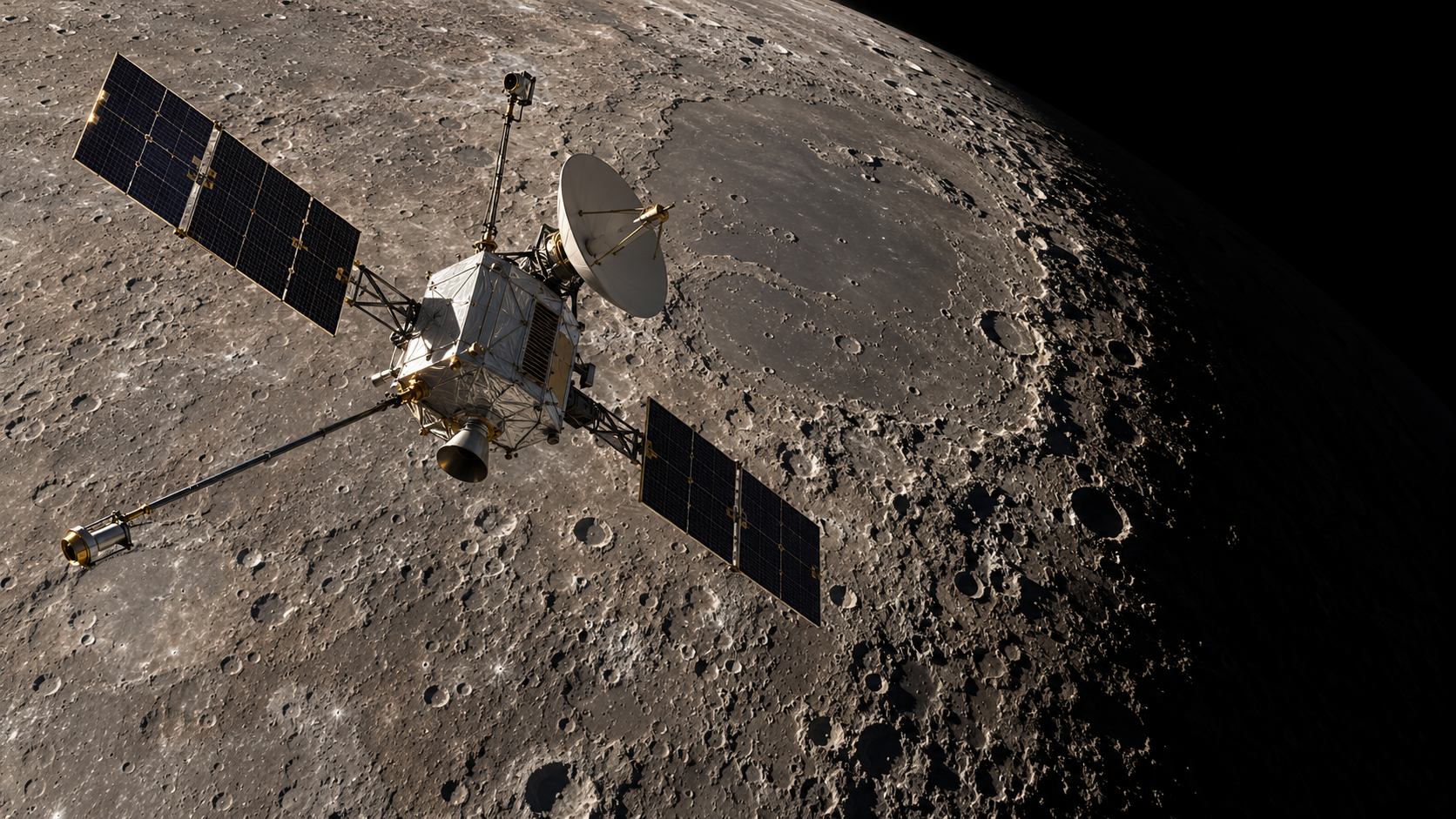
On This Day in Science: March 29, 1974
On March 29, 1974, NASA’s Mariner 10 passed within about 703 kilometers of Mercury, completing the first spacecraft encounter with the innermost planet. The probe had already flown past Venus and used that planet’s gravity to bend its path toward Mercury, the first mission to use a planetary gravity assist for another destination. Its cameras revealed a heavily cratered surface where only telescopic hints had existed before.
During the flyby, instruments measured temperature, charged particles, ultraviolet emissions, and the space environment. A magnetometer detected an unexpected intrinsic magnetic field, evidence that Mercury had a differentiated interior and some form of active or remanent dynamo process. Radio tracking through occultation placed limits on the atmosphere, which proved to be an extremely thin exosphere rather than a substantial envelope.
Mariner 10’s orbital path around the Sun brought it back for two more Mercury encounters in September 1974 and March 1975. Similar lighting meant that the cameras repeatedly saw much of the same hemisphere, so the mission mapped only part of the planet. Even so, it discovered the enormous Caloris basin, long scarps formed as the world contracted, and plains whose origins became subjects of debate.
Mercury received no second spacecraft visitor for more than three decades, giving Mariner 10’s partial map unusual longevity. The later MESSENGER mission entered orbit and completed global coverage, while BepiColombo continues the investigation. The first flyby demonstrated the power of gravity-assist navigation and opened a difficult planetary frontier close to the Sun, where heat and orbital energy complicate every mission. For science history, the episode is also a case study in how evidence moves from an observation or engineered test into a durable body of knowledge. Instruments supplied measurements, specialists debated interpretation, and later work refined what the first result could mean. Archives preserve the early record while new methods let researchers ask different questions of it. That continuing revision is not a weakness in the original achievement; it is the process through which a dated milestone remains scientifically useful. Seen across a longer timeline, the event also shows that scientific milestones are junctions rather than isolated beginnings. Earlier experiments, tools, and institutions made the work possible, while later teams tested its limits and carried the result into new settings. What survives is more than an anniversary fact: it is a traceable chain of evidence, correction, and application that allows one moment to remain relevant as knowledge and technology continue to change. The anniversary also highlights the difference between a first result and a finished understanding. A successful observation can settle one question while opening several harder ones, and even a failed objective can return measurements that reshape later designs. Preserved data, specimens, photographs, and hardware allow new generations to revisit the work with better tools. Science advances through that continuity, where a specific date marks progress without pretending that inquiry stopped there.
Mariner 10 returned the first close images of Mercury's craters, plains, and giant scarps.
Closest approach brought the spacecraft within about 703 kilometers of the surface.
The magnetometer showed that Mercury possesses an intrinsic global magnetic field.
Other instruments found only an exceedingly thin exosphere around the planet.
A Venus flyby redirected Mariner 10 toward Mercury without requiring impossible amounts of fuel.
The spacecraft returned twice more, establishing a method used throughout planetary exploration.
Explore more of "On This Day ..."
Discover more events from the same date across news, politics, technology, sports, and other fields. Each link highlights significant moments that shaped history on different fronts.