

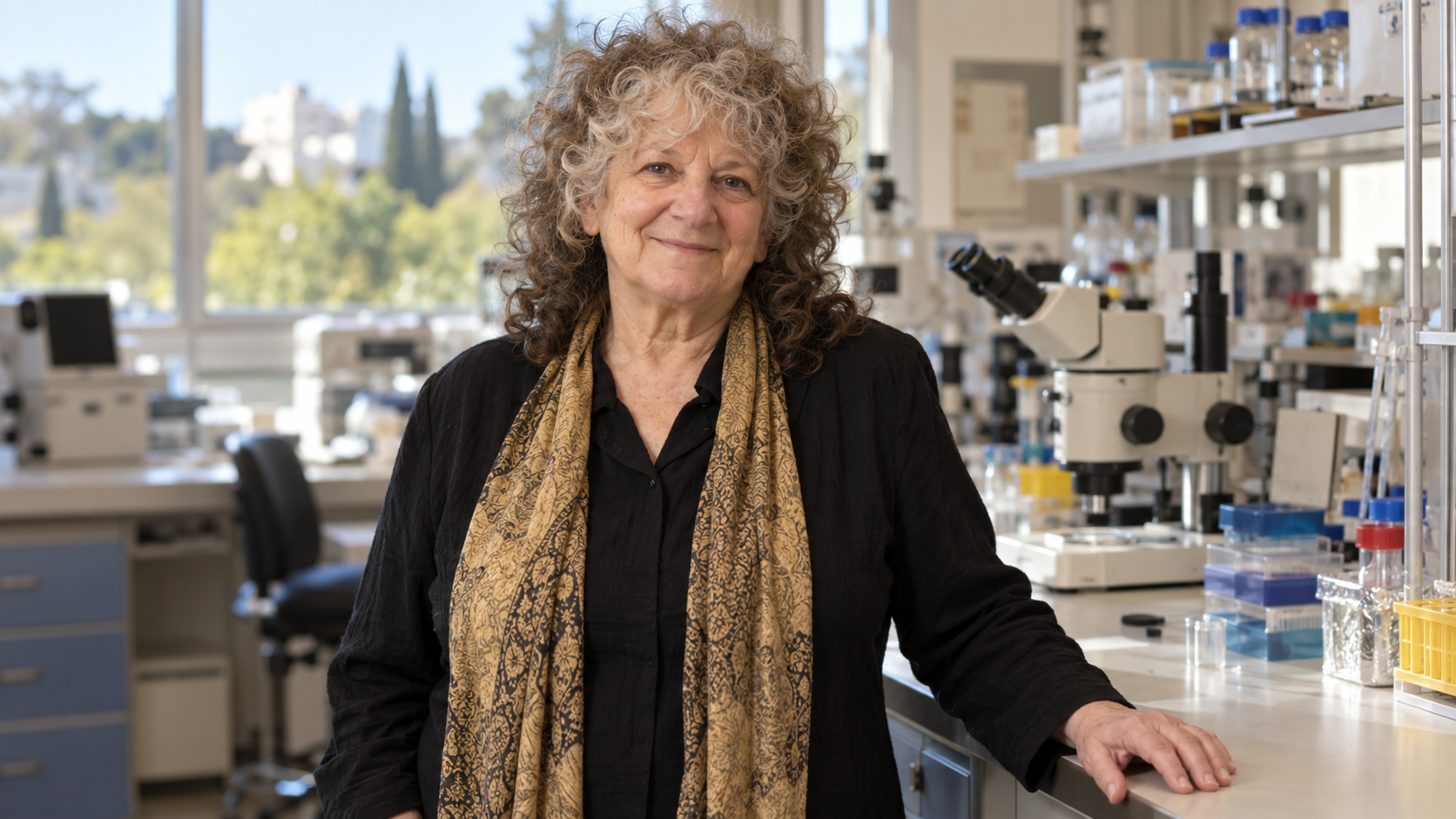
“hard conditions didn’t dampen my enormous curiosity.”
Ada Yonath wrote about curiosity before she wrote about scientific recognition. In the autobiography prepared for her 2009 Nobel Prize, she described growing up in Jerusalem under difficult financial circumstances, with her father’s illness also shaping family life. The featured excerpt belongs to that childhood account. It is not a quotation about overcoming a laboratory problem through optimism alone. Her story includes support from parents who valued her education and a mother who continued encouraging her studies after her father’s death. The US Department of Energy later repeated the same words in a profile of her research. That early desire to understand the world eventually found a demanding scientific subject: the ribosome, the cellular machinery involved in making proteins. Yonath shared the 2009 chemistry prize with Venkatraman Ramakrishnan and Thomas Steitz for studies of its structure and function, work with important connections to understanding antibiotics.
Curiosity matters because a familiar object can conceal an unanswered question. It asks how something works, what a measurement leaves uncertain and which assumption deserves another look. Yet the distance between a question and a dependable result can be long. Yonath’s autobiography describes years of work, collaborators, funding and experimental difficulties. These details make her childhood recollection more interesting, not less. A moment of wonder becomes scientific inquiry through methods that let others examine the answer. In health research, that distinction is especially valuable. An appealing explanation cannot substitute for observation, and a promising finding does not immediately become a treatment. The article draws a connection between curiosity and that patient process. Wanting to know keeps a question alive; careful experiments determine what can responsibly be said about it.
The account also resists a familiar habit of treating one celebrated person as the whole story. Yonath named colleagues and institutions that helped sustain the research, along with the family members who supported her. Recognition can draw attention to a scientist while leaving much of that supporting work outside the frame. Reading her own account restores some of it. For a student considering research, the useful lesson is not that hardship is desirable or that determination guarantees a Nobel Prize. Difficult circumstances can restrict opportunities, and curiosity needs practical room to develop. Good teaching, access to tools and colleagues willing to investigate an uncertain idea can help provide that room. Yonath’s words recall a desire that survived her childhood conditions. Their wider significance lies in what happened when that desire met education, shared effort and the demanding discipline of finding out.
The original passage concerns her childhood in Jerusalem, including financial hardship and her father’s medical difficulties.
The featured excerpt keeps that context; it is not presented as a comment made during an antibiotic experiment.
The autobiography explains how understanding ribosomal structure contributed to understanding the actions of antibiotics that target bacterial ribosomes.
The article discusses that research connection without claiming that curiosity itself treats disease or that every discovery immediately produces a drug.
No. Yonath’s account describes obstacles alongside family support, education, collaborators and resources.
Its interpretation recognizes the importance of making inquiry possible rather than asking students or researchers to succeed without assistance.
Explore more "Quotes of The Day"
Discover more notable quotes from influential voices across politics, science, business, technology, sports, and culture. Each quote offers insight into how ideas, beliefs, and decisions shape the world around us.