

How Earthquake Liquefaction Weakens Ground Explainer
Liquefaction occurs mainly in loose, water-saturated granular sediment such as young sand or silt. Under ordinary conditions, grains touch and carry the weight of the ground and structures above. Water fills the pore spaces, but the grain framework supplies effective strength. Strong shaking repeatedly squeezes and rearranges that framework.
Loose grains tend to settle into a denser arrangement during cyclic loading. If water cannot drain away quickly, the attempted compaction raises pore-water pressure. That pressure begins to carry more of the total load, while the effective stress at grain contacts falls. When contact forces become very small, the sediment can lose much of its shear strength.
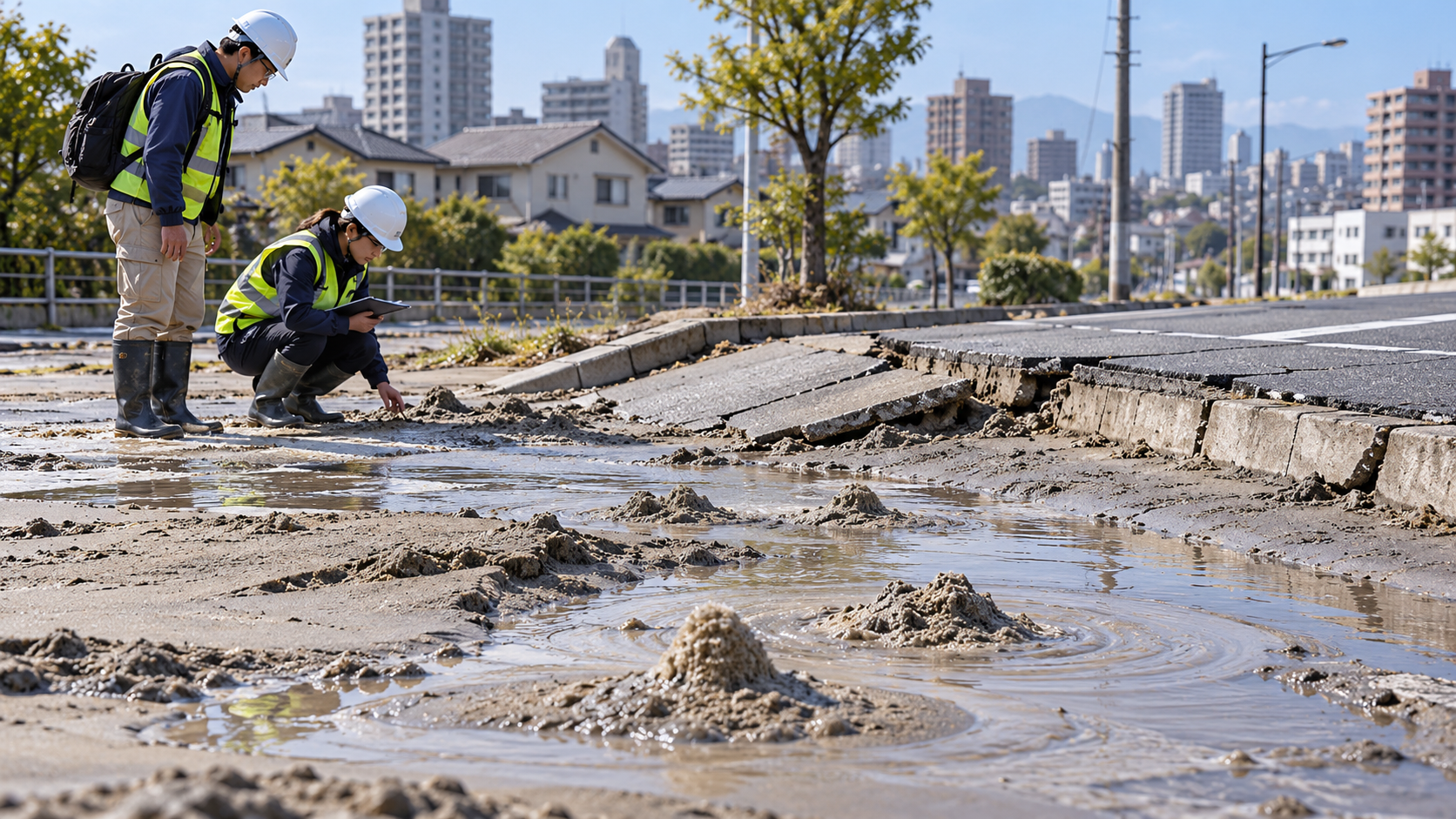
The ground does not literally become water, but it can deform and flow because the solid framework is temporarily weakened. Buildings may settle or tilt, buried tanks and pipes may rise, bridge foundations may shift, and slopes may spread laterally toward rivers or open ground. Water and sand can erupt through cracks as sand boils.
Risk is greatest where loose deposits are shallow, saturated, and geologically young, including river floodplains, deltas, beaches, and artificial fill. Stronger or longer shaking raises the chance of pore pressure buildup. Dense sand, clay-rich soil, deep groundwater, or rapid drainage generally changes the response, so nearby sites can behave very differently.
Geologists map susceptibility using sediment age, grain properties, groundwater depth, past observations, and expected shaking. Cone penetration tests, boreholes, and geophysical measurements help characterize local layers. A susceptibility map is not a prediction that every point will liquefy in the next earthquake; it identifies conditions where the mechanism is plausible.
Engineers can reduce risk by densifying soil, installing drains, mixing or grouting weak layers, using deep foundations, or avoiding the most susceptible ground. These measures either strengthen the grain skeleton, relieve water pressure, or transfer loads to firmer material. Liquefaction is a coupled soil-and-water response, not simply a synonym for earthquake damage.
Loose saturated sand and silt rely on grain contacts to support loads while water fills their pores.
Shaking encourages the grains to compact, but trapped water pressure rises when drainage is too slow.
Higher pore pressure lowers effective stress and removes much of the sediment's resistance to deformation.
Settlement, tilting, lateral spreading, floating structures, and sand boils are common consequences.
Young deposits, shallow groundwater, and strong prolonged shaking increase susceptibility.
Densification, drainage, ground improvement, deep foundations, and site choice can reduce the hazard.
Explore more "Explainers"
Discover additional explainers across politics, science, business, technology, and other fields. Each explainer breaks down a complex idea into clear, everyday language—helping you better understand how major concepts, systems, and debates shape the world around us.