

On This Day in Science: April 3, 1966
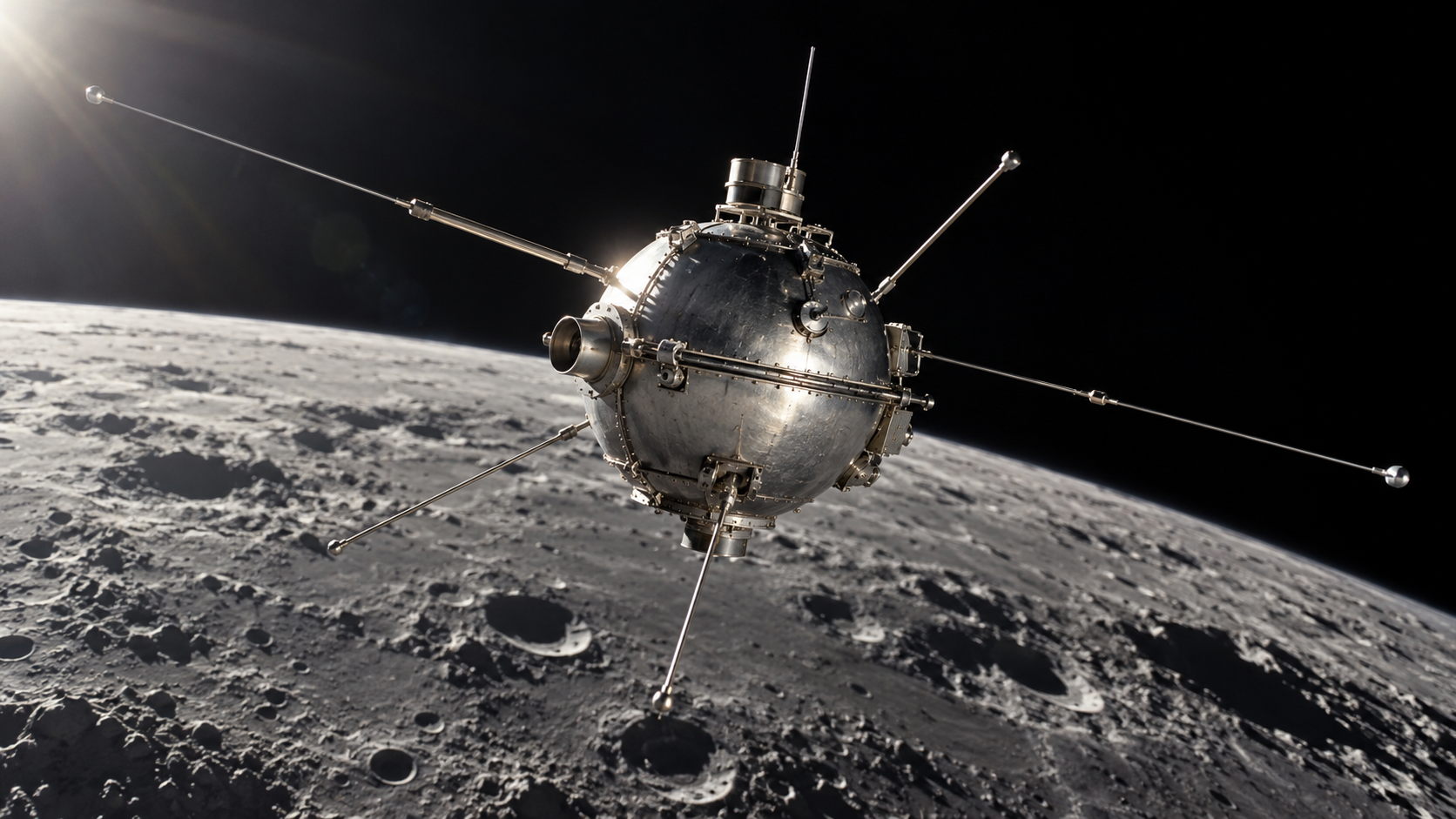
On April 3, 1966, the Soviet spacecraft Luna 10 fired its braking system and entered orbit around the Moon. Launched three days earlier, it became the first human-made object to orbit a celestial body other than Earth. The maneuver converted a fast lunar approach into an elliptical path roughly three hours long, creating a platform that could repeatedly measure the Moon and nearby space.
Lunar orbit insertion required precise navigation. Too little braking would leave the spacecraft on a flyby; too much or an incorrectly directed burn could produce an impact. Controllers commanded the maneuver from Earth after a midcourse correction, using radio tracking to estimate the trajectory. The accomplishment followed Luna 9’s first soft landing by only two months and opened a second way to investigate the Moon.
Luna 10 carried instruments for gamma rays, magnetic fields, charged particles, micrometeoroids, and gravitational effects. It returned data for several weeks and completed hundreds of circuits. Radio tracking revealed that lunar gravity was less uniform than simple models assumed, an issue later connected with mass concentrations that strongly influence low orbits. The probe carried no camera, so its contribution came through signals rather than photographs.
Orbit transformed lunar exploration from a brief encounter into repeated regional observation. Later Soviet and American spacecraft added cameras, mapping instruments, altimeters, and sample-site surveys. Luna 10 demonstrated the fundamental navigation and communications needed for every scientific orbiter that followed. The anniversary highlights the difference between a first result and a finished understanding. A successful observation can settle one question while opening several harder ones, and even a failed objective can reshape later designs. Preserved data, specimens, photographs, and hardware allow new generations to revisit the work with better tools. Science advances through that continuity rather than stopping on a memorable date. Its calendar date is an entry point, not an endpoint. The people involved worked with the instruments, assumptions, and social conditions of their time, and later research has both extended and corrected their conclusions. Separating what was known that day from what became clear afterward protects the history from myth and shows how cumulative evidence turns an episode into lasting scientific knowledge. For science history, the event also shows how evidence moves from an observation or engineered test into a durable body of knowledge. Instruments supplied measurements, specialists debated interpretation, and later work refined what the first result could mean. Archives preserve the early record while new methods let researchers ask different questions of it. That continuing revision is the process through which a dated milestone remains scientifically useful.
A precisely timed braking burn captured Luna 10 into orbit on April 3, 1966.
It was the first spacecraft to orbit a world beyond Earth.
Instruments studied radiation, particles, magnetic conditions, micrometeoroids, and gravity.
Radio tracking exposed unexpected irregularities in the Moon's gravitational field.
Repeated circuits allowed broad measurements that a single landing site could not provide.
Later orbiters expanded the method into photography, mapping, gravity science, and resource surveys.
Explore more of "On This Day ..."
Discover more events from the same date across news, politics, technology, sports, and other fields. Each link highlights significant moments that shaped history on different fronts.