

On This Day in Science: April 4, 1968
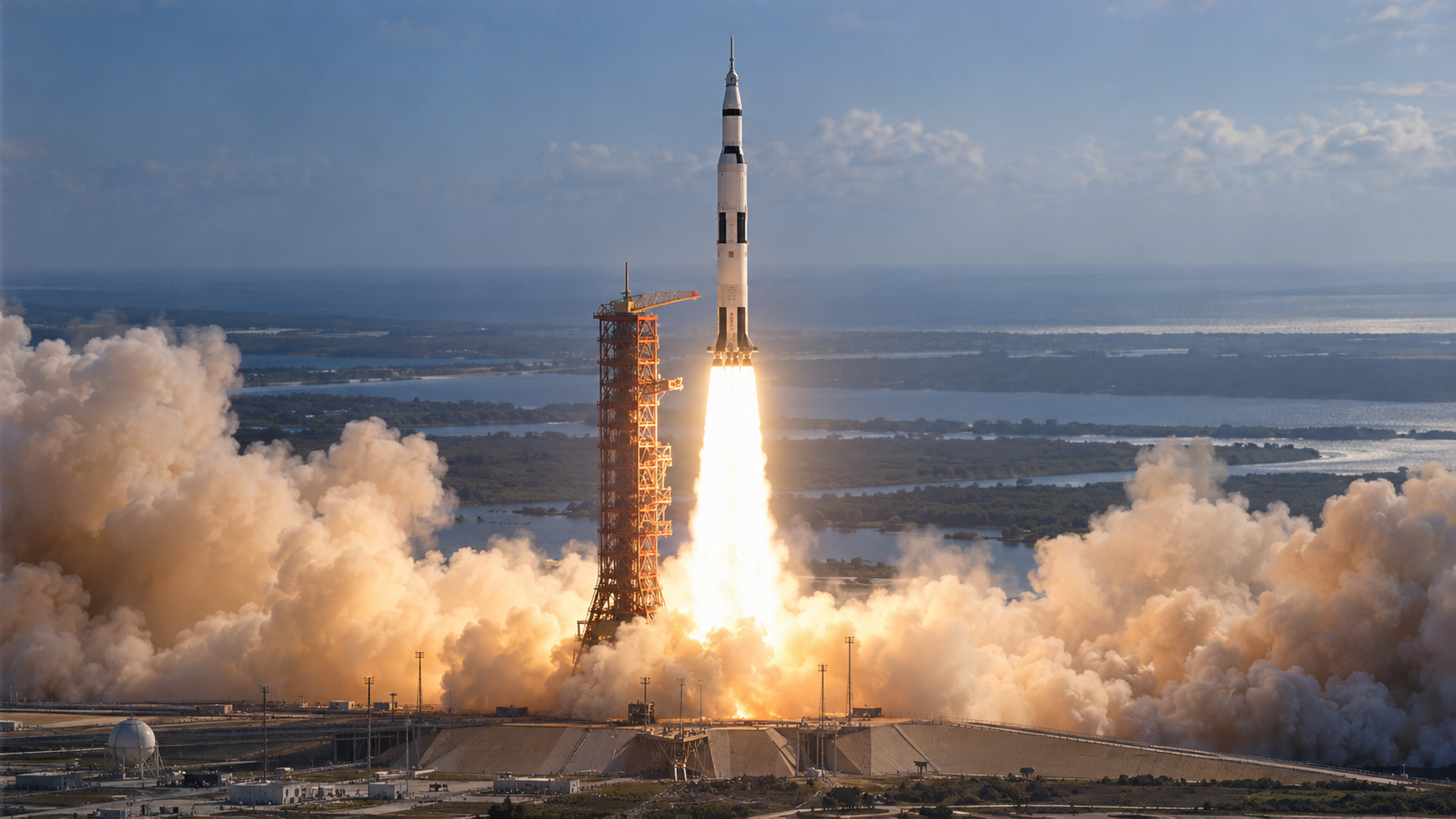
On April 4, 1968, Apollo 6 lifted off from Kennedy Space Center on the second uncrewed Saturn V flight. NASA intended the mission as a final high-energy qualification of the Moon rocket and Apollo command module before committing astronauts to the complete vehicle. The launch looked powerful, but excessive vibration appeared during first-stage flight and two second-stage engines shut down early.
The Saturn V’s guidance system compensated by extending the burns of the remaining engines and the third stage, placing the spacecraft into an orbit that was usable but not the planned one. Later, the third stage failed to restart for a simulated translunar injection. Controllers adopted an alternate mission and used the service module engine to raise the spacecraft before a high-speed reentry test.
Apollo 6 splashed down in the Pacific after nearly ten hours. Engineers traced the vibration and engine problems, changed hardware and procedures, and concluded that enough objectives had been achieved to proceed. The flight did not perform perfectly, but its automatic recovery demonstrated valuable redundancy while its failures appeared on an uncrewed test rather than a lunar expedition.
Qualification testing is designed to uncover weaknesses under realistic stress. Apollo 6 supplied that evidence at full scale, when components interacted in ways ground facilities could not completely reproduce. The troubled mission helped make later Saturn V flights more reliable precisely because it exposed problems before people depended on them. Its calendar date is an entry point, not an endpoint. The people involved worked with the instruments, assumptions, and social conditions of their time, and later research has both extended and corrected their conclusions. Separating what was known that day from what became clear afterward protects the history from myth and shows how cumulative evidence turns an episode into lasting scientific knowledge. For science history, the event also shows how evidence moves from an observation or engineered test into a durable body of knowledge. Instruments supplied measurements, specialists debated interpretation, and later work refined what the first result could mean. Archives preserve the early record while new methods let researchers ask different questions of it. That continuing revision is the process through which a dated milestone remains scientifically useful. Seen across a longer timeline, scientific milestones are junctions rather than isolated beginnings. Earlier experiments, tools, and institutions made the work possible, while later teams tested its limits and carried the result into new settings. What survives is a traceable chain of evidence, correction, and application that allows one moment to remain relevant as knowledge and technology continue to change.
Apollo 6 tested the Saturn V and command module in a high-energy uncrewed mission.
Vibration and premature engine shutdowns disturbed the planned ascent.
The launch vehicle extended other engine burns and still achieved a usable orbit.
A failed third-stage restart forced controllers to substitute a service-module-engine maneuver.
Engine and vibration evidence led to design and procedure changes before later Apollo flights.
The mission showed why imperfect qualification tests can improve operational reliability.
Explore more of "On This Day ..."
Discover more events from the same date across news, politics, technology, sports, and other fields. Each link highlights significant moments that shaped history on different fronts.