

On This Day in Science: May 12, 1926
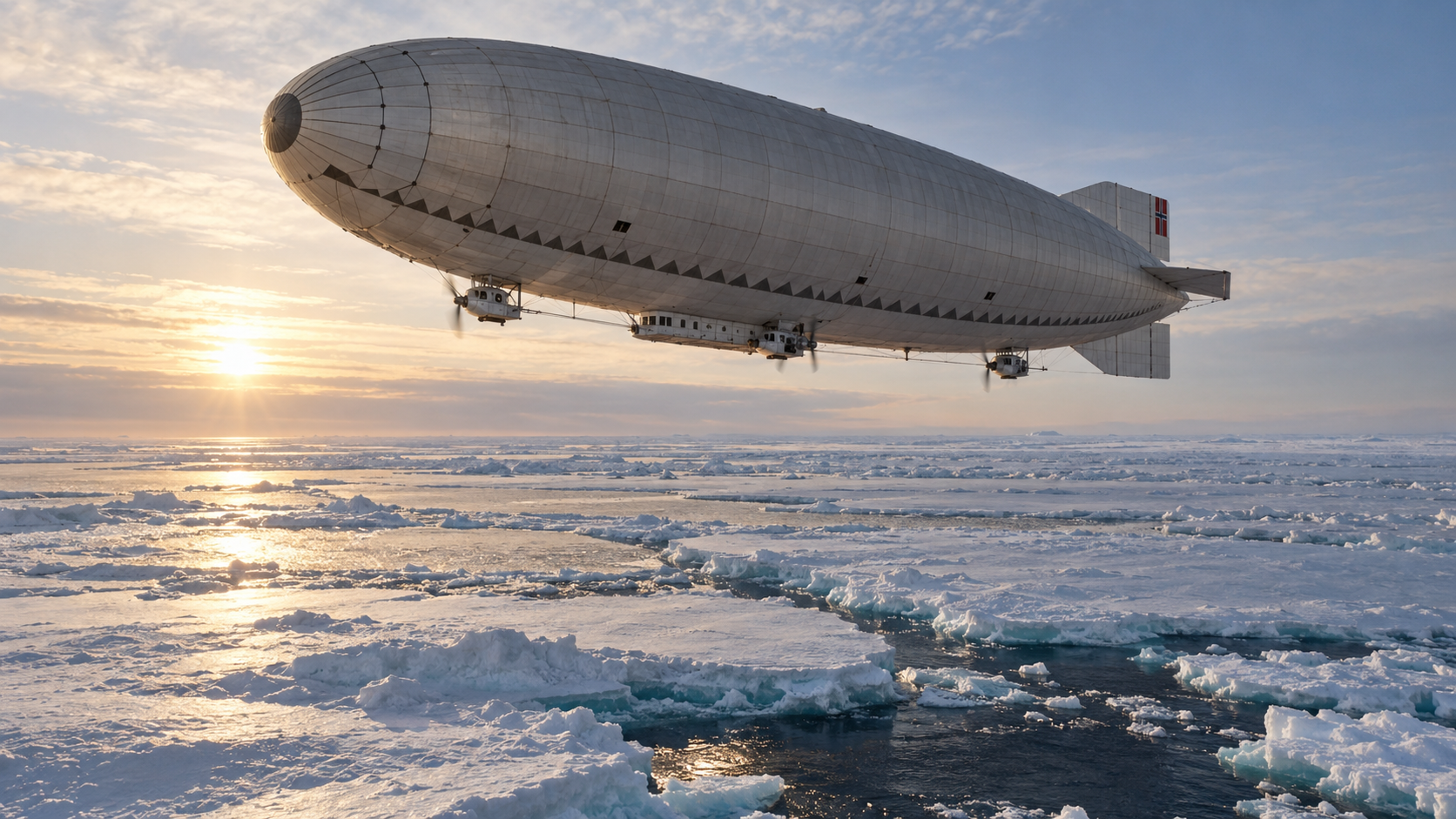
On May 12, 1926, the semi-rigid airship Norge crossed the geographic North Pole during a flight from Ny-Ålesund in Svalbard toward Alaska. The expedition joined Norwegian explorer Roald Amundsen, American sponsor and explorer Lincoln Ellsworth, and Italian aeronautical engineer Umberto Nobile, who had designed and commanded the airship. Their crew achieved the first generally accepted aerial crossing of the pole.
Norge combined a fabric gas envelope with a metal keel that carried engines, crew spaces, fuel, and controls. Its slow speed and long endurance made it a platform for crossing unknown Arctic regions, but the hydrogen-filled craft was vulnerable to weather, icing, and damage. Navigation depended on celestial observations, dead reckoning, radio, and estimates of wind over a largely featureless ice pack.
The airship passed above the pole early on May 12 and continued across the Arctic Ocean. Bad weather and ice accumulation complicated the later stages, and the crew ultimately brought Norge down near Teller, Alaska, rather than at the planned destination. The flight nevertheless completed a transpolar route and returned geographic and meteorological observations from poorly known areas.
The achievement is also a lesson in credit. Amundsen, Ellsworth, Nobile, and the multinational crew each supplied essential leadership, financing, engineering, or operations. The crossing succeeded because exploration and vehicle design were inseparable. Its calendar date is an entry point, not an endpoint. The people involved worked with the instruments, assumptions, and social conditions of their time, and later research has both extended and corrected their conclusions. Separating what was known that day from what became clear afterward protects the history from myth and shows how cumulative evidence turns an episode into lasting scientific knowledge. For science history, the event also shows how evidence moves from an observation or engineered test into a durable body of knowledge. Instruments supplied measurements, specialists debated interpretation, and later work refined what the first result could mean. Archives preserve the early record while new methods let researchers ask different questions of it. That continuing revision is the process through which a dated milestone remains scientifically useful. Seen across a longer timeline, scientific milestones are junctions rather than isolated beginnings. Earlier experiments, tools, and institutions made the work possible, while later teams tested limits and carried the result into new settings. What survives is a traceable chain of evidence, correction, and application that allows one moment to remain relevant as knowledge and technology continue to change. The anniversary highlights the difference between a first result and a finished understanding. A successful observation can settle one question while opening several harder ones, and even a failed objective can reshape later designs. Preserved data, specimens, photographs, and hardware allow new generations to revisit the work with better tools. Science advances through that continuity rather than stopping on a memorable date.
Norge's gas envelope provided lift while a rigid keel carried engines, crew, and controls.
The design traded airplane speed for the range needed to cross the Arctic Ocean.
Celestial sights and dead reckoning helped the crew estimate position near the pole.
Wind, cloud, and moving sea ice offered few stable visual references.
Amundsen, Ellsworth, and Nobile represented different parts of the project.
The crew's engineering and operational work made the verified crossing possible.
Explore more of "On This Day ..."
Discover more events from the same date across news, politics, technology, sports, and other fields. Each link highlights significant moments that shaped history on different fronts.