

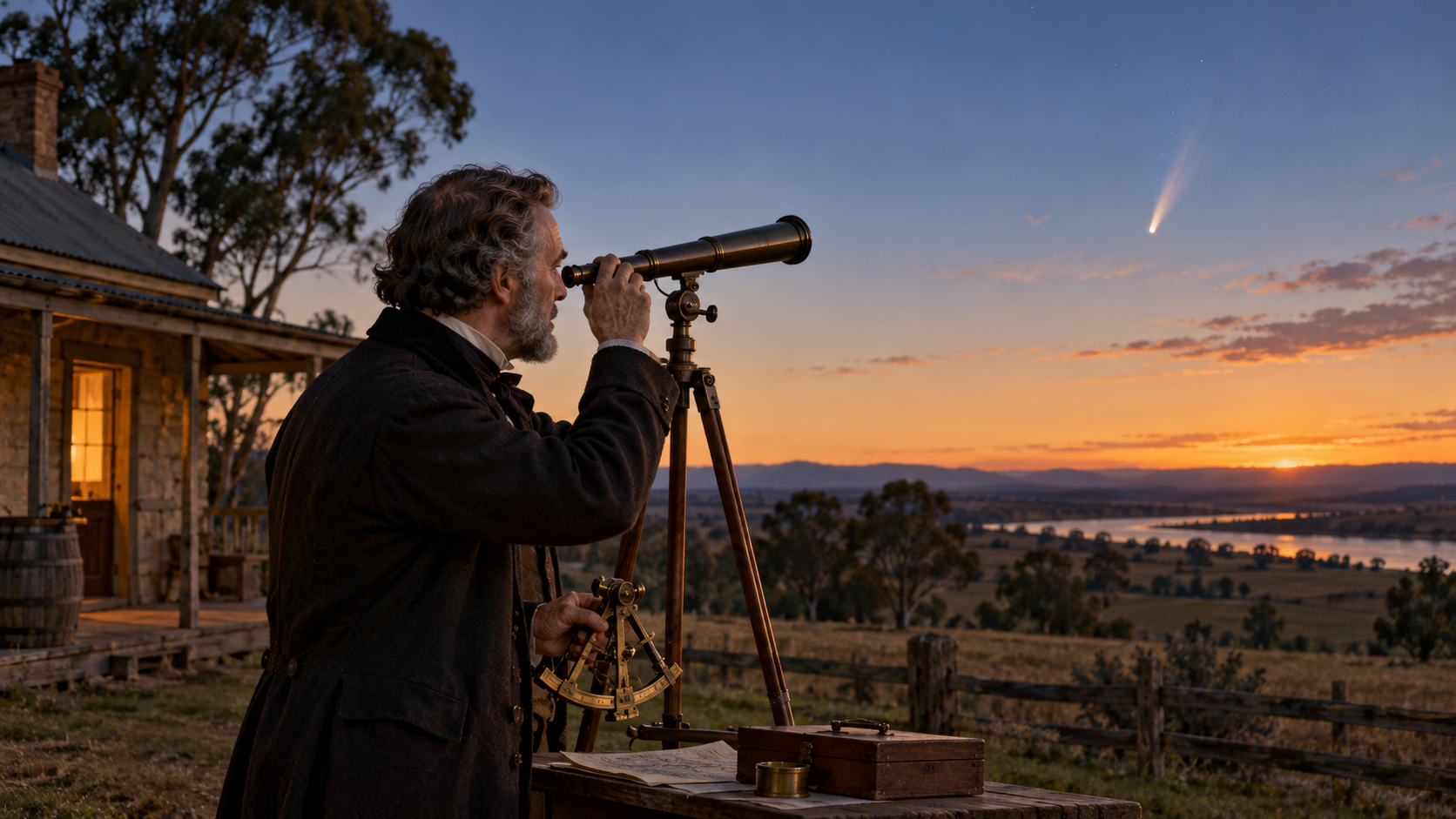
On This Day in Science: May 13, 1861
On May 13, 1861, John Tebbutt observed a faint nebulous object from his family’s property at Windsor, New South Wales. The twenty-six-year-old farmer and self-taught astronomer was searching the western sky with a small marine telescope. He carefully measured the object’s position against known stars but could not find it in the limited catalogues available to him.
For several nights the suspected object moved too slowly for Tebbutt to be certain it was a comet. By May 21 he detected clear motion and notified the government astronomer at Sydney Observatory. Continued observations confirmed the discovery, now known as C/1861 J1 or the Great Comet of 1861. Tebbutt also calculated an orbit using modest instruments and hand computation.
The comet brightened dramatically as it approached the Sun. By late June it became a spectacular naked-eye object in the Northern Hemisphere, with a tail reported across an enormous span of sky. Earth passed through part of the tail, and astronomers documented rapid changes in the comet’s head and streamers. The event gave observers an unusual view of cometary structure.
Tebbutt’s discovery established his international reputation and led to decades of precise work on comets, occultations, variable stars, and weather. The date shows how systematic observation outside a large institution can enter global science when positions, timing, and methods are recorded well enough for others to verify. For science history, the event also shows how evidence moves from an observation or engineered test into a durable body of knowledge. Instruments supplied measurements, specialists debated interpretation, and later work refined what the first result could mean. Archives preserve the early record while new methods let researchers ask different questions of it. That continuing revision is the process through which a dated milestone remains scientifically useful. Seen across a longer timeline, scientific milestones are junctions rather than isolated beginnings. Earlier experiments, tools, and institutions made the work possible, while later teams tested limits and carried the result into new settings. What survives is a traceable chain of evidence, correction, and application that allows one moment to remain relevant as knowledge and technology continue to change. The anniversary highlights the difference between a first result and a finished understanding. A successful observation can settle one question while opening several harder ones, and even a failed objective can reshape later designs. Preserved data, specimens, photographs, and hardware allow new generations to revisit the work with better tools. Science advances through that continuity rather than stopping on a memorable date. Its calendar date is an entry point, not an endpoint. The people involved worked with the instruments, assumptions, and social conditions of their time, and later research has both extended and corrected their conclusions. Separating what was known that day from what became clear afterward protects the history from myth and shows how cumulative evidence turns an episode into lasting scientific knowledge.
Tebbutt found a diffuse point that did not appear in his available catalogues.
He measured it against nearby stars instead of relying on a single impression.
Several nights passed before the object's changing position became unmistakable.
Tebbutt then reported the discovery and began calculating its path.
The comet later became one of the most impressive naked-eye objects of the century.
Tebbutt's reliable measurements connected a private Australian observatory with international astronomy.
Explore more of "On This Day ..."
Discover more events from the same date across news, politics, technology, sports, and other fields. Each link highlights significant moments that shaped history on different fronts.