

On This Day in Science: May 15, 1958
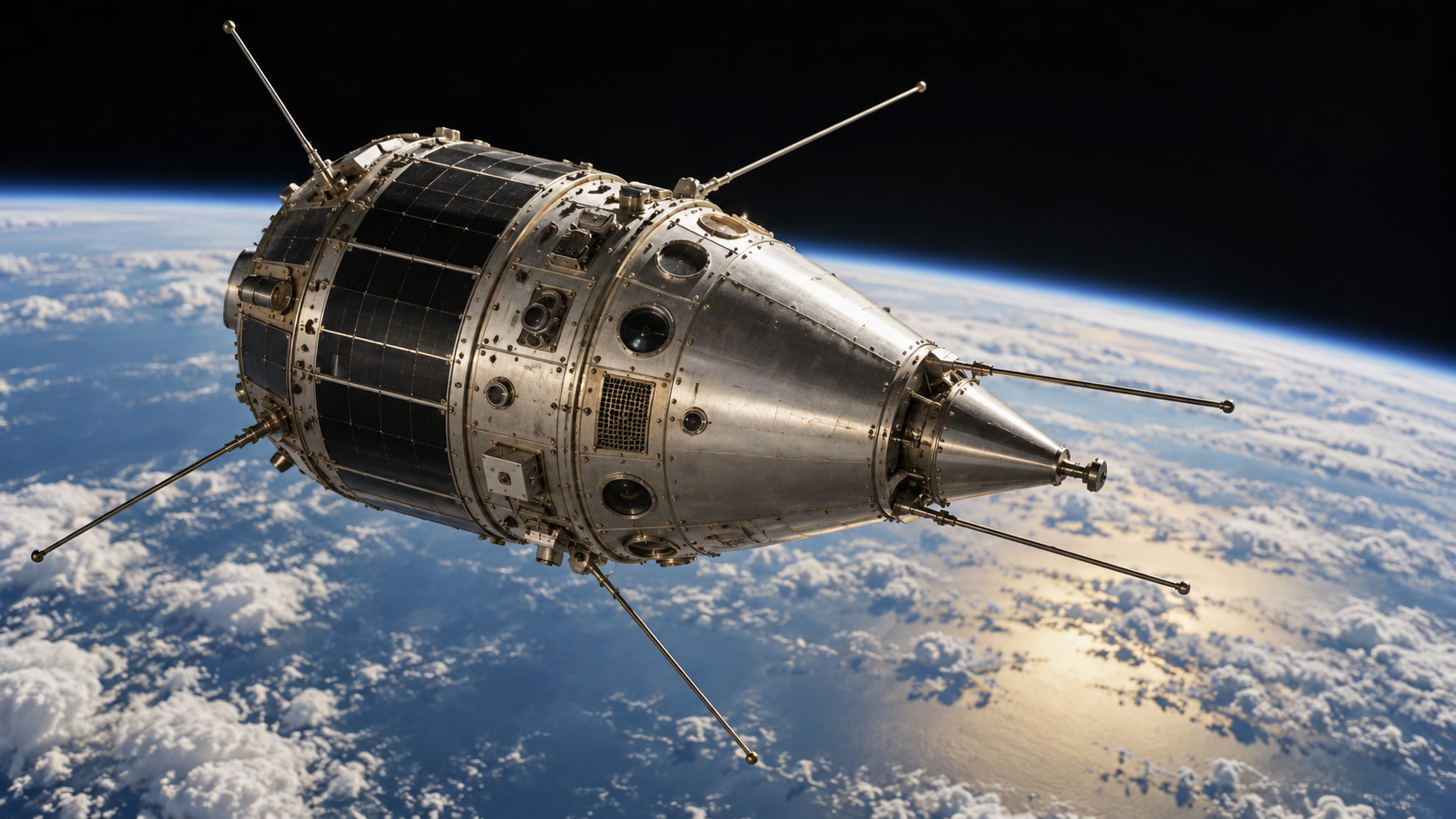
On May 15, 1958, the Soviet Union launched Sputnik 3 from Baikonur into an elongated Earth orbit. The cone-shaped spacecraft weighed more than 1,300 kilograms and carried a broad suite of instruments for the upper atmosphere and near-Earth space. It was far more capable than the radio-beacon Sputnik 1 and represented the original scientific ambition of the early Soviet satellite program.
Its instruments measured cosmic rays, charged particles, magnetic and electric fields, micrometeoroids, pressure, temperature, and the composition of the upper atmosphere. Solar cells supplemented chemical batteries, while radio transmitters returned data to ground stations. A tape recorder failed, limiting coverage when the satellite was beyond direct receiving range.
Sputnik 3 flew as scientists were beginning to understand the belts of energetic particles around Earth. Its measurements detected intense radiation, but the recording failure and incomplete geographic coverage complicated interpretation. American Explorer satellites, especially Explorer 1 and Explorer 3, supplied complementary evidence that led to recognition of the Van Allen radiation belts.
The mission operated until 1960 and showed how quickly satellites were becoming laboratories rather than demonstrations. Its limits also illustrated that sensing, storage, timing, and communications are one measurement system: a detector can encounter a phenomenon without producing a complete scientific record. The anniversary highlights the difference between a first result and a finished understanding. A successful observation can settle one question while opening several harder ones, and even a failed objective can reshape later designs. Preserved data, specimens, photographs, and hardware allow new generations to revisit the work with better tools. Science advances through that continuity rather than stopping on a memorable date. Its calendar date is an entry point, not an endpoint. The people involved worked with the instruments, assumptions, and social conditions of their time, and later research has both extended and corrected their conclusions. Separating what was known that day from what became clear afterward protects the history from myth and shows how cumulative evidence turns an episode into lasting scientific knowledge. For science history, the event also shows how evidence moves from an observation or engineered test into a durable body of knowledge. Instruments supplied measurements, specialists debated interpretation, and later work refined what the first result could mean. Archives preserve the early record while new methods let researchers ask different questions of it. That continuing revision is the process through which a dated milestone remains scientifically useful. Seen across a longer timeline, scientific milestones are junctions rather than isolated beginnings. Earlier experiments, tools, and institutions made the work possible, while later teams tested limits and carried the result into new settings. What survives is a traceable chain of evidence, correction, and application that allows one moment to remain relevant as knowledge and technology continue to change.
Sputnik 3 carried instruments for particles, fields, meteoroids, and the upper atmosphere.
Its mass and complexity greatly exceeded the first two Sputnik spacecraft.
A failed tape recorder reduced measurements outside Soviet receiving range.
Important radiation signals were detected but could not be mapped as completely as planned.
Sputnik and Explorer results together revealed a dynamic radiation environment around Earth.
The mission helped transform satellites into systematic geophysical observatories.
Explore more of "On This Day ..."
Discover more events from the same date across news, politics, technology, sports, and other fields. Each link highlights significant moments that shaped history on different fronts.