

On This Day in Science: May 16, 1960
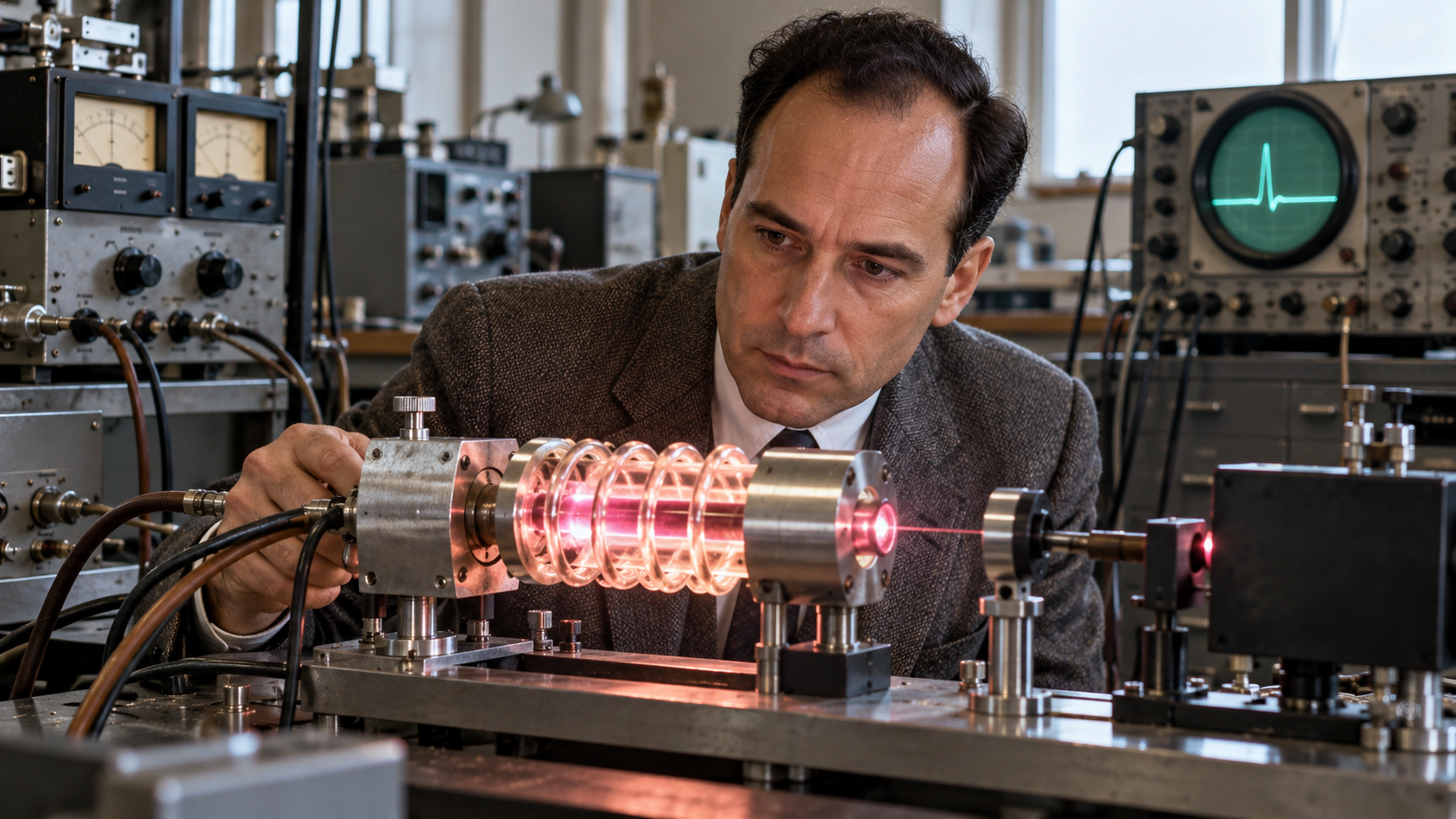
On May 16, 1960, physicist Theodore Maiman operated the first working laser at Hughes Research Laboratories in Malibu, California. The compact device placed a synthetic ruby rod inside a helical xenon flashlamp. When the lamp delivered an intense burst, chromium atoms in the ruby stored energy and released a short pulse of coherent red light between reflective ends of the crystal.
The theoretical foundation came from stimulated emission, described by Albert Einstein, and from masers that amplified microwaves. Several research groups were racing to extend the principle to visible or infrared wavelengths. Many doubted that ruby was a suitable material, but Maiman rechecked key absorption measurements and built a simple pulsed design that could pump the crystal hard enough.
A laser differs from an ordinary lamp because its light is highly directional, narrow in wavelength, and phase-related. Those properties allow energy to be focused, timed, and transmitted with exceptional control. Early observers called the device a solution looking for a problem, yet laboratories rapidly produced gas, semiconductor, and other solid-state lasers.
Lasers now read and write data, carry communications, cut and weld material, guide measurements, perform surgery, cool atoms, and probe planets. The first flash was brief, but it established a general instrument whose usefulness came from the controlled behavior of light itself. Its calendar date is an entry point, not an endpoint. The people involved worked with the instruments, assumptions, and social conditions of their time, and later research has both extended and corrected their conclusions. Separating what was known that day from what became clear afterward protects the history from myth and shows how cumulative evidence turns an episode into lasting scientific knowledge. For science history, the event also shows how evidence moves from an observation or engineered test into a durable body of knowledge. Instruments supplied measurements, specialists debated interpretation, and later work refined what the first result could mean. Archives preserve the early record while new methods let researchers ask different questions of it. That continuing revision is the process through which a dated milestone remains scientifically useful. Seen across a longer timeline, scientific milestones are junctions rather than isolated beginnings. Earlier experiments, tools, and institutions made the work possible, while later teams tested limits and carried the result into new settings. What survives is a traceable chain of evidence, correction, and application that allows one moment to remain relevant as knowledge and technology continue to change. The anniversary highlights the difference between a first result and a finished understanding. A successful observation can settle one question while opening several harder ones, and even a failed objective can reshape later designs. Preserved data, specimens, photographs, and hardware allow new generations to revisit the work with better tools. Science advances through that continuity rather than stopping on a memorable date.
A xenon lamp pumped energy into chromium atoms within a synthetic ruby rod.
Reflective ends formed a resonant cavity that released a concentrated red pulse.
Stimulated emission had already amplified microwaves in maser systems.
Maiman identified a practical material and pumping method for optical wavelengths.
Directionality and spectral purity make laser light unusually controllable.
Applications now span measurement, medicine, manufacturing, communications, and fundamental physics.
Explore more of "On This Day ..."
Discover more events from the same date across news, politics, technology, sports, and other fields. Each link highlights significant moments that shaped history on different fronts.