

On This Day in Science: May 17, 1861
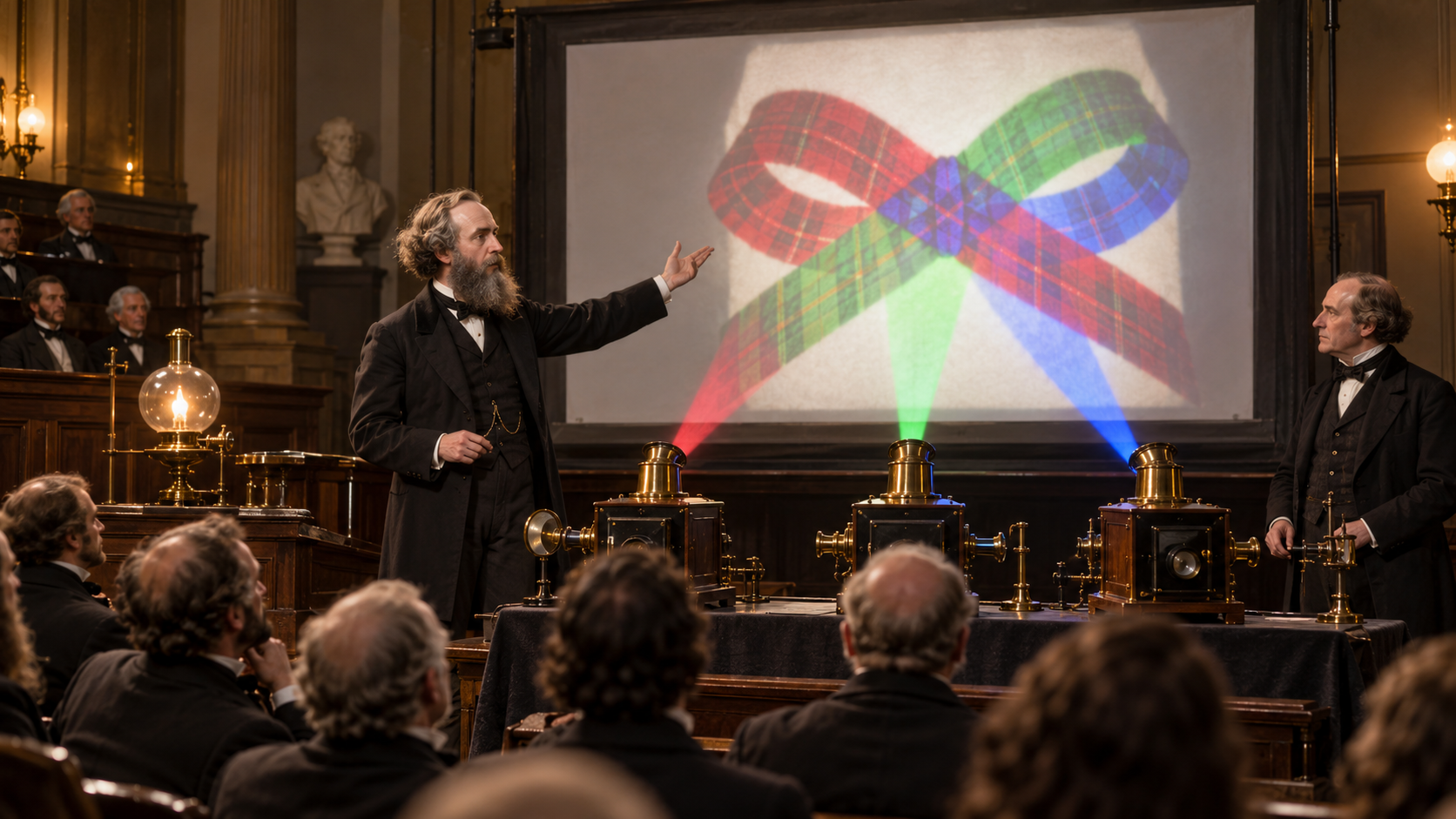
On May 17, 1861, James Clerk Maxwell demonstrated a method of color photography during a lecture at the Royal Institution in London. Photographer Thomas Sutton had made three black-and-white exposures of a tartan ribbon through red, green, and blue filters. Maxwell projected transparencies from those negatives through matching filters and superimposed the images on a screen, producing a recognizable color result.
The demonstration grew from Maxwell’s research on human color vision. He argued that many perceived colors could be produced by mixing three primary components in different proportions. Photography offered a way to separate a scene into those components and then recombine them, converting a theory of vision into an imaging system.
The result was imperfect because photographic emulsions of the period responded weakly to much of the visible spectrum. Later analysis showed that ultraviolet sensitivity and the dyes in the ribbon contributed to what the plates recorded. The experiment therefore did not provide a practical everyday color process, but it demonstrated the additive three-color principle in a durable photographic form.
Modern screens, cameras, scanners, and color-management systems still rely on separating and recombining color channels. The lecture showed that an image need not capture color as a single substance; it can reconstruct color from measured components matched to human perception. For science history, the event also shows how evidence moves from an observation or engineered test into a durable body of knowledge. Instruments supplied measurements, specialists debated interpretation, and later work refined what the first result could mean. Archives preserve the early record while new methods let researchers ask different questions of it. That continuing revision is the process through which a dated milestone remains scientifically useful. Seen across a longer timeline, scientific milestones are junctions rather than isolated beginnings. Earlier experiments, tools, and institutions made the work possible, while later teams tested limits and carried the result into new settings. What survives is a traceable chain of evidence, correction, and application that allows one moment to remain relevant as knowledge and technology continue to change. The anniversary highlights the difference between a first result and a finished understanding. A successful observation can settle one question while opening several harder ones, and even a failed objective can reshape later designs. Preserved data, specimens, photographs, and hardware allow new generations to revisit the work with better tools. Science advances through that continuity rather than stopping on a memorable date. Its calendar date is an entry point, not an endpoint. The people involved worked with the instruments, assumptions, and social conditions of their time, and later research has both extended and corrected their conclusions. Separating what was known that day from what became clear afterward protects the history from myth and shows how cumulative evidence turns an episode into lasting scientific knowledge.
Sutton photographed the tartan through red, green, and blue filters.
Maxwell projected the three records through matching filters onto the same screen.
The experiment illustrated Maxwell's idea that three components can reproduce many perceived colors.
It joined physiology, optics, and photographic chemistry in one demonstration.
The emulsions did not respond evenly across the visible spectrum.
Even so, the channel-based method anticipated modern color imaging and display systems.
Explore more of "On This Day ..."
Discover more events from the same date across news, politics, technology, sports, and other fields. Each link highlights significant moments that shaped history on different fronts.