

On This Day in Science: May 21, 1927
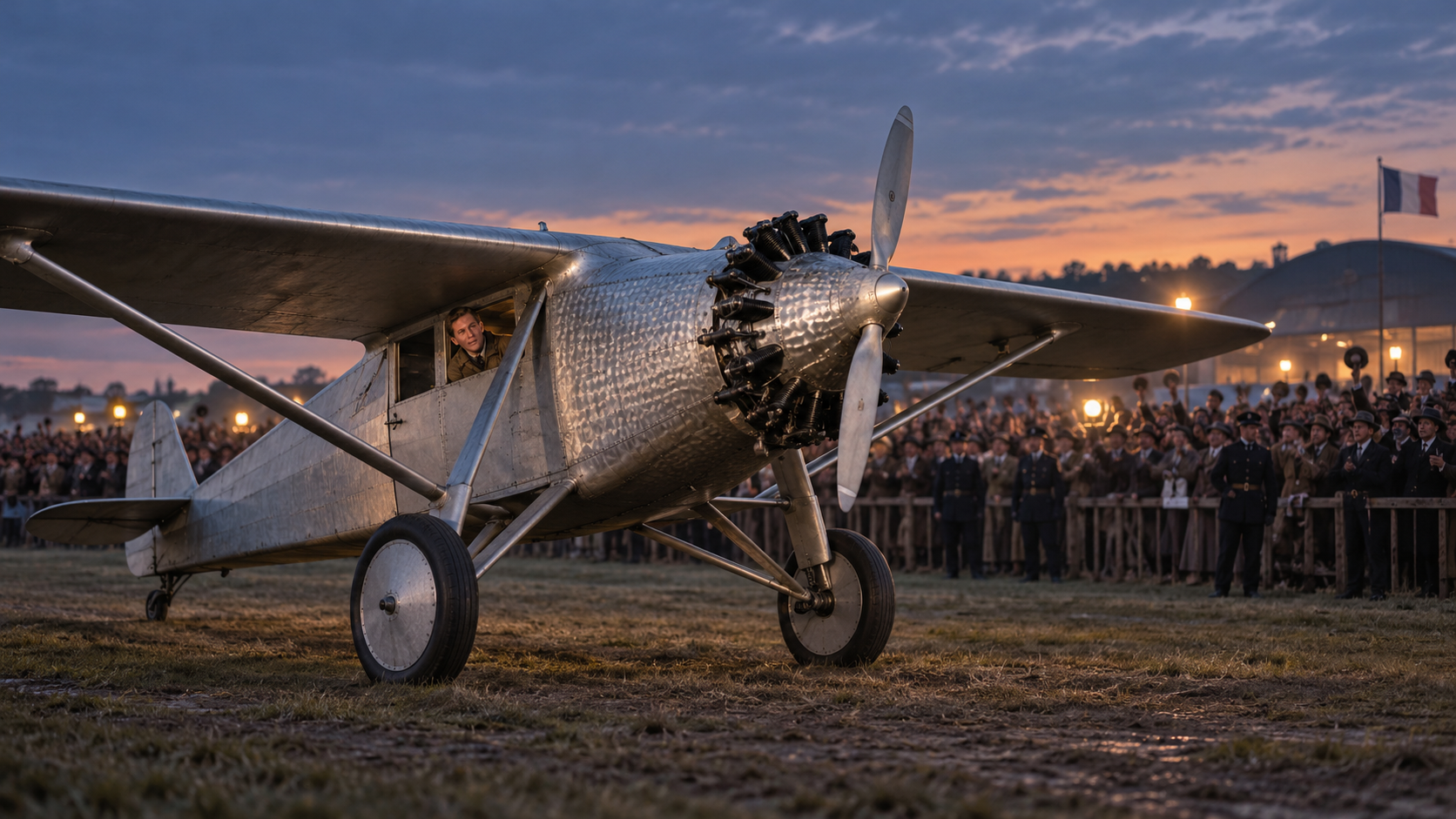
On the evening of May 21, 1927, Charles Lindbergh landed the Spirit of St. Louis at Le Bourget aerodrome outside Paris. He had taken off from Roosevelt Field on Long Island the previous morning and flown alone for about thirty-three and a half hours. The 5,810-kilometer journey was the first solo nonstop flight between New York and Paris and won the Orteig Prize.
The Spirit of St. Louis was a custom Ryan monoplane designed around fuel capacity and reliability. A large tank blocked the pilot’s forward view, so Lindbergh looked through side windows, used a small periscope, and occasionally yawed the airplane. He carried no radio, navigated with a compass, clock, maps, and dead reckoning, and chose a single engine to reduce weight and complexity.
Fog, icing, fatigue, and uncertain winds made the Atlantic crossing hazardous. Lindbergh flew close to waves at times for visual reference and arrived with fuel remaining. A vast crowd surged around the aircraft at Le Bourget, turning a technical achievement into an international spectacle. The flight accelerated public confidence in long-distance aviation even though scheduled ocean transport required multi-engine aircraft, radios, weather services, and extensive ground infrastructure.
The landing showed what careful weight control, navigation, engine reliability, and human endurance could achieve. Its deeper legacy came when those lessons were converted from one exceptional airplane into safer systems for routine air travel. For science history, the event also shows how evidence moves from an observation or engineered test into a durable body of knowledge. Instruments supplied measurements, specialists debated interpretation, and later work refined what the first result could mean. Archives preserve the early record while new methods let researchers ask different questions of it. That continuing revision is the process through which a dated milestone remains scientifically useful. Seen across a longer timeline, scientific milestones are junctions rather than isolated beginnings. Earlier experiments, tools, and institutions made the work possible, while later teams tested limits and carried the result into new settings. What survives is a traceable chain of evidence, correction, and application that allows one moment to remain relevant as knowledge and technology continue to change. The anniversary highlights the difference between a first result and a finished understanding. A successful observation can settle one question while opening several harder ones, and even a failed objective can reshape later designs. Preserved data, specimens, photographs, and hardware allow new generations to revisit the work with better tools. Science advances through that continuity rather than stopping on a memorable date. Its calendar date is an entry point, not an endpoint. The people involved worked with the instruments, assumptions, and social conditions of their time, and later research has both extended and corrected their conclusions. Separating what was known that day from what became clear afterward protects the history from myth and shows how cumulative evidence turns an episode into lasting scientific knowledge.
The main fuel tank occupied the space in front of the cockpit.
Lindbergh used side windows, a periscope, and changes in heading to see ahead.
Compass headings, time, maps, weather estimates, and dead reckoning guided the crossing.
Cloud, fog, and wind repeatedly made the calculated position uncertain.
The solo flight proved range and reliability in dramatic form.
Routine transatlantic aviation still required crews, communications, forecasts, airports, and redundancy.
Explore more of "On This Day ..."
Discover more events from the same date across news, politics, technology, sports, and other fields. Each link highlights significant moments that shaped history on different fronts.