

On This Day in Science: May 25, 2008
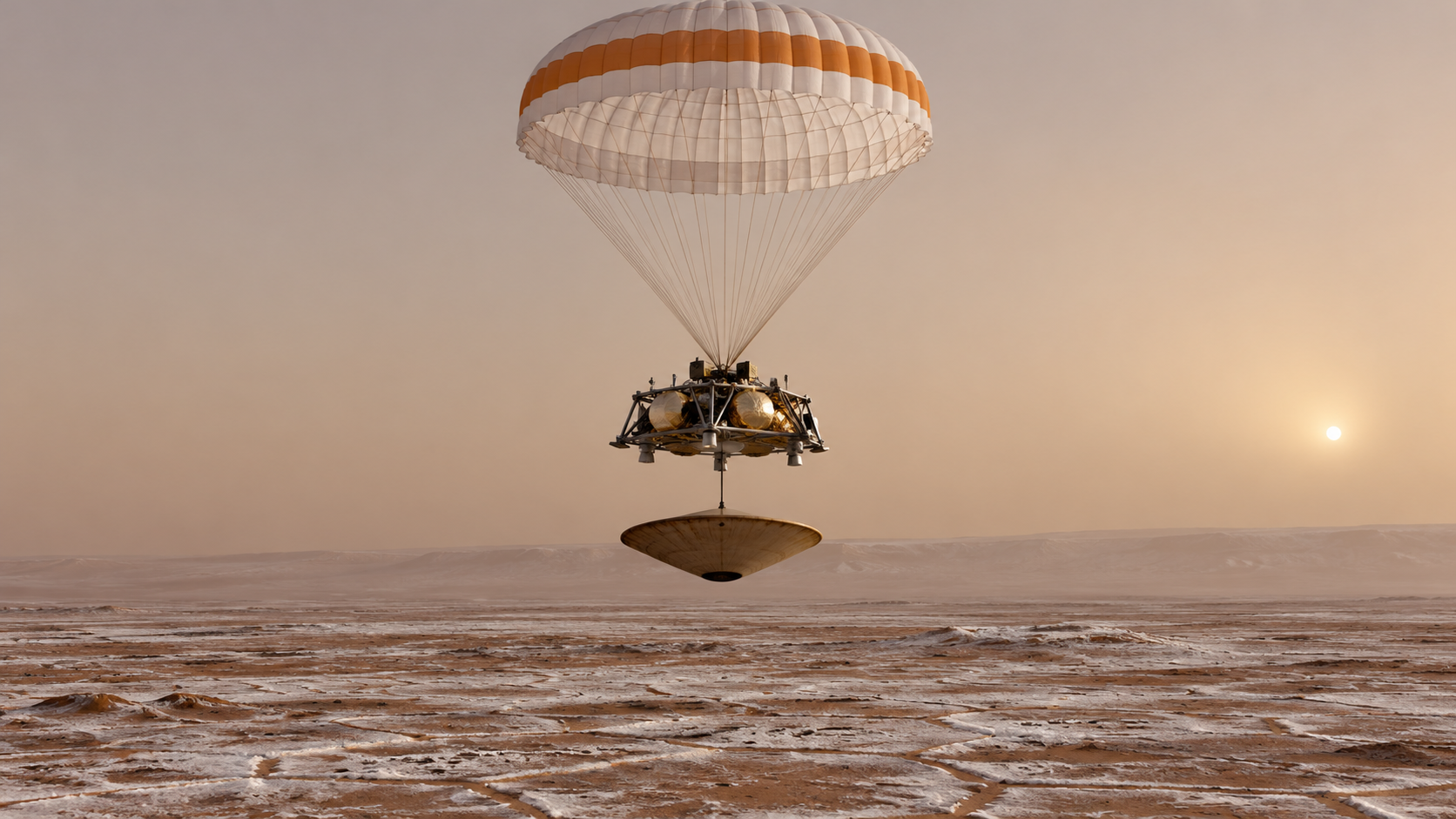
On May 25, 2008, NASA’s Phoenix spacecraft entered the Martian atmosphere at nearly 21,000 kilometers per hour and landed safely in the northern plains of Vastitas Borealis. A heat shield, parachute, and pulsed retrorockets slowed the stationary lander through the final minutes. Mars Reconnaissance Orbiter photographed Phoenix beneath its parachute, the first image of one spacecraft descending to another planet taken by a different spacecraft.
Phoenix targeted a high-latitude site where orbital neutron data indicated shallow water ice. Its robotic arm dug trenches and delivered soil and ice-rich samples to onboard laboratories. Cameras, a weather station, and microscopes documented the site, while chemical instruments heated samples and tested dissolved ions. The lander directly exposed bright material that disappeared or changed over time, supporting its identification as water ice.
Analyses found perchlorate salts and characterized an alkaline soil, results that complicated assumptions about habitability and the preservation of organic molecules. Phoenix also measured atmospheric conditions, dust, clouds, frost, and the exchange of water between ground and air. It was designed to study the history of water rather than to detect life directly.
The mission operated until declining sunlight and cold ended communications in November. Its landing and trench work turned an orbital hydrogen signal into physical evidence at the surface, linking remote sensing with chemistry in a specific Martian environment. For science history, the event also shows how evidence moves from an observation or engineered test into a durable body of knowledge. Instruments supplied measurements, specialists debated interpretation, and later work refined what the first result could mean. Archives preserve the early record while new methods let researchers ask different questions of it. That continuing revision is the process through which a dated milestone remains scientifically useful. Seen across a longer timeline, scientific milestones are junctions rather than isolated beginnings. Earlier experiments, tools, and institutions made the work possible, while later teams tested limits and carried the result into new settings. What survives is a traceable chain of evidence, correction, and application that allows one moment to remain relevant as knowledge and technology continue to change. The anniversary highlights the difference between a first result and a finished understanding. A successful observation can settle one question while opening several harder ones, and even a failed objective can reshape later designs. Preserved data, specimens, photographs, and hardware allow new generations to revisit the work with better tools. Science advances through that continuity rather than stopping on a memorable date. Its calendar date is an entry point, not an endpoint. The people involved worked with the instruments, assumptions, and social conditions of their time, and later research has both extended and corrected their conclusions. Separating what was known that day from what became clear afterward protects the history from myth and shows how cumulative evidence turns an episode into lasting scientific knowledge.
Phoenix used a heat shield, parachute, and retrorockets to reach the northern plains.
An orbiter photographed the lander hanging beneath its parachute during descent.
The robotic arm dug through soil to bright subsurface material.
Changes in the exposed patches supported their identification as water ice.
Phoenix found perchlorate salts and alkaline soil.
The results changed how scientists plan organic-chemistry experiments on Mars.
Explore more of "On This Day ..."
Discover more events from the same date across news, politics, technology, sports, and other fields. Each link highlights significant moments that shaped history on different fronts.