

How Gravitational Lensing Bends Light Explainer
Gravitational lensing occurs because mass curves spacetime and light follows the resulting paths. A galaxy, galaxy cluster, star, planet, or compact object between an observer and a distant source can deflect the source’s light. The foreground object acts like a lens, although gravity does not focus light through glass. The observed geometry depends on mass, distances, alignment, and how the mass is distributed.
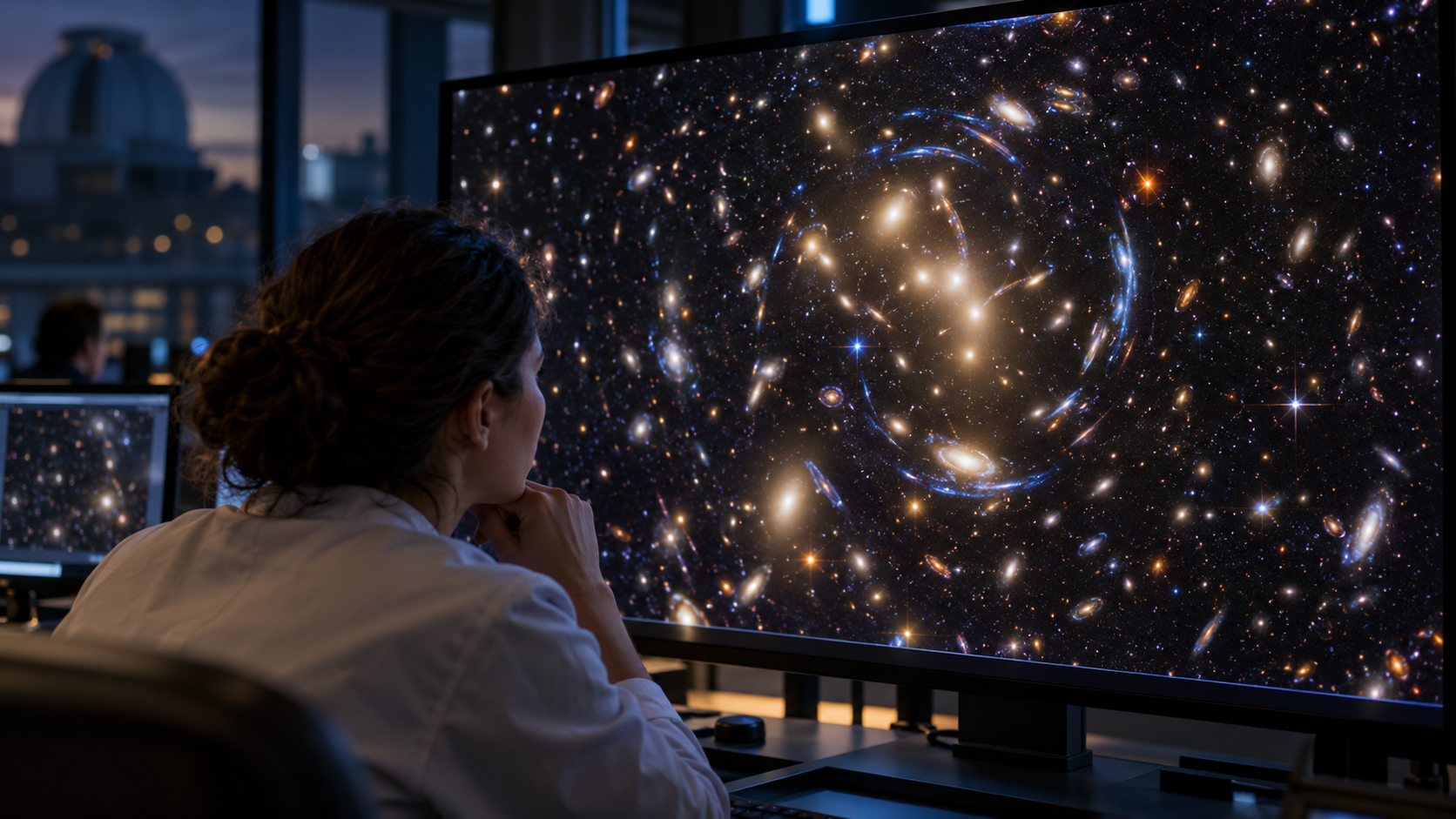
When a massive galaxy cluster lies in front of more distant galaxies, their images can stretch into arcs. Near-perfect alignment around a compact symmetric lens can form an Einstein ring. Several light paths can produce multiple images of one source. These patterns are not physical duplicates; they are different routes taken by light that left the same background object.
Lensing can magnify objects too faint or distant to study directly, turning natural mass concentrations into cosmic telescopes. The magnification is uneven, so scientists use lens models to reconstruct the source. Clusters contain visible galaxies, hot gas, and dark matter. Matching observed arcs allows researchers to infer the total mass distribution, including matter that emits little or no light.
Microlensing occurs when the lens images are too close to resolve. Instead, a background star temporarily brightens as a foreground star passes near the line of sight. A planet around the lens star can add a brief extra feature to the light curve. The method can reveal planets far from their stars and isolated compact objects, but the alignment usually does not repeat.
Different light paths have different lengths and pass through different gravitational potentials, so they can arrive at different times. If the source varies, such as a quasar or supernova, astronomers measure delays between its lensed images. Combined with a mass model, those delays can constrain cosmological distances and the expansion history of the universe.
Lensing observations require careful modeling. Unseen mass along the line of sight, complex cluster structure, and assumptions about the lens can produce different reconstructions. Yet the underlying deflection follows general relativity and has been tested across many scales. Lensing is powerful precisely because gravity responds to all mass, not only the material bright enough to see.
Foreground mass curves spacetime and deflects light from a more distant source.
Alignment can create arcs, Einstein rings, magnification, or several images of one object.
Lens models map total mass, including dark matter that does not emit detectable light.
Microlensing records temporary brightening when separate images cannot be resolved.
Arrival-time differences between changing lensed images provide cosmological distance information.
Complex mass distributions and material along the line of sight create modeling uncertainty.
Explore more "Explainers"
Discover additional explainers across politics, science, business, technology, and other fields. Each explainer breaks down a complex idea into clear, everyday language—helping you better understand how major concepts, systems, and debates shape the world around us.