

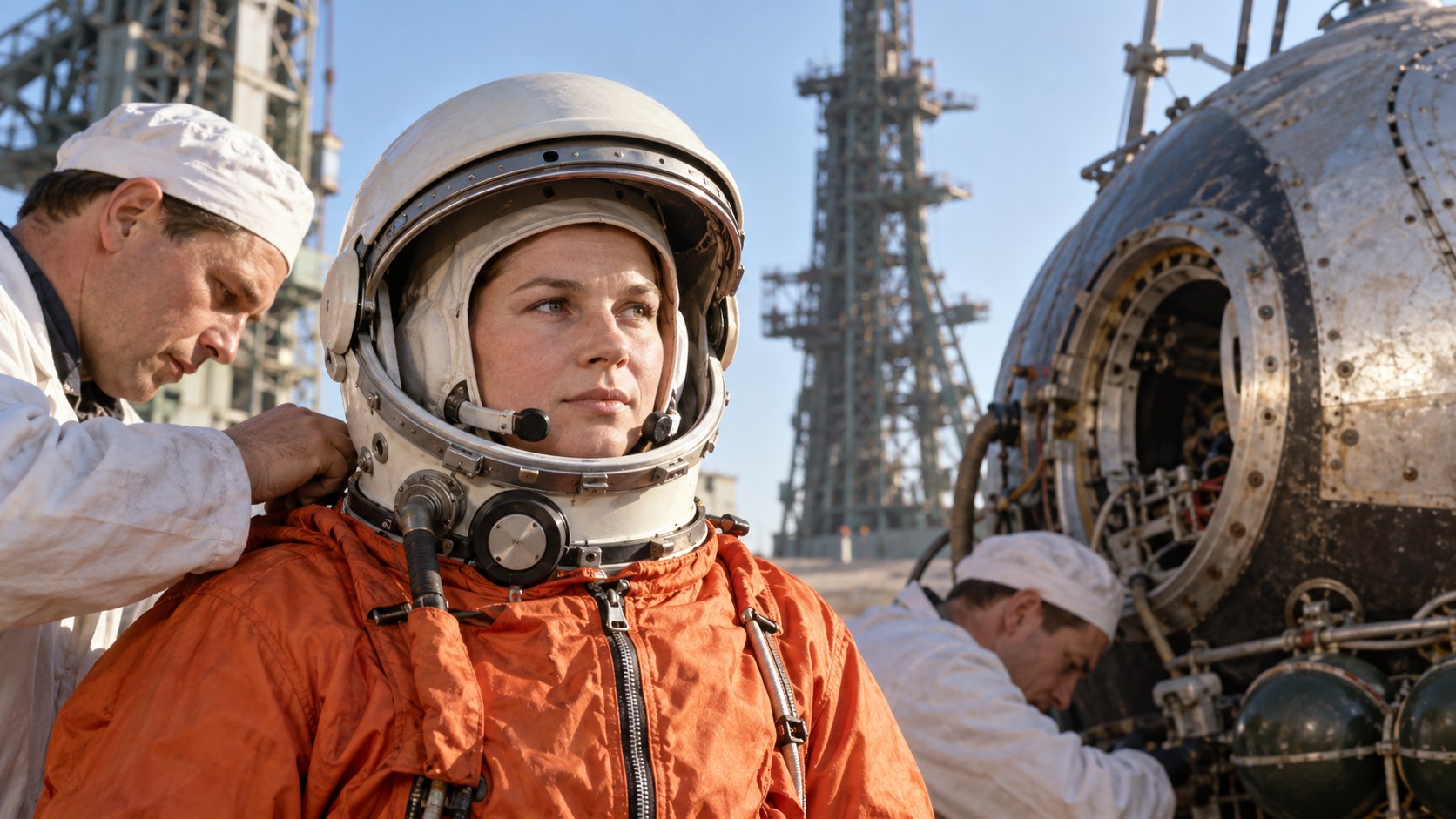
On This Day in Science: June 16, 1963
On June 16, 1963, Valentina Tereshkova launched from Baikonur aboard Vostok 6 and became the first woman in space. The Soviet cosmonaut used the call sign Chaika, meaning seagull. Her flight occurred while Vostok 5, carrying Valery Bykovsky, was already in orbit, allowing controllers to operate two human spacecraft at the same time.
Tereshkova had been selected from a group of women with parachuting experience, a useful skill because Vostok cosmonauts ejected from the capsule and landed separately. During nearly three days in orbit she completed forty-eight circuits of Earth, maintained a flight log, photographed the horizon, and collected biomedical information about the effects of spaceflight.
The mission encountered discomfort and technical concerns. Tereshkova reported nausea and fatigue, and a problem in the programmed orientation sequence required correction before reentry. Historians have reconstructed the details from later testimony and records, separating operational issues from Cold War propaganda that surrounded both Soviet successes and criticism.
No other woman flew in space for nineteen years, so the flight did not immediately create equal participation. Its enduring importance lies in demonstrating that gender was no barrier to orbital flight while also revealing how slowly institutions opened training, selection, and leadership to a broader range of people. Its calendar date is an entry point, not an endpoint. The people involved worked with the instruments, assumptions, and social conditions of their time, and later research has both extended and corrected their conclusions. Separating what was known that day from what became clear afterward protects the history from myth and shows how cumulative evidence turns an episode into lasting scientific knowledge. For science history, the event also shows how evidence moves from an observation or engineered test into a durable body of knowledge. Instruments supplied measurements, specialists debated interpretation, and later work refined what the first result could mean. Archives preserve the early record while new methods let researchers ask different questions of it. That continuing revision is the process through which a dated milestone remains scientifically useful. Seen across a longer timeline, scientific milestones are junctions rather than isolated beginnings. Earlier experiments, tools, and institutions made the work possible, while later teams tested limits and carried the result into new settings. What survives is a traceable chain of evidence, correction, and application that allows one moment to remain relevant as knowledge and technology continue to change. The anniversary highlights the difference between a first result and a finished understanding. A successful observation can settle one question while opening several harder ones, and even a failed objective can reshape later designs. Preserved data, specimens, photographs, and hardware allow new generations to revisit the work with better tools. Science advances through that continuity rather than stopping on a memorable date.
Vostok 6 remained in flight for almost three days while another crewed Vostok was in orbit.
The mission gathered operational and medical data during a sustained solo flight.
Vostok crews left the capsule during descent and landed by personal parachute.
Tereshkova's extensive jumping experience was one reason she entered the selection program.
The flight proved a woman could perform an orbital mission.
Institutional opportunity did not keep pace, and another woman did not fly until 1982.
Explore more of "On This Day ..."
Discover more events from the same date across news, politics, technology, sports, and other fields. Each link highlights significant moments that shaped history on different fronts.