

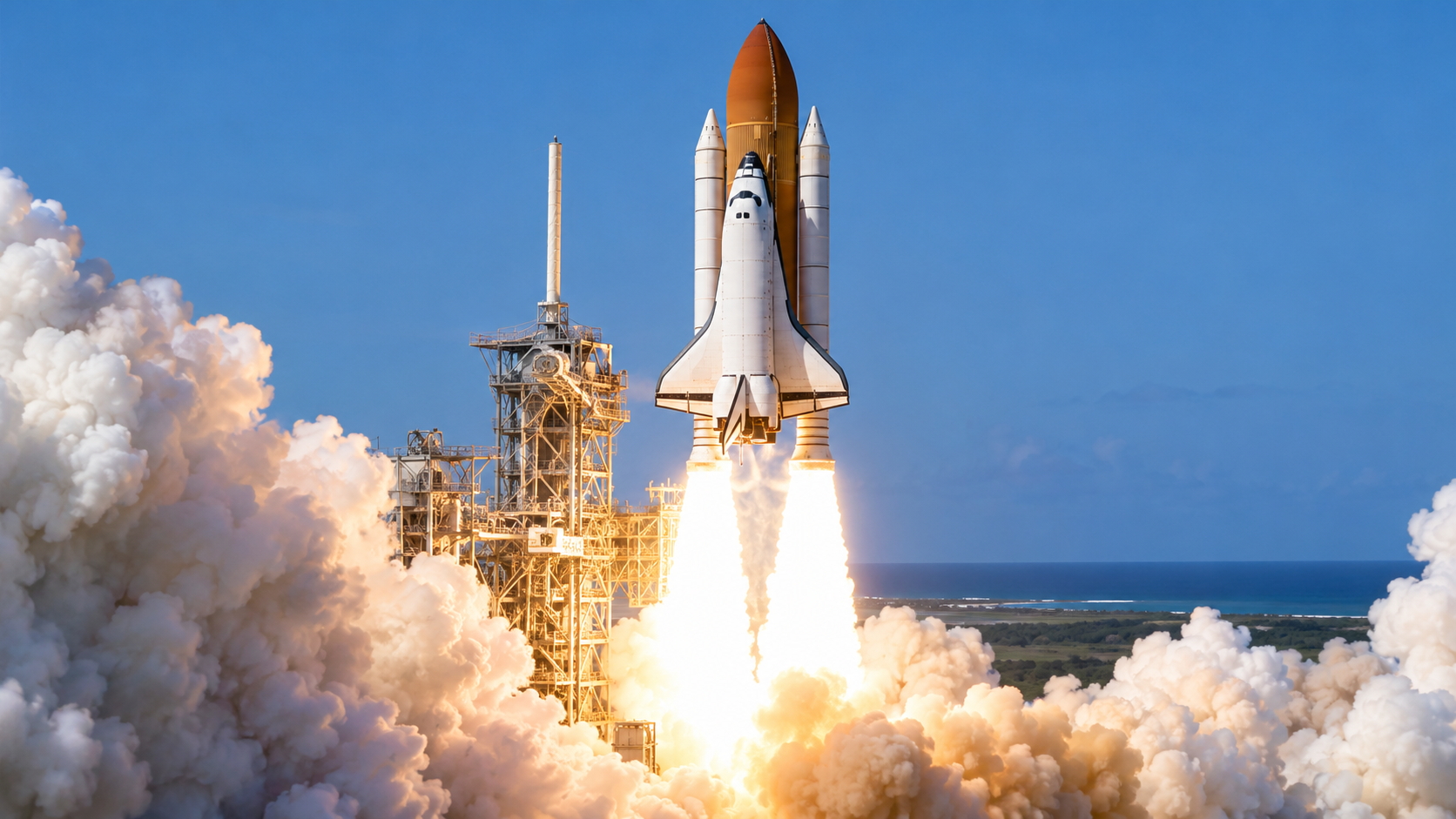
On This Day in Science: June 17, 1985
On June 17, 1985, Space Shuttle Discovery launched from Kennedy Space Center on mission STS-51G. The seven-person crew included French astronaut Patrick Baudry and Saudi payload specialist Sultan bin Salman Al Saud, making the flight notably international. The payload bay carried three communications satellites and a free-flying astronomy platform called SPARTAN 1.
The crew deployed satellites for Mexico, the Arab Satellite Communications Organization, and the United States. Each left the payload bay with a spinning support cradle and later used its own upper stage to climb toward geosynchronous orbit. The mission illustrated how the shuttle briefly served as a crewed launch platform for commercial and government spacecraft.
SPARTAN 1 was released by the robotic arm to observe X-rays from galaxy clusters, then retrieved after an independent flight. Other investigations examined materials, fluid behavior, medicine, and Earth observations. A small laser experiment tested tracking between the orbiter and a ground station in Hawaii.
Discovery landed at Edwards Air Force Base after seven days. STS-51G reflects an era when the shuttle combined satellite delivery, temporary free flyers, laboratory research, diplomacy, and public symbolism in one mission, before later safety changes ended routine deployment of powerful upper stages from a crewed payload bay. For science history, the event also shows how evidence moves from an observation or engineered test into a durable body of knowledge. Instruments supplied measurements, specialists debated interpretation, and later work refined what the first result could mean. Archives preserve the early record while new methods let researchers ask different questions of it. That continuing revision is the process through which a dated milestone remains scientifically useful. Seen across a longer timeline, scientific milestones are junctions rather than isolated beginnings. Earlier experiments, tools, and institutions made the work possible, while later teams tested limits and carried the result into new settings. What survives is a traceable chain of evidence, correction, and application that allows one moment to remain relevant as knowledge and technology continue to change. The anniversary highlights the difference between a first result and a finished understanding. A successful observation can settle one question while opening several harder ones, and even a failed objective can reshape later designs. Preserved data, specimens, photographs, and hardware allow new generations to revisit the work with better tools. Science advances through that continuity rather than stopping on a memorable date. Its calendar date is an entry point, not an endpoint. The people involved worked with the instruments, assumptions, and social conditions of their time, and later research has both extended and corrected their conclusions. Separating what was known that day from what became clear afterward protects the history from myth and shows how cumulative evidence turns an episode into lasting scientific knowledge.
Communications payloads for several organizations were deployed on separate support cradles.
Their upper stages completed the climb from low Earth orbit to higher operational paths.
The crew released SPARTAN 1 to make X-ray observations away from shuttle disturbances.
Discovery later rendezvoused with the platform and returned it to Earth.
Crew members represented the United States, France, and Saudi Arabia.
Their work mixed technical operations with the expanding international character of spaceflight.
Explore more of "On This Day ..."
Discover more events from the same date across news, politics, technology, sports, and other fields. Each link highlights significant moments that shaped history on different fronts.