

On This Day in Science: June 22, 1978
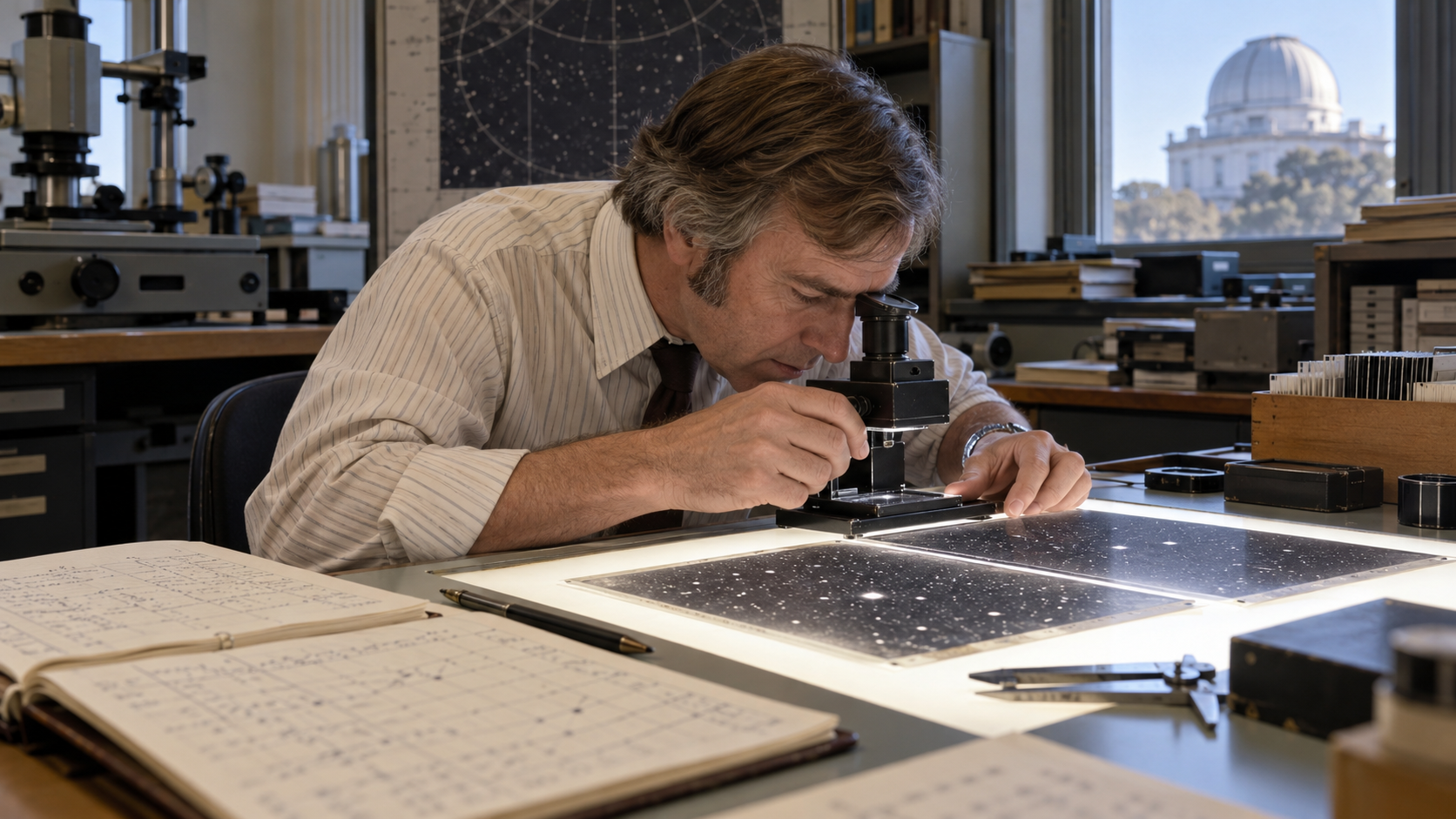
On June 22, 1978, astronomer James Christy noticed that photographic images of Pluto sometimes showed a small elongation. Working at the U.S. Naval Observatory in Flagstaff, Arizona, he examined plates taken to refine Pluto’s orbit and suspected that the recurring bulge was a separate companion rather than a flaw in the emulsion or telescope.
Christy and colleague Robert Harrington checked older plates and found that the elongation moved around Pluto in a repeating pattern. The companion completed an orbit in about 6.4 days, matching Pluto’s rotation period. It was later named Charon, with the official pronunciation accommodating both a mythological ferryman and a personal tribute intended by Christy.
Charon’s discovery transformed estimates of Pluto’s mass. Once astronomers could measure the moon’s orbit, Newtonian dynamics provided the total mass of the system, revealing Pluto to be far smaller than earlier estimates. Later mutual eclipses helped determine sizes and surface properties, and additional much smaller moons were eventually found.
NASA’s New Horizons spacecraft flew through the system in 2015 and showed Charon as a complex world with canyons, plains, and a dark polar region. The original discovery remains an example of careful attention to an apparent defect: a repeated irregularity became evidence for a previously unseen body. Seen across a longer timeline, scientific milestones are junctions rather than isolated beginnings. Earlier experiments, tools, and institutions made the work possible, while later teams tested limits and carried the result into new settings. What survives is a traceable chain of evidence, correction, and application that allows one moment to remain relevant as knowledge and technology continue to change. The anniversary highlights the difference between a first result and a finished understanding. A successful observation can settle one question while opening several harder ones, and even a failed objective can reshape later designs. Preserved data, specimens, photographs, and hardware allow new generations to revisit the work with better tools. Science advances through that continuity rather than stopping on a memorable date. Its calendar date is an entry point, not an endpoint. The people involved worked with the instruments, assumptions, and social conditions of their time, and later research has both extended and corrected their conclusions. Separating what was known that day from what became clear afterward protects the history from myth and shows how cumulative evidence turns an episode into lasting scientific knowledge. For science history, the event also shows how evidence moves from an observation or engineered test into a durable body of knowledge. Instruments supplied measurements, specialists debated interpretation, and later work refined what the first result could mean. Archives preserve the early record while new methods let researchers ask different questions of it. That continuing revision is the process through which a dated milestone remains scientifically useful.
Some photographic plates showed Pluto stretched toward a small companion.
The changing direction matched an orbit rather than a fixed optical or emulsion defect.
The companion's period and separation allowed the system's mass to be calculated.
The result showed that Pluto was much less massive than many earlier estimates.
Charon is unusually large compared with the body it orbits.
New Horizons later revealed cliffs, plains, fractures, and a distinctive dark polar area.
Explore more of "On This Day ..."
Discover more events from the same date across news, politics, technology, sports, and other fields. Each link highlights significant moments that shaped history on different fronts.