

How Plant Roots Absorb Water and Minerals Explainer
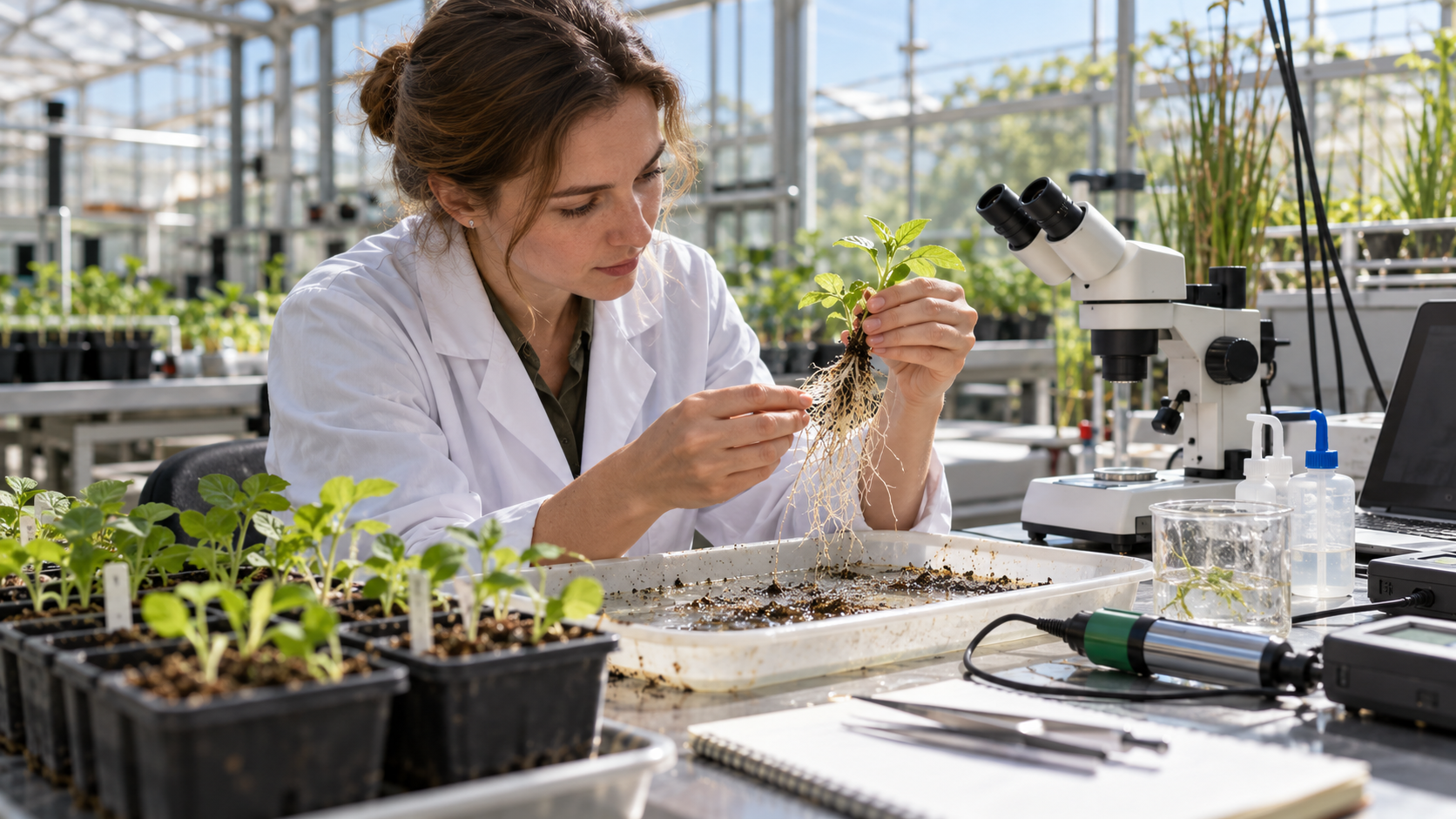
Most land plants acquire water and mineral nutrients from soil through young root regions. Fine roots and microscopic root hairs greatly increase contact with the thin films of water surrounding soil particles. Water enters root cells when the combined effects of solute concentration and pressure create a favorable water-potential gradient. It can move through cell walls and spaces or cross cell membranes from cell to cell.
Mineral ions do not simply wash into the plant in fixed proportions. Transport proteins in root-cell membranes selectively move nitrate, phosphate, potassium, calcium, and other ions. Proton pumps use ATP to export hydrogen ions, creating voltage and concentration gradients that power many nutrient carriers. Uptake therefore depends on membrane chemistry, root energy, soil pH, oxygen, temperature, and the chemical form of each nutrient.
Many plants partner with mycorrhizal fungi. Fungal filaments extend beyond the root’s own depletion zone and explore tiny soil pores, improving access especially to relatively immobile nutrients such as phosphate. The plant supplies carbohydrates and lipids in return. The partnership is widespread but not a guaranteed benefit under every condition; outcome depends on species, nutrient availability, and environmental stress.
Before water and solutes enter the central vascular tissue, they cross the endodermis. A waterproof band in endodermal cell walls, the Casparian strip, blocks uncontrolled flow through wall spaces and forces material across a cell membrane. This checkpoint helps the plant select what reaches the xylem and limits leakage back toward the soil, though roots also have specialized bypasses and developmental zones.
Once in the xylem, water is pulled upward mainly by evaporation from leaves. Cohesion between water molecules and adhesion to xylem walls help maintain a continuous column under tension. Root pressure can contribute under some conditions, but it is usually not the main force lifting water through tall plants. Dissolved minerals travel with the stream and are unloaded into growing or active tissues.
Dry soil can still contain water held too tightly for roots to extract, and waterlogged soil may starve roots of oxygen needed for active transport. Salty soil lowers water potential and can make uptake difficult even when it looks wet. Roots continually change growth, transport proteins, symbioses, and architecture in response. Absorption is therefore a regulated exchange among living roots, microbes, water, minerals, and soil structure.
Root hairs and fine roots enlarge the absorbing surface in contact with soil-water films.
Water follows water-potential gradients, while mineral ions use selective membrane transporters.
ATP-driven proton pumps create gradients that power much nutrient uptake.
Mycorrhizal fungi extend the explored soil volume and exchange nutrients for plant carbon.
The endodermis and Casparian strip regulate entry into the central xylem.
Drought, salt, waterlogging, pH, temperature, and soil chemistry can each limit absorption.
Explore more "Explainers"
Discover additional explainers across politics, science, business, technology, and other fields. Each explainer breaks down a complex idea into clear, everyday language—helping you better understand how major concepts, systems, and debates shape the world around us.