

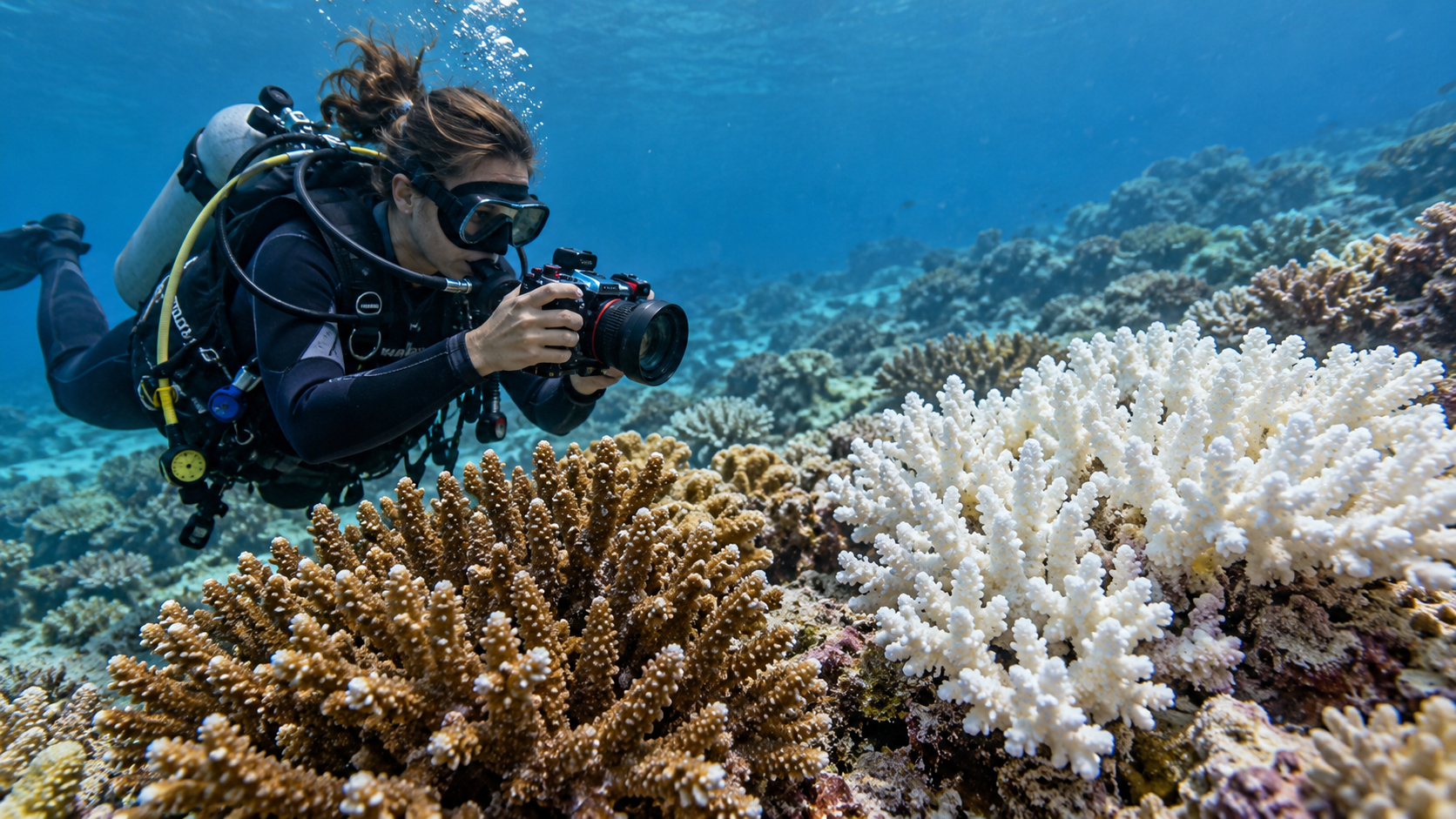
How Coral Bleaching Happens Explainer
Reef-building corals are colonies of tiny animals that commonly host photosynthetic algae inside their tissues. The algae receive shelter and nutrients, while transferring much of the energy-rich carbon they produce to the coral. Their pigments give many corals a brownish or greenish color over the white calcium-carbonate skeleton. Bleaching happens when stress breaks down this partnership and algae or their pigments are lost.
Unusually warm water is the leading cause of widespread bleaching. Heat and strong light can disrupt photosynthesis in the algae, producing reactive oxygen chemistry and damaging both partners. The coral expels algae or loses algal pigments and cells. The transparent coral tissue then reveals the pale skeleton beneath. Cold, pollution, disease, freshwater, sediment, and intense sunlight can also cause localized or regional bleaching.
A bleached coral is not necessarily dead. Its living tissue may remain on the skeleton and can regain algae if stressful conditions ease soon enough. During bleaching, however, the coral receives less photosynthetic energy, grows and reproduces less, and becomes more vulnerable to disease and other stress. Severe or prolonged bleaching can starve the colony and lead to partial or complete mortality.
Sensitivity differs among coral species, colonies, algal partners, depths, and reef locations. Prior exposure can sometimes increase tolerance, and corals may shuffle or acquire different symbionts, but acclimatization has limits. Heat stress is tracked with both temperature and duration; a modest anomaly lasting weeks can be more damaging than a brief spike. Local cloud cover and water movement can change exposure.
After mortality, algae may cover the skeleton and the three-dimensional reef framework can erode. Fish, invertebrates, coastal protection, tourism, and fisheries may be affected as habitat changes. Recovery requires surviving corals, successful reproduction and settlement, suitable water quality, and time without repeated severe disturbance. Fast-growing species may return sooner than the former diversity and structure.
Bleaching is a visible stress response, not a single disease and not proof that an entire reef is permanently lost. Surveys combine color observations with tissue condition, species, temperature history, and later survival. Reducing local pollution and physical damage can improve resilience, but increasingly frequent marine heat waves can outpace recovery. The process links cellular stress inside coral tissue to ecosystem-scale change.
Coral animals normally exchange nutrients and energy with photosynthetic algae living in their tissues.
Heat and excess light disrupt algal photosynthesis and can trigger expulsion or pigment loss.
The white skeleton becomes visible through living but transparent coral tissue.
Bleached coral may recover if stress eases, but prolonged energy loss raises disease and death risk.
Species, symbionts, depth, currents, and stress duration produce uneven outcomes across reefs.
Repeated severe events can remove habitat structure faster than coral communities rebuild it.
Explore more "Explainers"
Discover additional explainers across politics, science, business, technology, and other fields. Each explainer breaks down a complex idea into clear, everyday language—helping you better understand how major concepts, systems, and debates shape the world around us.