

How Cosmic Rays Interact With the Atmosphere Explainer
Cosmic rays are high-energy charged particles arriving from the Sun, the galaxy, and more distant energetic environments. Most are protons or atomic nuclei stripped of electrons, with smaller contributions from electrons and other particles. Because magnetic fields bend charged paths, the arrival direction of a cosmic ray usually does not point straight back to its source, especially at lower energies.
When a primary cosmic ray strikes a nitrogen or oxygen nucleus high in the atmosphere, the collision converts energy into a spray of new particles. Unstable particles such as pions quickly decay into gamma rays, electrons, positrons, muons, neutrinos, and more nuclear fragments. Those products can collide or decay again, creating a branching extensive air shower that spreads over a wide area.
Electromagnetic parts of the shower multiply through pair production and high-energy radiation, while the hadronic core continues nuclear interactions. Many short-lived particles vanish before reaching sea level, but fast muons can penetrate kilometers of air and sometimes rock. Neutrinos interact so weakly that most pass through Earth, while lower-energy charged particles are absorbed or deflected.
The atmosphere therefore acts as both target and shield. People at higher altitude receive more cosmic-ray exposure because there is less air above to absorb the shower. Exposure also varies with latitude and solar activity because Earth’s magnetic field and the solar wind change which charged primaries reach the atmosphere. Commercial aircrew accumulate more exposure than people spending the same time at sea level.
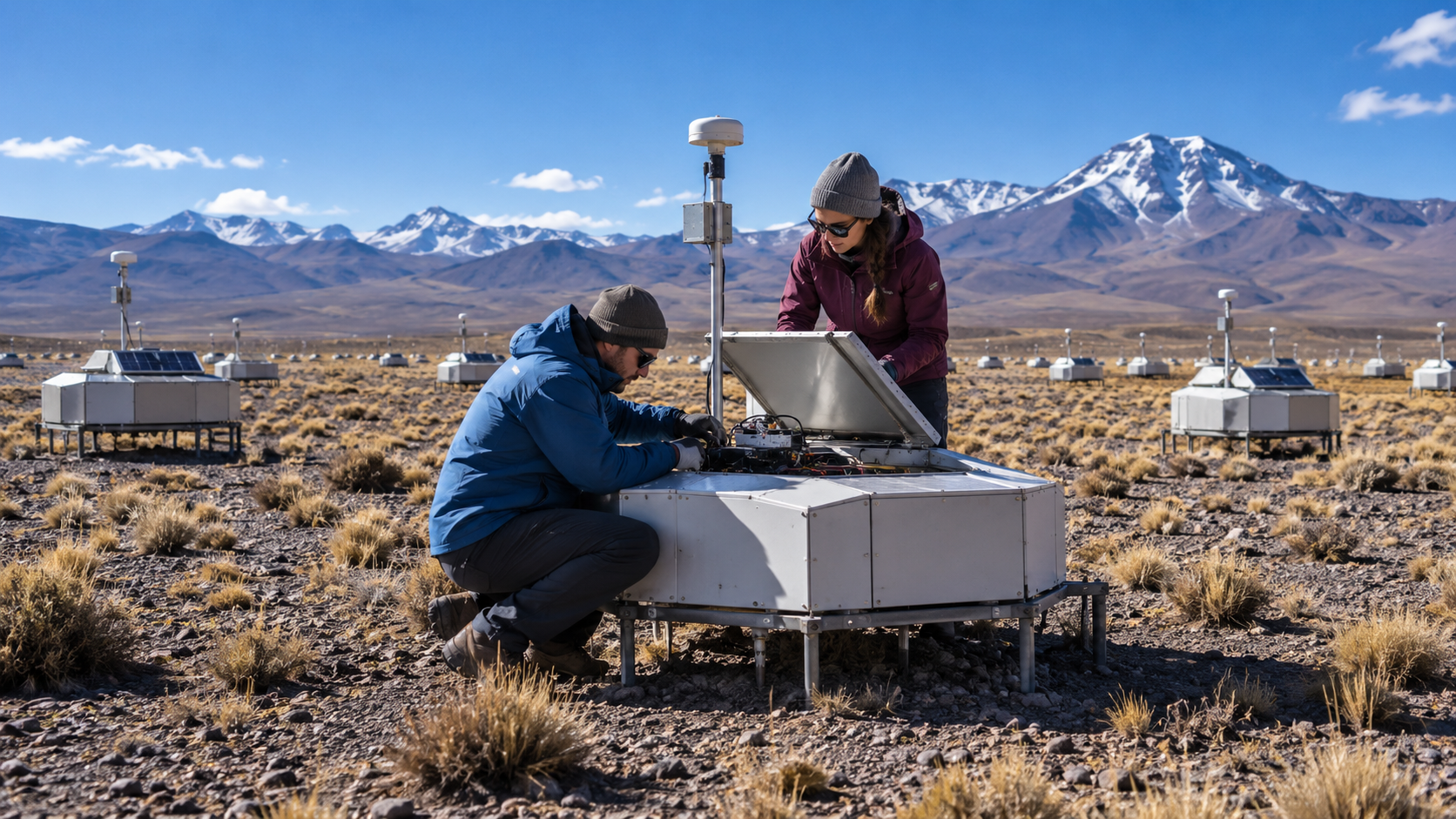
Detectors sample different pieces of the cascade. Ground arrays count particles across large areas, water or ice detectors record faint light from fast charged particles, balloons measure higher-altitude components, and fluorescence telescopes observe ultraviolet light from excited air. Researchers reconstruct the primary particle’s energy, direction, and likely mass from an incomplete shower footprint and simulation.
Cosmic rays are not electromagnetic rays despite the historical name, and most ordinary background events are not hazardous catastrophes. They do create natural radiation, atmospheric isotopes, and occasional electronic errors. Air showers provide a way to study particles far more energetic than human accelerators can produce, but interpretation depends on models of collisions that cannot be observed directly at the first impact.
Primary cosmic rays are mostly energetic protons and atomic nuclei, not beams of light.
A collision with an atmospheric nucleus converts energy into many unstable secondary particles.
Repeated collisions and decays create a broad cascade called an extensive air shower.
Muons can reach the ground, while neutrinos pass through matter with little interaction.
Altitude, latitude, magnetic fields, and solar activity change exposure and detection rates.
Arrays, light detectors, balloons, and simulations reconstruct the unseen primary event.
Explore more "Explainers"
Discover additional explainers across politics, science, business, technology, and other fields. Each explainer breaks down a complex idea into clear, everyday language—helping you better understand how major concepts, systems, and debates shape the world around us.