

On This Day in Science: July 9, 1979
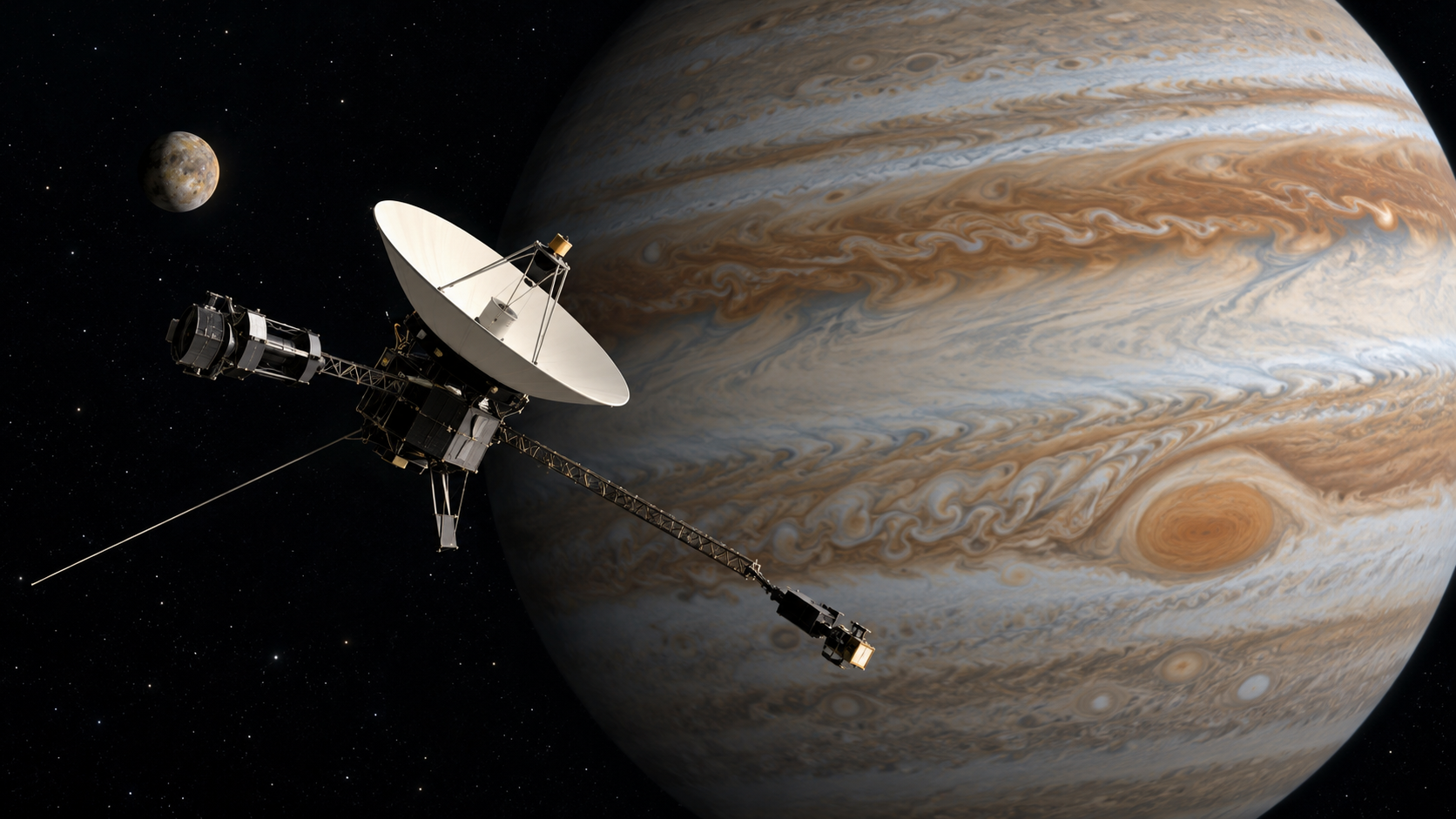
On July 9, 1979, NASA’s Voyager 2 spacecraft made its closest approach to Jupiter, passing about 645,000 kilometers above the planet’s cloud tops. It arrived four months after Voyager 1, using a different trajectory to continue the first detailed reconnaissance of the giant planet, its moons, rings, magnetic field, and radiation environment.
Voyager 2’s cameras revealed moving atmospheric systems and returned additional views of Jupiter’s faint ring. It observed active volcanoes on Io, a discovery first made in Voyager 1 images, and examined the icy surfaces of Europa, Ganymede, and Callisto. Instruments measured charged particles, fields, ultraviolet emissions, and temperature structure.
The encounter depended on precise celestial navigation and a gravity assist. Jupiter’s motion bent Voyager 2’s path and increased its speed toward Saturn while also setting up the geometry that eventually enabled visits to Uranus and Neptune. Small errors at Jupiter would have multiplied across billions of kilometers.
Voyager 2 remains the only spacecraft to have visited all four giant planets. The July 1979 flyby was an early stage in that journey, showing how one planetary encounter could produce a major scientific survey and simultaneously serve as a navigation maneuver for destinations years farther away. For science history, the event also shows how evidence moves from an observation or engineered test into a durable body of knowledge. Instruments supplied measurements, specialists debated interpretation, and later work refined what the first result could mean. Archives preserve the early record while new methods let researchers ask different questions of it. That continuing revision is the process through which a dated milestone remains scientifically useful. Seen across a longer timeline, scientific milestones are junctions rather than isolated beginnings. Earlier experiments, tools, and institutions made the work possible, while later teams tested limits and carried the result into new settings. What survives is a traceable chain of evidence, correction, and application that allows one moment to remain relevant as knowledge and technology continue to change. The anniversary highlights the difference between a first result and a finished understanding. A successful observation can settle one question while opening several harder ones, and even a failed objective can reshape later designs. Preserved data, specimens, photographs, and hardware allow new generations to revisit the work with better tools. Science advances through that continuity rather than stopping on a memorable date. Its calendar date is an entry point, not an endpoint. The people involved worked with the instruments, assumptions, and social conditions of their time, and later research has both extended and corrected their conclusions. Separating what was known that day from what became clear afterward protects the history from myth and shows how cumulative evidence turns an episode into lasting scientific knowledge.
Voyager 2 followed Voyager 1 with complementary timing and geometry.
Its observations confirmed change in the atmosphere and extended coverage of the moons.
Cameras and field instruments studied rings, satellites, plasma, and radiation.
The encounter treated Jupiter as the center of a complex environment.
Jupiter redirected and accelerated Voyager 2 toward Saturn.
That carefully planned path ultimately continued to Uranus and Neptune.
Explore more of "On This Day ..."
Discover more events from the same date across news, politics, technology, sports, and other fields. Each link highlights significant moments that shaped history on different fronts.