

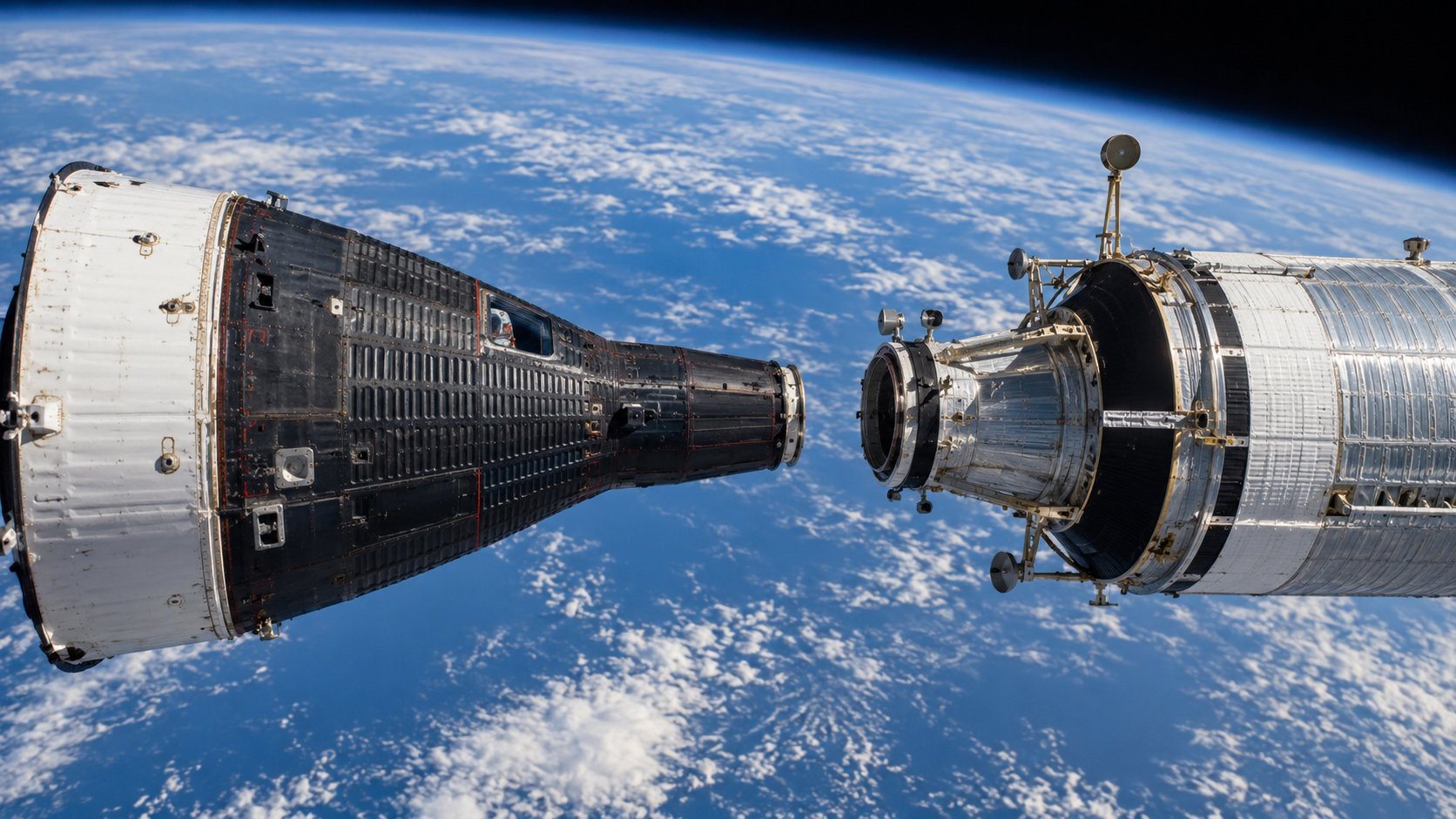
On This Day in Science: July 18, 1966
On July 18, 1966, astronauts John Young and Michael Collins launched aboard Gemini 10 from Cape Kennedy. Their two-day mission was designed to practice rendezvous, docking, high-altitude maneuvering, and extravehicular work, capabilities required before Apollo could attempt lunar landings.
Gemini 10 caught and docked with the Agena target vehicle launched earlier that day. The crew used the Agena’s engine to raise the joined spacecraft to a record altitude of more than 700 kilometers. That maneuver showed that a separately launched propulsion stage could change the orbit of a crewed vehicle after docking.
The higher orbit allowed Gemini 10 to rendezvous with the inert Agena left from Gemini 8. Collins performed two excursions: a stand-up activity through the hatch and a tethered spacewalk to retrieve a micrometeorite experiment from the older target. Working outside remained physically demanding and difficult to control.
The mission achieved the first rendezvous with two separate vehicles and expanded experience with orbital mechanics. Its challenges reinforced the need for better restraints, training, and workload planning during spacewalks. Gemini 10 turned the abstract choreography needed for Apollo into practiced flight operations. Seen across a longer timeline, scientific milestones are junctions rather than isolated beginnings. Earlier experiments, tools, and institutions made the work possible, while later teams tested limits and carried the result into new settings. What survives is a traceable chain of evidence, correction, and application that allows one moment to remain relevant as knowledge and technology continue to change. The anniversary highlights the difference between a first result and a finished understanding. A successful observation can settle one question while opening several harder ones, and even a failed objective can reshape later designs. Preserved data, specimens, photographs, and hardware allow new generations to revisit the work with better tools. Science advances through that continuity rather than stopping on a memorable date. Its calendar date is an entry point, not an endpoint. The people involved worked with the instruments, assumptions, and social conditions of their time, and later research has both extended and corrected their conclusions. Separating what was known that day from what became clear afterward protects the history from myth and shows how cumulative evidence turns an episode into lasting scientific knowledge. For science history, the event also shows how evidence moves from an observation or engineered test into a durable body of knowledge. Instruments supplied measurements, specialists debated interpretation, and later work refined what the first result could mean. Archives preserve the early record while new methods let researchers ask different questions of it. That continuing revision is the process through which a dated milestone remains scientifically useful.
Gemini 10 adjusted its path to meet an Agena launched the same day.
Docking required precise timing, navigation, and controlled closing rates.
The target vehicle raised the combined craft to a record altitude.
This demonstrated propulsion after docking with another spacecraft.
The crew also reached an older inactive Agena.
Collins retrieved an experiment while learning the limits of unsupported orbital work.
Explore more of "On This Day ..."
Discover more events from the same date across news, politics, technology, sports, and other fields. Each link highlights significant moments that shaped history on different fronts.