

How Surface Tension Shapes Droplets Explainer
Surface tension describes the energetic cost of creating more liquid surface, or equivalently the tangential force per unit length along that surface. Molecules inside a liquid are attracted by neighbors in all directions. Molecules at the boundary lack neighbors on one side, leaving their interactions unbalanced. The system can lower its energy by reducing the amount of exposed surface.
For a given volume, a sphere has the smallest surface area, so small free droplets tend toward spherical shapes. Gravity pulls downward and flattens larger droplets, while air resistance distorts falling raindrops. The competition can be summarized by comparing surface forces with gravity or inertia. Tiny droplets are surface-tension dominated; large puddles are shaped much more by gravity and their container.
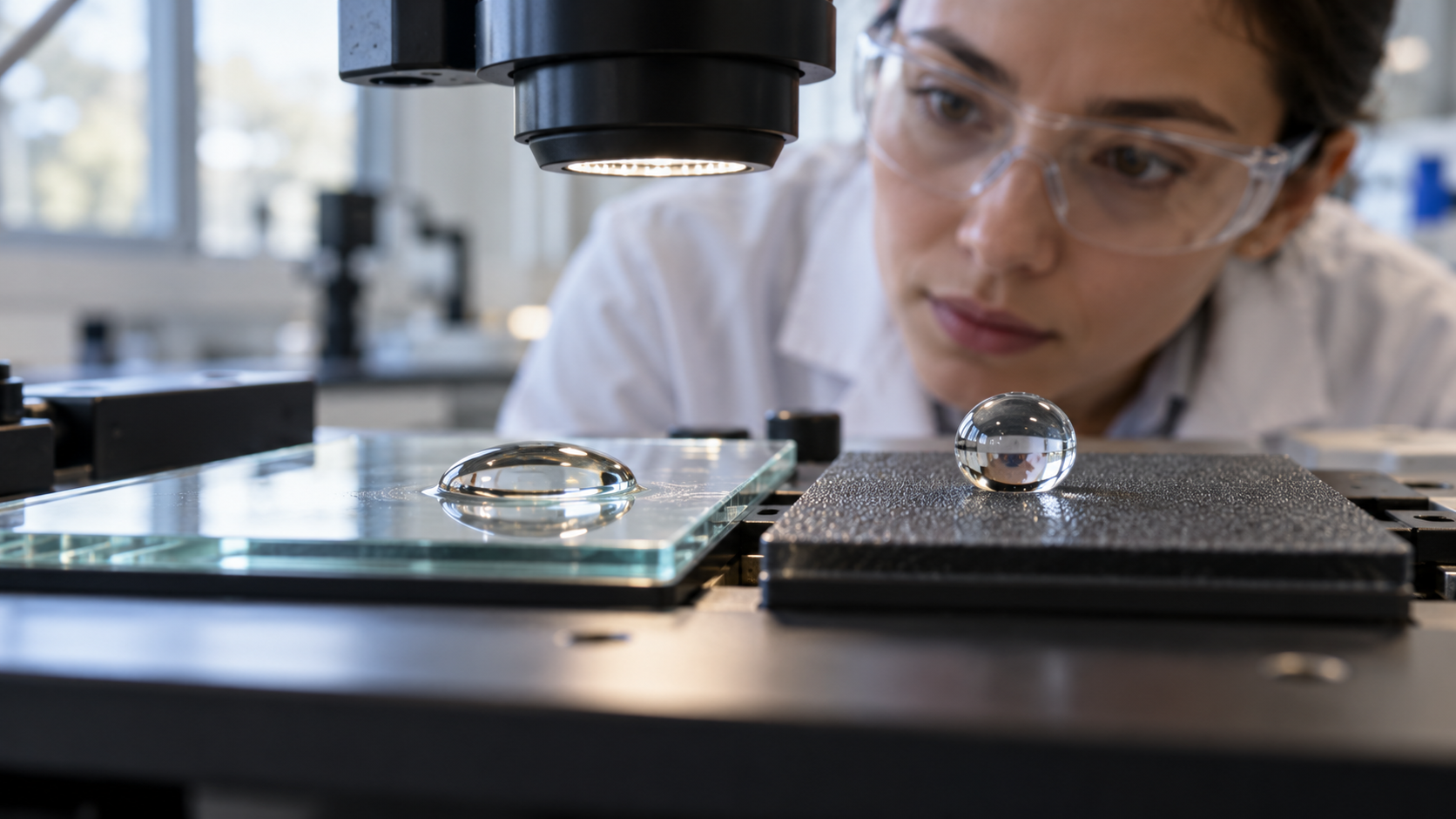
Where a droplet meets a solid, cohesion within the liquid competes with adhesion to the surface. If the liquid interacts strongly with the material, it spreads and forms a small contact angle. If the interaction is weak, it beads up. Surface roughness and chemical coatings can amplify wetting or repellency, which is why the same water behaves differently on clean glass, waxed leaves, and fabric.
Curved interfaces also create a pressure difference. A small droplet or bubble needs a larger internal pressure than a large one because surface tension acts around tighter curvature. Soap bubbles have both inner and outer surfaces, and thin-film drainage eventually weakens them. Surfactants lower surface tension and can stabilize films by changing how molecules occupy and move along the boundary.
Capillary action combines surface tension, wetting, and geometry. In a narrow tube or pore, a wetting liquid forms a curved meniscus, and the associated pressure difference can raise liquid against gravity. The effect helps move water through soils and plant tissues and governs ink, coatings, microfluidic devices, and porous materials. It does not mean the surface is a literal elastic skin.
Temperature, dissolved substances, contamination, and surface history can all change measured tension and contact angle. A photograph of a bead cannot by itself reveal one universal material property without controlled conditions. Surface tension matters because behavior at boundaries dominates small scales, explaining droplets, bubbles, sprays, foams, wetting, and the surprising ability of some insects to distribute their weight on water.
Molecules at an interface have unbalanced attractions and create a surface-energy cost.
Minimizing area makes small free droplets nearly spherical.
Gravity, inertia, and airflow increasingly distort droplets as their size or speed grows.
Contact angle reflects competition between liquid cohesion and adhesion to a solid.
Curvature creates pressure differences in droplets, bubbles, and capillary menisci.
Surfactants, temperature, contamination, texture, and coatings alter interfacial behavior.
Explore more "Explainers"
Discover additional explainers across politics, science, business, technology, and other fields. Each explainer breaks down a complex idea into clear, everyday language—helping you better understand how major concepts, systems, and debates shape the world around us.