

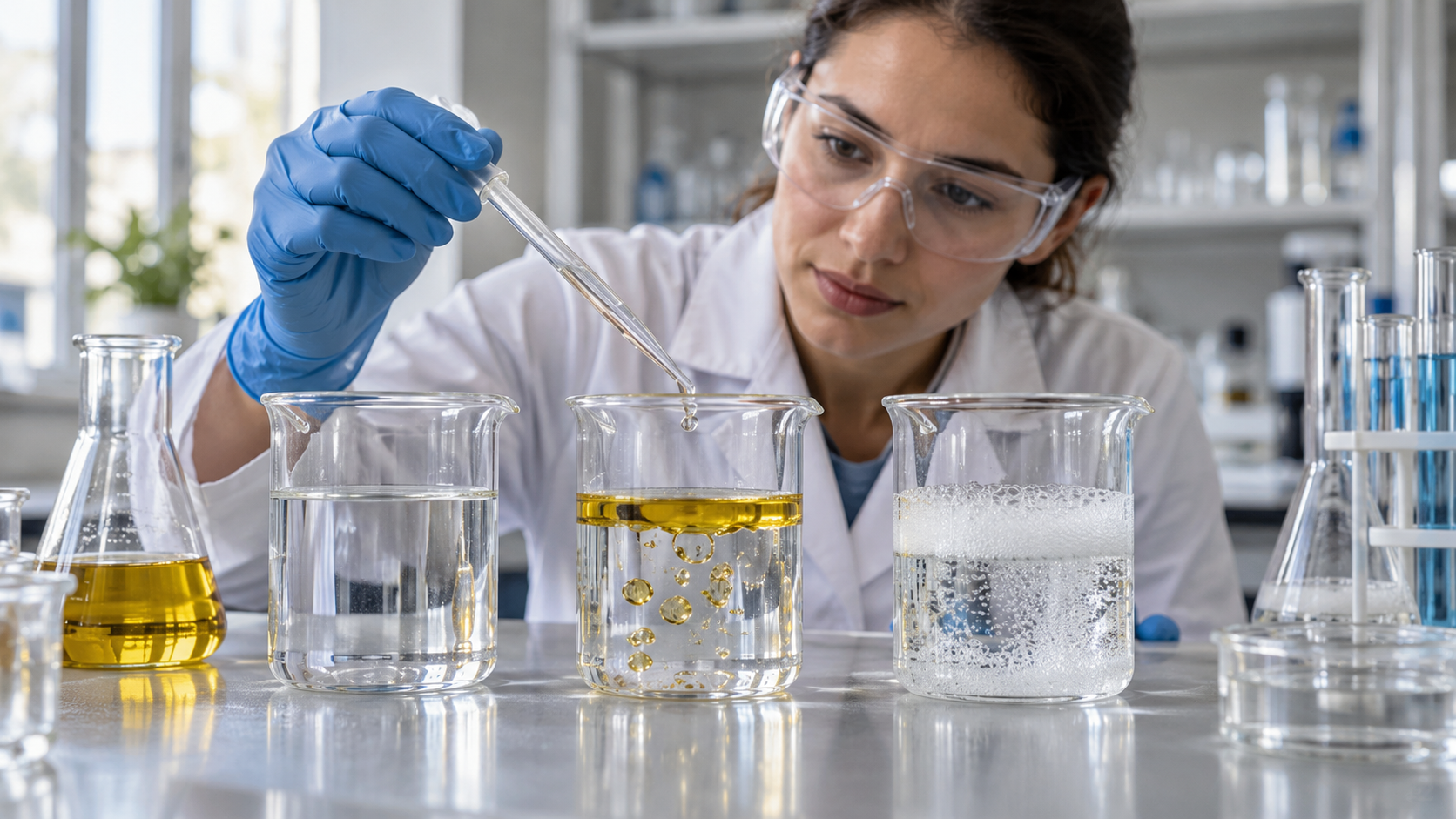
How Soap Removes Grease Explainer
Water does not readily wash away grease because polar water molecules attract one another while nonpolar oils prefer their own company. Soap solves this mismatch with surfactant molecules that have two contrasting regions. Their charged or polar heads interact with water, while their hydrocarbon tails interact with oils and other nonpolar material. This dual structure lets soap gather at boundaries between water, air, surfaces, and grease.
At a greasy surface, surfactant tails insert into the oil while the heads remain in water. The molecules reduce water’s surface tension and lower the energetic cost of spreading water across the material. Agitation adds mechanical work, breaking a large greasy film into smaller droplets and exposing more boundary where surfactants can act. Warmth can soften fats, although chemistry and fabric limits determine a safe temperature.
Above a characteristic concentration, many surfactants assemble into micelles. In a simple picture, the oil-attracting tails face inward and the water-attracting heads face outward. Grease can be incorporated into the hydrophobic interior or held among surfactant layers on a droplet. The coated material remains dispersed in water instead of quickly settling back onto the cleaned surface.
Rinsing removes the suspended droplets, micelles, loosened particles, and excess surfactant. Builders, enzymes, alkalinity regulators, and other detergent ingredients can soften water, break down proteins or starches, keep particles dispersed, or improve performance at lower temperature. A cleaning product is therefore usually a formulated system, not simply a container of one surfactant.
Traditional soap is produced when fats react with a strong base, yielding fatty-acid salts and glycerol. Calcium and magnesium ions in hard water can form insoluble salts with soap, creating scum and reducing cleaning efficiency. Many synthetic detergents use head groups that remain more soluble in hard water. Both families still rely on amphiphilic molecules and interfacial chemistry.
More foam does not necessarily mean more cleaning. Foam depends on air-water films, formulation, water chemistry, and agitation, while grease removal depends on wetting, molecular interactions, suspension, time, and rinsing. Surfactants can also irritate skin or affect aquatic environments at sufficient exposure. Soap works because molecular architecture helps water contact, divide, stabilize, and transport material it could not carry efficiently alone.
Surfactants pair a water-attracting head with an oil-attracting tail.
They lower surface tension so water spreads more easily over greasy surfaces.
Agitation divides grease into droplets and increases the area surfactants can cover.
Micelles and coated droplets keep oily material suspended until rinsing.
Hard-water ions can precipitate traditional soap, while many detergents remain soluble.
Foam is not a direct measure of cleaning power or environmental safety.
Explore more "Explainers"
Discover additional explainers across politics, science, business, technology, and other fields. Each explainer breaks down a complex idea into clear, everyday language—helping you better understand how major concepts, systems, and debates shape the world around us.