

On This Day in Science: August 1, 1774
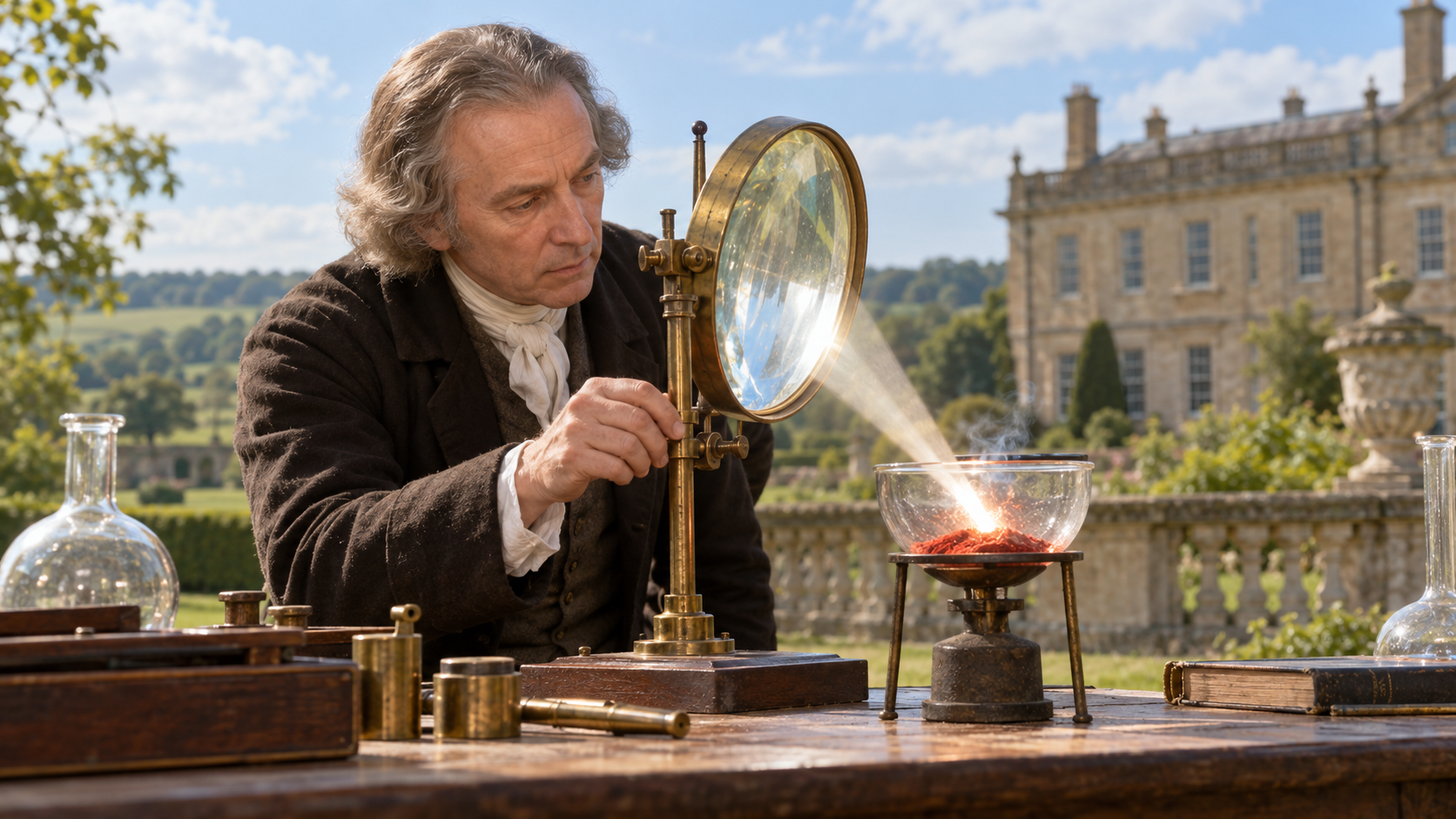
On August 1, 1774, Joseph Priestley heated red mercuric oxide with sunlight focused through a large burning lens at Bowood House in Wiltshire, England. The experiment released a gas in which a candle burned unusually brightly and a mouse survived longer than it did in ordinary air. Priestley called the substance “dephlogisticated air,” using the dominant theory of combustion at the time.
Priestley was an exceptionally inventive experimenter with gases, which he called airs. He collected them over liquids and compared how they supported burning, breathing, and chemical reactions. The new gas was not immediately named oxygen, and Priestley did not abandon phlogiston theory. His measurements nevertheless provided reproducible evidence that ordinary air was a mixture rather than a single element.
Carl Wilhelm Scheele had independently prepared oxygen earlier but published later. Antoine Lavoisier interpreted oxygen within a new theory of combustion and helped give the element its name. The episode therefore was not a solitary discovery with an instant modern meaning; experiment, priority, publication, and theoretical interpretation were divided among several investigators.
Priestley’s August experiment became a landmark because it joined careful apparatus with a result that existing theory struggled to explain. The work helped open modern pneumatic chemistry and supported the wider chemical revolution in which mass, composition, and reaction replaced older qualitative accounts. For science history, the event also shows how evidence moves from an observation or engineered test into a durable body of knowledge. Instruments supplied measurements, specialists debated interpretation, and later work refined what the first result could mean. Archives preserve the early record while new methods let researchers ask different questions of it. That continuing revision is the process through which a dated milestone remains scientifically useful. Seen across a longer timeline, scientific milestones are junctions rather than isolated beginnings. Earlier experiments, tools, and institutions made the work possible, while later teams tested limits and carried the result into new settings. What survives is a traceable chain of evidence, correction, and application that allows one moment to remain relevant as knowledge and technology continue to change. The anniversary highlights the difference between a first result and a finished understanding. A successful observation can settle one question while opening several harder ones, and even a failed objective can reshape later designs. Preserved data, specimens, photographs, and hardware allow new generations to revisit the work with better tools. Science advances through that continuity rather than stopping on a memorable date. Its calendar date is an entry point, not an endpoint. The people involved worked with the instruments, assumptions, and social conditions of their time, and later research has both extended and corrected their conclusions. Separating what was known that day from what became clear afterward protects the history from myth and shows how cumulative evidence turns an episode into lasting scientific knowledge.
Priestley concentrated sunlight onto mercuric oxide inside a sealed vessel.
The heated material released a gas that supported combustion unusually well.
The experiment showed that different gases could have distinct chemical properties.
Ordinary air could no longer be treated as one simple substance.
Scheele made oxygen independently and Lavoisier supplied a new theoretical framework.
Modern chemistry emerged through experiments, arguments, and revised language.
Explore more of "On This Day ..."
Discover more events from the same date across news, politics, technology, sports, and other fields. Each link highlights significant moments that shaped history on different fronts.