

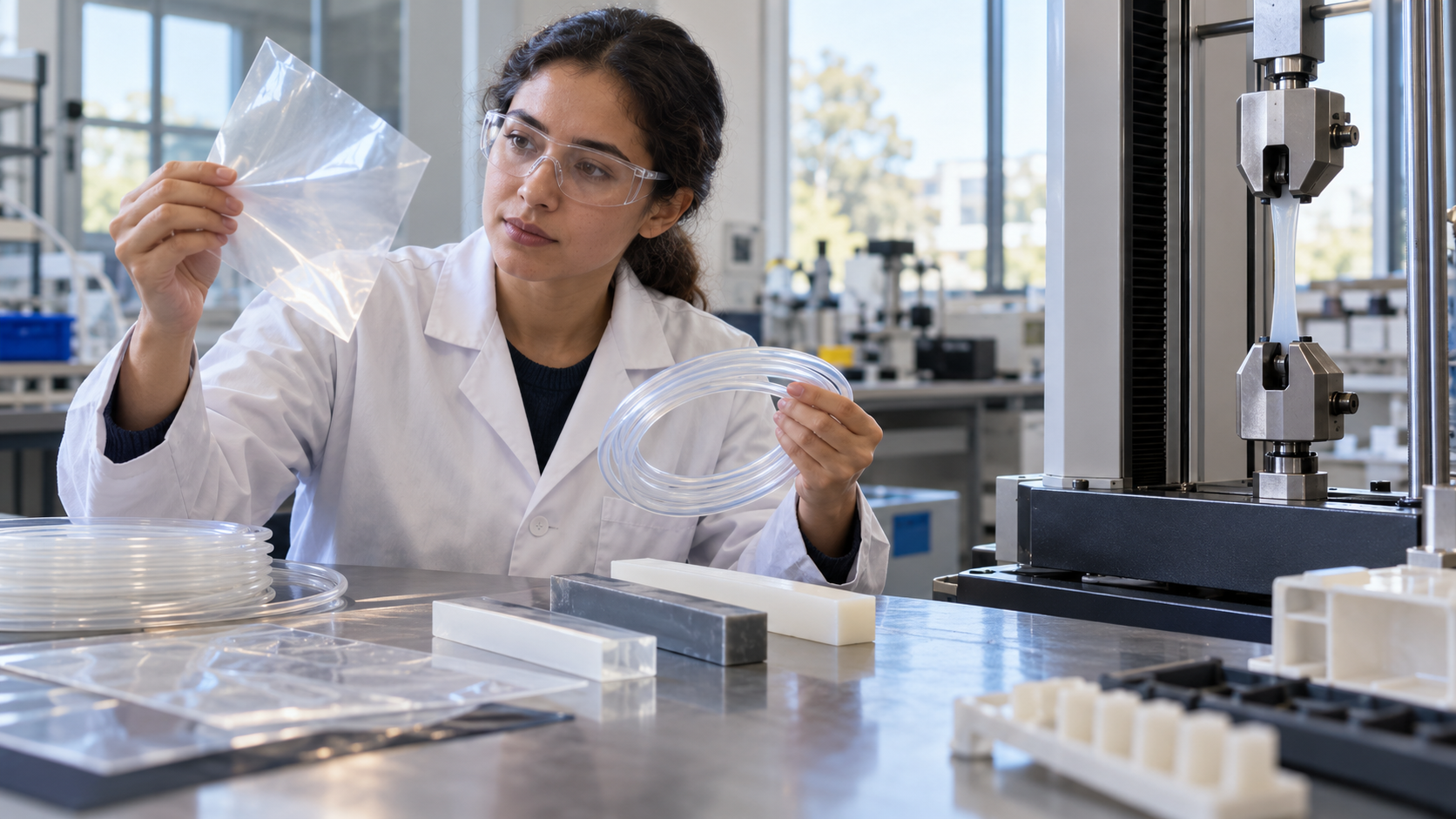
How Polymer Structure Controls Material Properties Explainer
A polymer is a large molecule made from many repeating building blocks called monomers. Plastics, rubbers, fibers, proteins, and DNA are all polymers, although their chemistry and structures differ greatly. A material’s behavior cannot be predicted from the repeating unit alone. Chain length, branching, orientation, interactions, additives, and processing history all influence how the chains pack and move.
Long chains become entangled like cooked noodles, resisting separation and giving a material toughness and melt viscosity. Linear chains may pack closely, while branching can prevent efficient packing. Strong attractions between chains raise the energy needed for motion. Copolymers combine different monomers in blocks, random sequences, or grafts, creating domains or interfaces that can balance stiffness, flexibility, adhesion, and impact resistance.
Many polymers contain both ordered crystalline regions and disordered amorphous regions. Greater crystallinity can increase stiffness, density, chemical resistance, and melting behavior, but it may reduce transparency or flexibility. Amorphous chain segments undergo a glass transition: below that temperature they move slowly and may be rigid or brittle; above it they have greater mobility and behave more rubber-like.
Crosslinks connect chains into a network. A few crosslinks help rubber spring back after stretching, while dense networks produce hard thermosets that do not melt and flow again. Thermoplastics lack permanent network-wide crosslinks and can usually be softened and reshaped, though heating can still degrade them. Plasticizers increase chain mobility, fillers reinforce or reduce cost, and stabilizers slow damage from heat or light.
Manufacturing aligns and freezes structure. Drawing a fiber or film can orient chains and greatly strengthen one direction. Cooling rate changes crystallinity, and molding leaves residual stress. Repeated load, heat, oxygen, ultraviolet light, solvents, and moisture can cut chains, change crosslinks, or encourage cracks. The same named polymer can therefore appear in products with very different performance.
Recycling is complicated because polymers with different chemistry often do not mix, additives are difficult to identify, and each processing cycle may change chain length or contamination. Sorting by molecular composition improves the quality of recycled feedstock. Polymer science matters because macroscopic properties are engineered through molecular architecture and processing, not because plastic is one interchangeable substance.
Polymers are long chains whose repeating units do not alone determine behavior.
Chain length, entanglement, branching, and intermolecular forces control motion and strength.
Crystalline and amorphous regions contribute different mechanical and optical properties.
Glass transition marks a change in mobility; melting applies to ordered regions.
Crosslinks, plasticizers, fillers, and stabilizers tune elasticity, rigidity, and durability.
Processing history and mixed additives complicate identification and recycling.
Explore more "Explainers"
Discover additional explainers across politics, science, business, technology, and other fields. Each explainer breaks down a complex idea into clear, everyday language—helping you better understand how major concepts, systems, and debates shape the world around us.