

How Concrete Hardens Explainer
Concrete is a composite of aggregate held together by cement paste. After water is added, minerals in hydraulic cement undergo hydration reactions and form new solid products. Concrete does not harden mainly because water evaporates. Water is a reactant, and enough moisture must remain available for hydration to continue and develop strength, lower permeability, and connect the paste around sand and stone.
Early reactions begin quickly, followed by a quieter period that gives workers time to mix, transport, place, and finish the material. Hydration then accelerates and releases heat. Calcium silicate hydrate forms a nanoscale binding phase that fills space and adheres to particles, while calcium hydroxide and aluminate-bearing products also develop. Setting marks loss of plastic workability; hardening continues long afterward.
The water-to-cementitious-material ratio strongly affects the resulting pore structure. Too little water may leave cement inaccessible to complete hydration, while excess water occupies space and later leaves connected capillary pores as it moves or evaporates. Lower porosity generally supports higher strength and durability, but a workable mixture also needs proper placement and consolidation so trapped air and voids are controlled.
Curing maintains suitable moisture and temperature near the concrete surface. Wet coverings, membranes, curing compounds, or internal water reservoirs reduce early drying. If the surface loses water too quickly, hydration slows and shrinkage can produce cracking or a weak, permeable layer. Cold slows reactions, while high early temperature can accelerate initial strength yet create gradients or reduce later performance.
Aggregate restrains paste shrinkage and carries much of the load, but its size, grading, shape, cleanliness, and bond with paste matter. Supplementary cementitious materials and admixtures can change reaction rate, workability, pore structure, heat, and durability. Reinforcing steel carries tension because concrete is strong in compression but comparatively weak and brittle in tension.
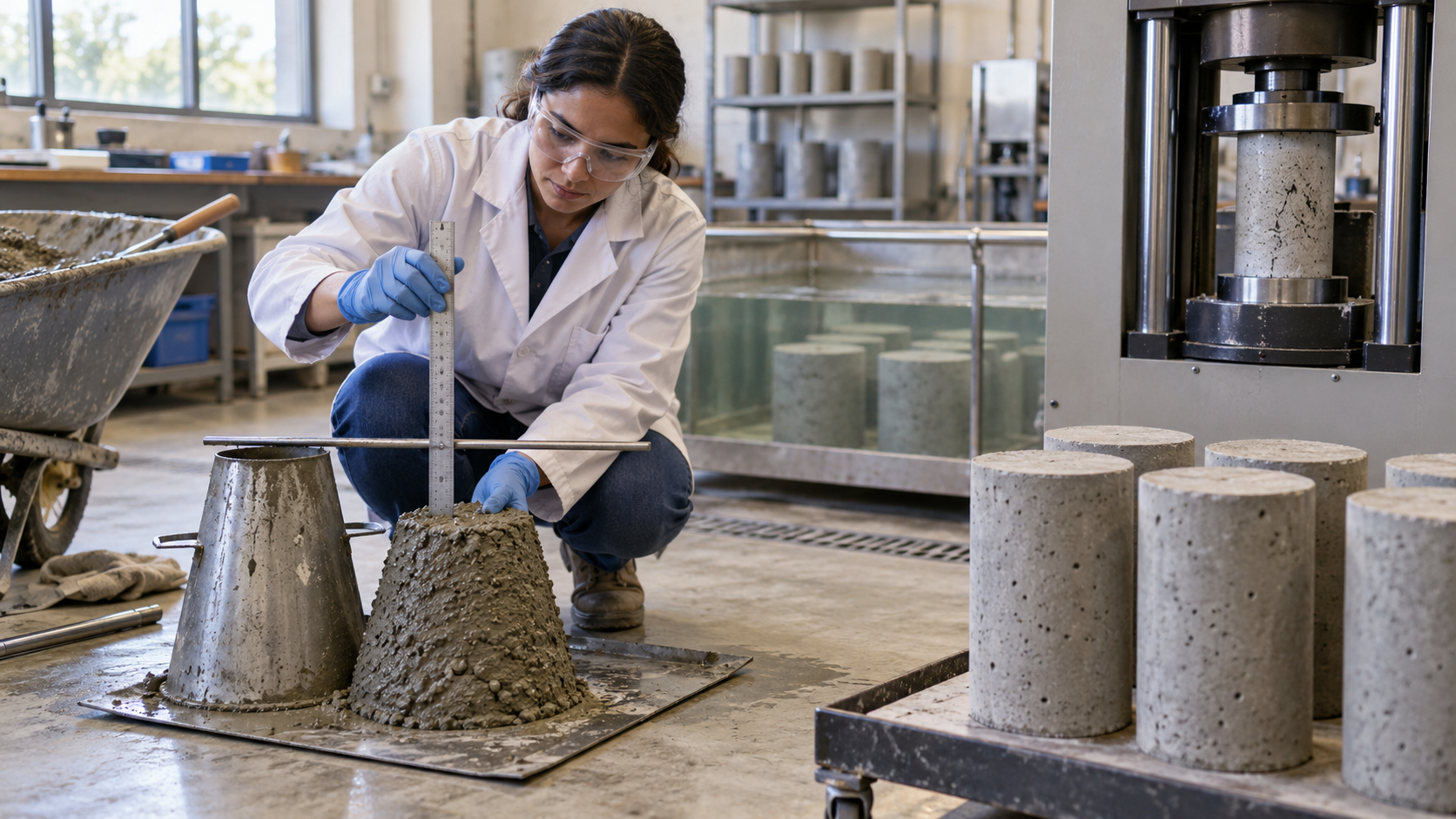
Concrete properties continue to evolve with hydration, drying, temperature, chemical exposure, and loading. A hard surface does not prove the interior was properly consolidated or cured. Tests of cylinders, moisture, temperature history, and field conditions provide different evidence. Concrete hardens through a coupled chemical and structural process whose outcome depends on mixture proportions, construction, curing, geometry, and environment.
Hydraulic cement minerals react with water rather than simply drying in place.
Calcium silicate hydrate forms much of the binding matrix between aggregate particles.
Water ratio and consolidation determine capillary porosity and many later properties.
Curing preserves moisture and temperature so hydration can continue near exposed surfaces.
Early heat, drying, restraint, and low tensile capacity can create cracking.
Mixture design, aggregate, admixtures, placement, curing, and environment jointly control performance.
Explore more "Explainers"
Discover additional explainers across politics, science, business, technology, and other fields. Each explainer breaks down a complex idea into clear, everyday language—helping you better understand how major concepts, systems, and debates shape the world around us.