

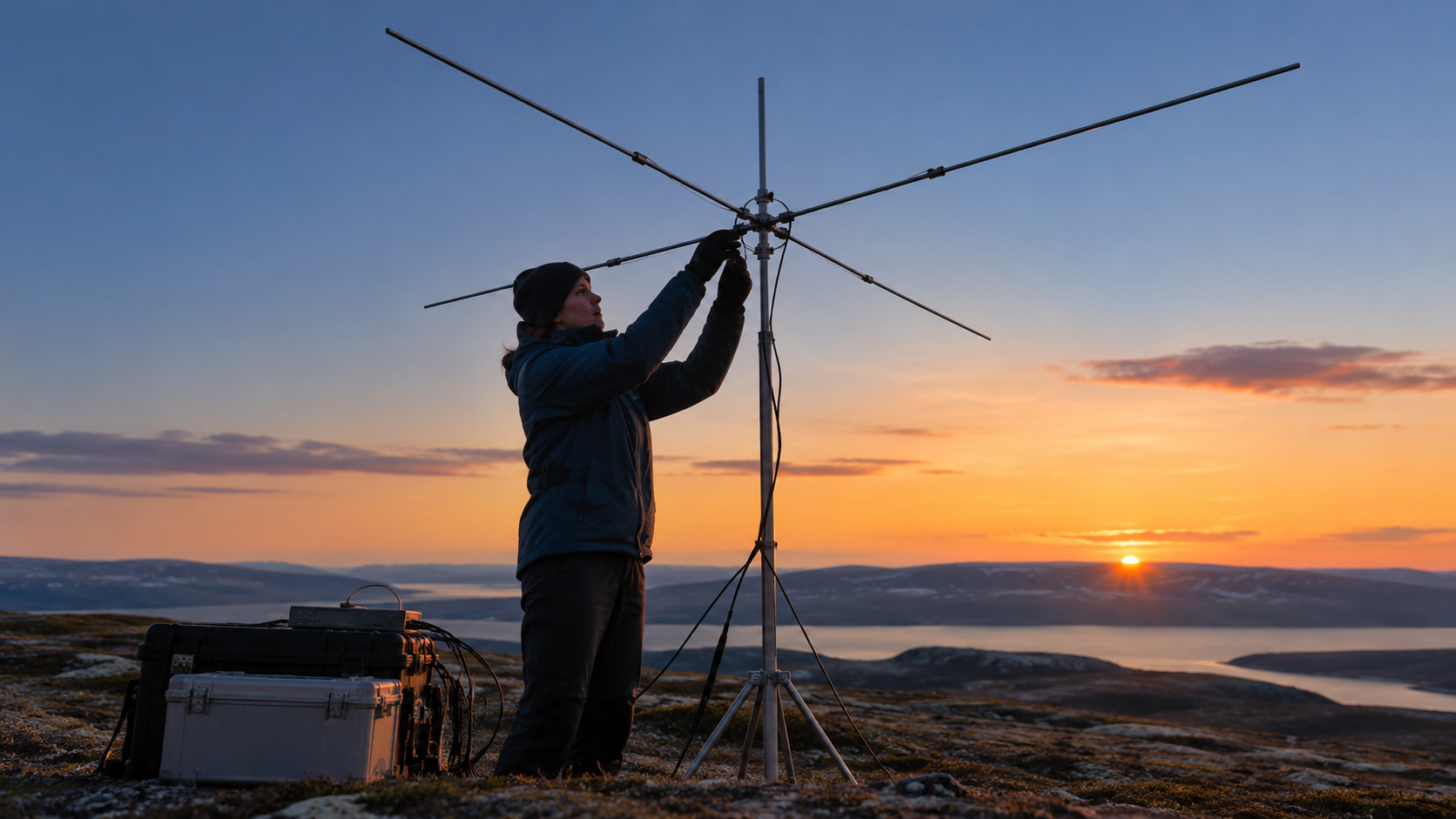
How the Ionosphere Bends Radio Waves Explainer
The ionosphere is a region of Earth’s upper atmosphere where solar ultraviolet and X-ray radiation ionizes atoms and molecules, leaving free electrons and positive ions. It is not a hard reflecting shell and its boundaries shift. Electron density generally varies with altitude, sunlight, season, latitude, geomagnetic activity, and atmospheric conditions, producing several overlapping regions rather than permanent uniform layers.
A radio wave drives the free electrons into oscillation. Their response changes the plasma’s refractive index, so the wave’s phase speed and path differ from those in neutral air. If electron density changes gradually with height, a suitable wave can bend continuously until its path returns toward the ground. The familiar phrase “reflection from the ionosphere” often describes this cumulative refraction.
Frequency is crucial. Lower high-frequency radio waves are bent more strongly, while sufficiently high frequencies usually pass through to satellites and space. If the frequency is too low, collisions between electrons and neutral particles can absorb substantial energy, especially in the lower ionosphere. Launch angle, polarization, electron-density profile, and Earth’s magnetic field also affect propagation.
A returned wave can reach far beyond the direct line of sight, creating skywave communication. The first point at which it returns defines a skip distance, leaving a zone where that transmitter may not be heard by either ground wave or skywave. Multiple hops between Earth and the ionosphere can extend range, but fading occurs when waves following different paths interfere.
Daylight increases ionization, and the lower absorbing region weakens after sunset, so usable paths change between day and night. Solar flares can suddenly increase X-rays and disrupt the sunlit ionosphere; geomagnetic storms can reorganize electron density and cause irregular fading. Measurements from ionosondes, beacons, radar, and navigation satellites help operators estimate conditions rather than guarantee a path.
The ionosphere affects broadcast, emergency, aviation, maritime, radar, astronomy, and satellite-navigation signals. At navigation frequencies it usually delays and distorts signals instead of returning them to the ground, so receivers use models or multiple frequencies for correction. The main lesson is selective, variable plasma refraction—not a mirror in the sky that reflects every radio signal equally.
Solar radiation creates free electrons and ions in the upper atmosphere.
Electron-density gradients change refractive index and curve some radio paths.
Frequency, launch angle, polarization, collisions, and magnetic field affect propagation.
Some high-frequency signals return beyond the horizon while higher frequencies pass through.
Day-night cycles, solar flares, and geomagnetic storms change usable paths.
The ionosphere can refract, absorb, delay, rotate, and scintillate different radio signals.
Explore more "Explainers"
Discover additional explainers across politics, science, business, technology, and other fields. Each explainer breaks down a complex idea into clear, everyday language—helping you better understand how major concepts, systems, and debates shape the world around us.