

How the Cosmic Microwave Background Reveals the Early Universe Explainer
The cosmic microwave background, or CMB, is the oldest electromagnetic radiation that astronomers can observe directly. It comes from an era roughly 380,000 years after the hot early universe began expanding. Before then, matter was largely an ionized plasma. Free electrons scattered photons repeatedly, so light could not travel far and the universe behaved like an opaque glowing fog.
As expansion continued, the plasma cooled enough for electrons to combine with nuclei and form neutral atoms. The sharp drop in free electrons let photons travel largely unimpeded, a transition called recombination or photon decoupling. Those photons did not originate at one surrounding wall. They arrive from every direction because every observable region passed through the same physical transition.
Cosmic expansion stretched the photons’ wavelengths by about a thousandfold. Radiation released at visible and near-infrared wavelengths is now detected mainly as microwaves with a temperature near 2.7 kelvin. Its spectrum is extremely close to a blackbody, strong evidence that the early matter and radiation were once in thermal equilibrium during a hot, dense phase.
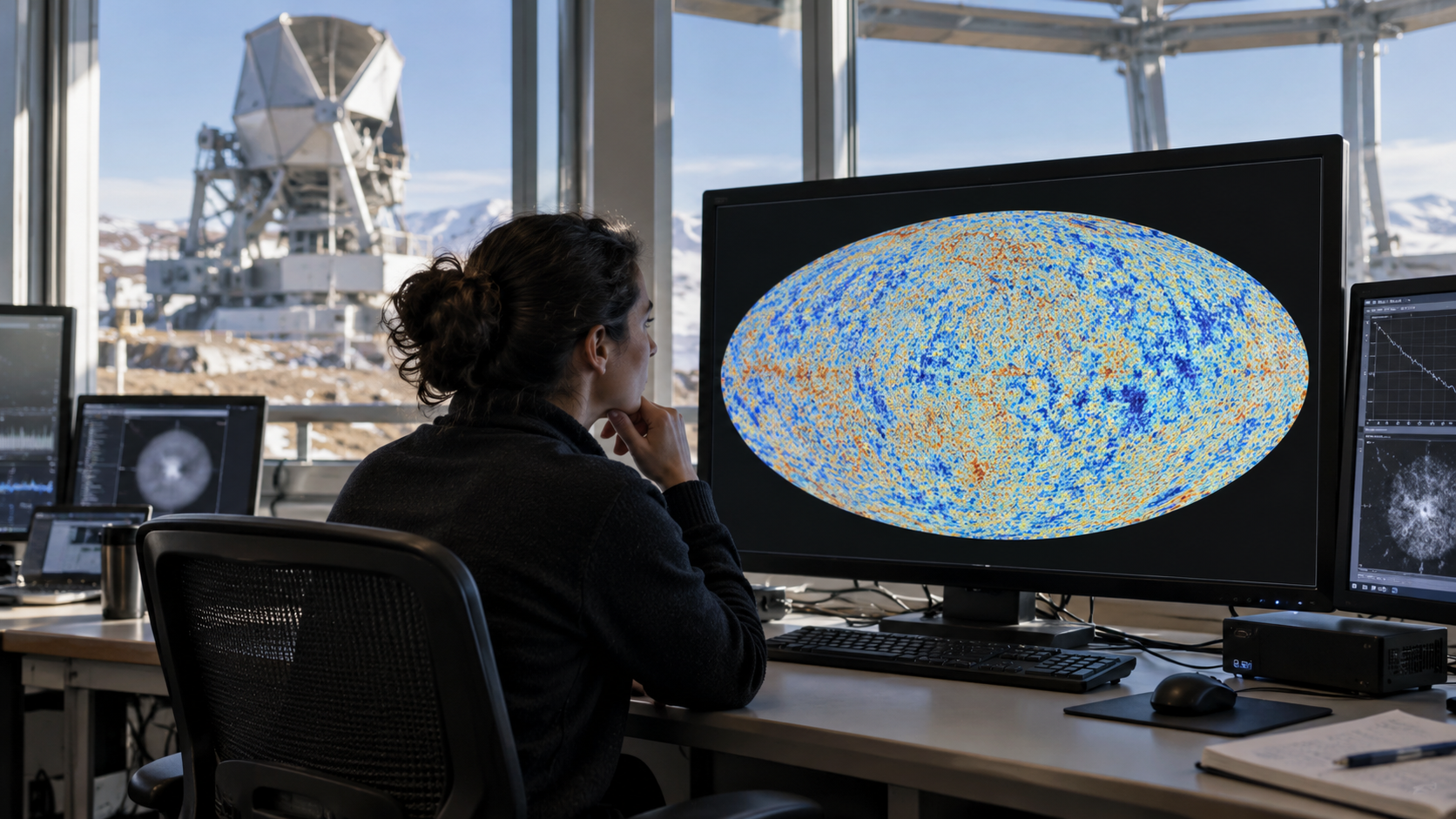
The CMB is almost uniform, but its temperature varies by only tens of millionths of a degree across the sky. These anisotropies trace small differences in density, motion, and gravitational potential. Sound waves in the early plasma produced a characteristic pattern of angular scales. The pattern’s peaks encode the geometry and contents of the universe and the conditions that seeded later structure.
Microwave light is also polarized. Temperature and polarization maps test models of recombination, early fluctuations, reionization, and possible primordial gravitational effects. Telescopes observe at many frequencies because our galaxy emits microwave radiation from dust, electrons, and spinning grains. Teams model and remove those foregrounds while checking instruments, scan patterns, calibration, and independent experiments.
CMB measurements support a universe containing ordinary matter, dark matter, and dark energy, but conclusions depend on a cosmological model and other data. The CMB is not a photograph of the beginning itself and cannot show earlier opaque epochs directly. It is a precise fossil radiation field whose spectrum, tiny variations, and polarization connect early-universe physics to galaxies seen today.
The hot early universe was opaque because free electrons repeatedly scattered photons.
Recombination removed most free electrons and allowed radiation to travel freely.
Expansion redshifted that radiation into a nearly perfect 2.7-kelvin microwave spectrum.
Tiny temperature anisotropies trace early density, velocity, and gravitational variations.
Angular peaks and polarization constrain geometry, contents, and ionization history.
Multi-frequency observations separate the CMB from galactic and instrumental foregrounds.
Explore more "Explainers"
Discover additional explainers across politics, science, business, technology, and other fields. Each explainer breaks down a complex idea into clear, everyday language—helping you better understand how major concepts, systems, and debates shape the world around us.