

How Astronomers Measure the Expansion of the Universe Explainer
Cosmic expansion means that, on sufficiently large scales, distances between galaxies carried with the cosmic flow increase over time. Astronomers do not watch a single galaxy visibly move during one observing run. They compare the wavelengths of identifiable spectral features with independently estimated distances for many galaxies. The relationship between recession and distance reveals an expansion rate rather than an explosion from one central point.
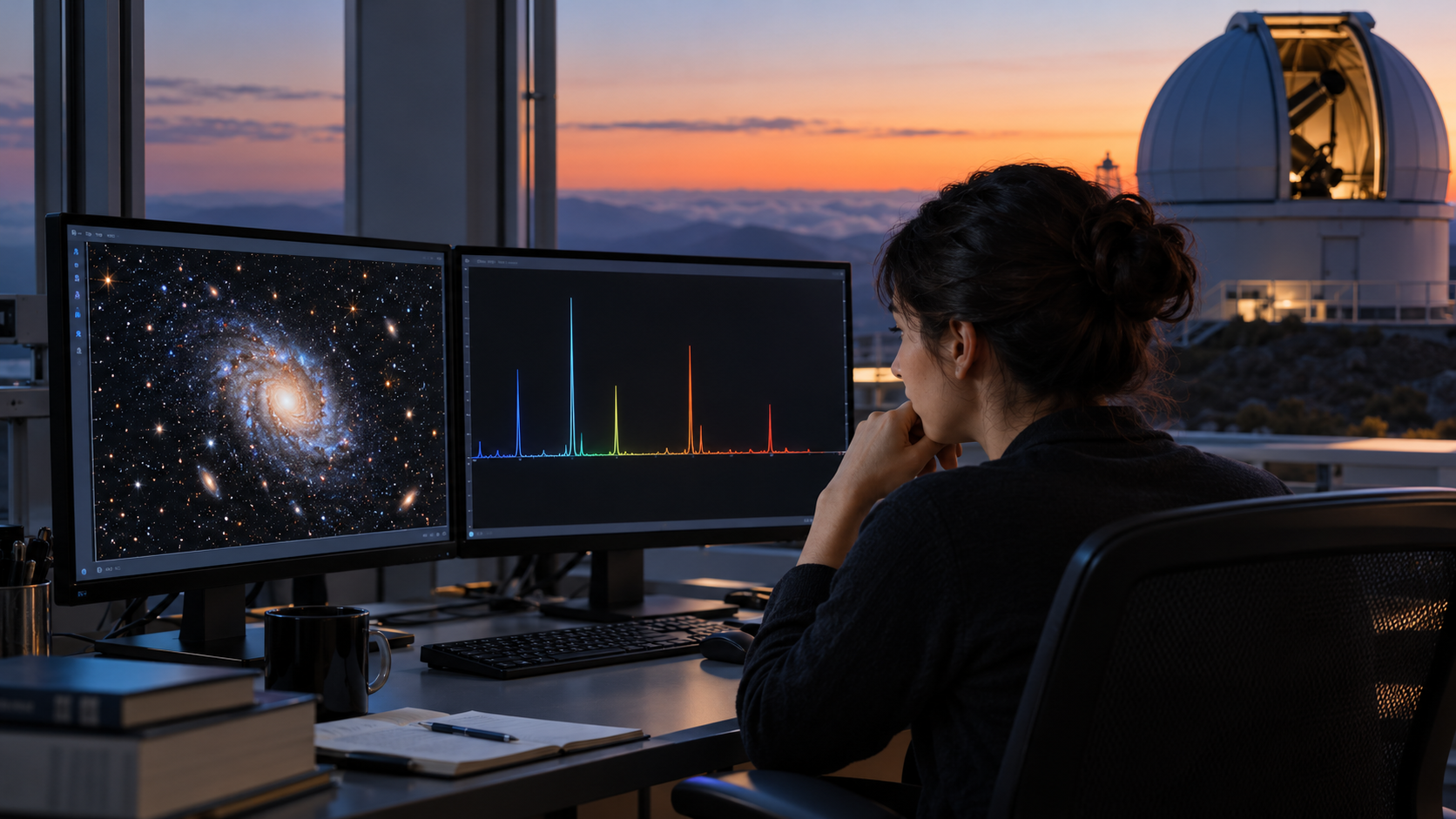
Atoms produce spectral lines at known laboratory wavelengths. In distant galaxies those patterns are shifted toward longer wavelengths, yielding a redshift. Nearby galaxies also have local motions caused by gravitational interactions, so one object may not follow the smooth trend. Over larger samples and distances, cosmological redshift reflects the stretching of light as space expands, interpreted through relativity and a cosmological model.
Redshift alone does not provide the calibration. Astronomers build a distance ladder from overlapping methods. Parallax establishes nearby stellar distances; stars with predictable luminosities calibrate more distant galaxies; and Type Ia supernovae extend comparisons much farther. Other approaches, including masers, surface-brightness methods, gravitational lenses, and early-universe sound-scale measurements, provide cross-checks with different assumptions.
For relatively nearby cosmic distances, recession rate is approximately proportional to distance, summarized by the Hubble-Lemaître law. The constant of proportionality is the present expansion rate. At very large redshift, the relation is not simply linear because the expansion rate has changed over cosmic history and because light has traveled while the universe evolved.
Supernova brightness versus redshift showed that expansion has accelerated in the recent universe. Teams fit observations to models containing matter, radiation, spatial geometry, and dark energy. Dust, stellar populations, detector calibration, sample selection, gravitational lensing, and the physics of standard candles can bias results, so analyses use blind procedures, simulations, independent instruments, and explicit uncertainty budgets.
Different measurement routes currently provide a valuable test of both calibration and cosmology when they disagree. No single plot directly measures every epoch or identifies the cause of acceleration. The evidence for expansion rests on consistent redshift-distance patterns and multiple probes, while the exact present rate and the nature of dark energy remain active research questions rather than settled by one telescope.
Known spectral lines reveal galaxy redshift relative to laboratory wavelengths.
Local galaxy motions add scatter, so expansion emerges statistically across large samples.
Parallax, variable stars, supernovae, masers, and other methods form overlapping distance scales.
The nearby redshift-distance relation yields the present expansion rate.
High-redshift observations require models of how expansion changed through cosmic history.
Independent probes and uncertainty budgets test calibration, acceleration, and cosmological assumptions.
Explore more "Explainers"
Discover additional explainers across politics, science, business, technology, and other fields. Each explainer breaks down a complex idea into clear, everyday language—helping you better understand how major concepts, systems, and debates shape the world around us.