

On This Day in Science: September 19, 1991
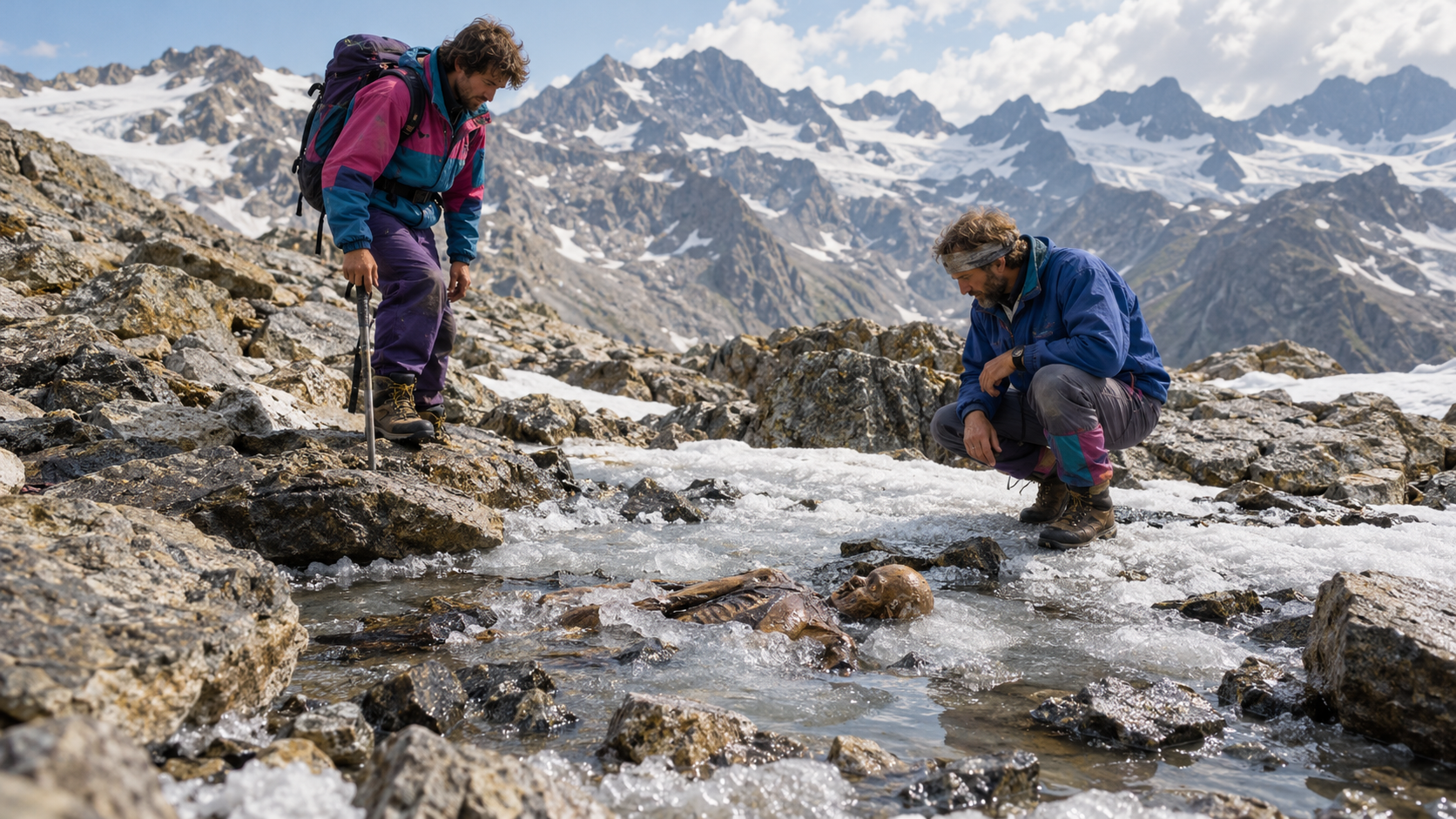
On September 19, 1991, hikers Erika and Helmut Simon noticed a human body emerging from melting ice in the Ötztal Alps near the Austrian-Italian border. Authorities initially assumed it was a recent mountaineering fatality. Archaeologists soon recognized that the remains and associated objects were ancient, dating to more than five thousand years ago.
The cold, dry, and protected setting had naturally mummified the man now called Ötzi. His clothing included garments of hide, leather, grass, and fur. Nearby equipment included a copper-bladed axe, unfinished longbow, quiver, flint tools, containers, and materials for making fire, an unusually complete survival kit from the Copper Age.
Medical imaging, isotopes, DNA, microscopy, and chemical analyses have reconstructed parts of his life and death. Researchers have examined his diet, ancestry, illnesses, injuries, tattoos, travel, and final meals. An arrow wound in his shoulder and other trauma indicate a violent death, though the full sequence remains uncertain.
The discovery turned one individual into a multidisciplinary archive, but preservation requires strict temperature and humidity control. Continuing research must balance new sampling against irreversible damage, showing how archaeological science depends on both analytical opportunity and careful stewardship. The anniversary highlights the difference between a first result and a finished understanding. A successful observation can settle one question while opening several harder ones, and even a failed objective can reshape later designs. Preserved data, specimens, photographs, and hardware allow new generations to revisit the work with better tools. Science advances through that continuity rather than stopping on a memorable date. Its calendar date is an entry point, not an endpoint. The people involved worked with the instruments, assumptions, and social conditions of their time, and later research has both extended and corrected their conclusions. Separating what was known that day from what became clear afterward protects the history from myth and shows how cumulative evidence turns an episode into lasting scientific knowledge. For science history, the event also shows how evidence moves from an observation or engineered test into a durable body of knowledge. Instruments supplied measurements, specialists debated interpretation, and later work refined what the first result could mean. Archives preserve the early record while new methods let researchers ask different questions of it. That continuing revision is the process through which a dated milestone remains scientifically useful. Seen across a longer timeline, scientific milestones are junctions rather than isolated beginnings. Earlier experiments, tools, and institutions made the work possible, while later teams tested limits and carried the result into new settings. What survives is a traceable chain of evidence, correction, and application that allows one moment to remain relevant as knowledge and technology continue to change.
The exposed body first appeared to be a recently lost climber.
Its equipment and preservation soon revealed a far older archaeological discovery.
Clothing, weapons, containers, cordage, and fire-making materials survived together.
The group offers rare evidence of daily technology rather than a single isolated artifact.
Imaging and tiny samples reveal diet, disease, ancestry, wounds, and movement.
Conservation limits are essential because every invasive test consumes irreplaceable material.
Explore more of "On This Day ..."
Discover more events from the same date across news, politics, technology, sports, and other fields. Each link highlights significant moments that shaped history on different fronts.