

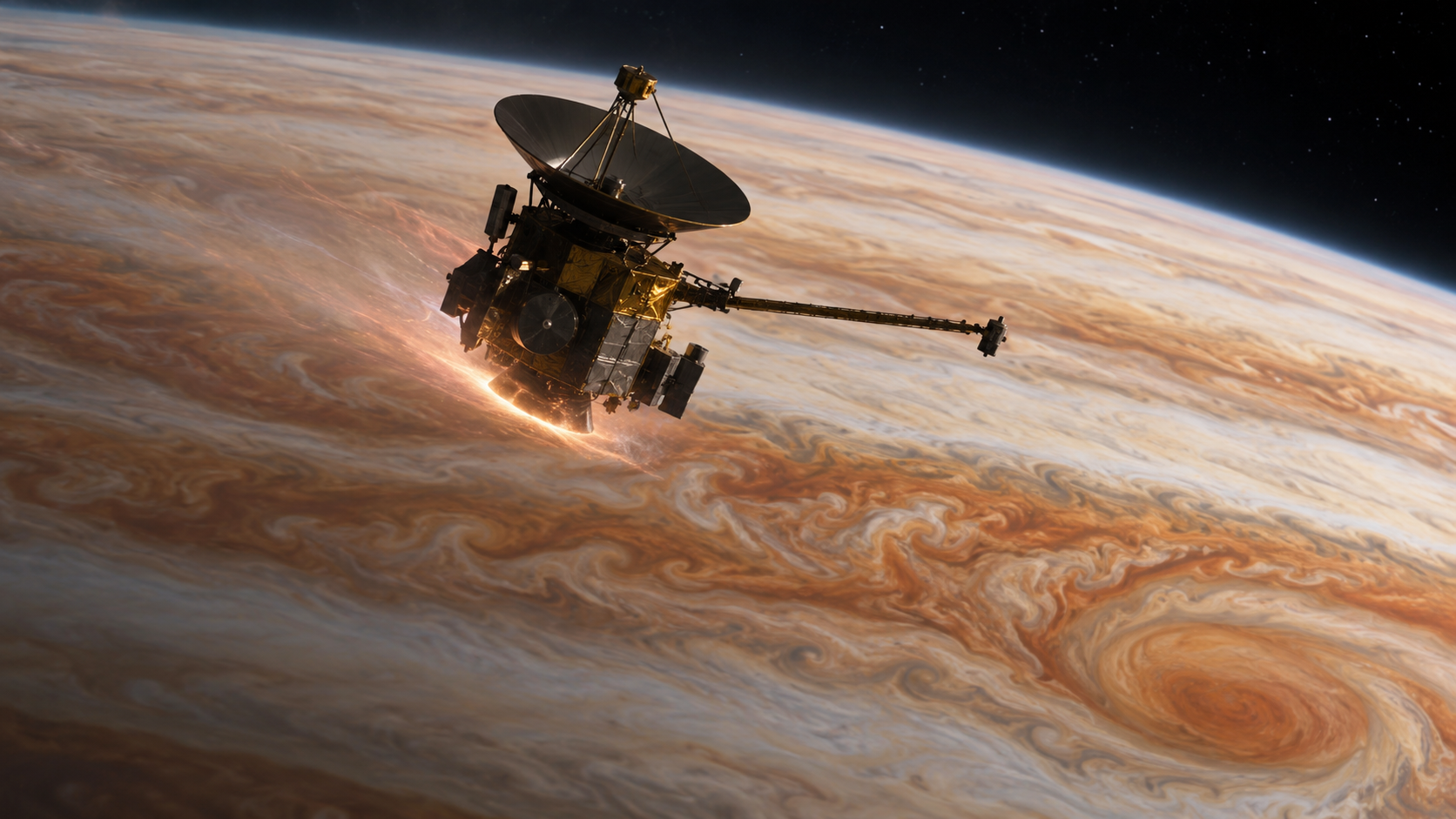
On This Day in Science: September 21, 2003
On September 21, 2003, NASA’s Galileo spacecraft entered Jupiter’s atmosphere and was destroyed, ending nearly eight years of orbital exploration. Mission controllers had deliberately placed it on an impact trajectory so that a future loss of control could not allow the unsterilized spacecraft to strike Europa, a moon suspected of harboring a subsurface ocean.
Galileo had launched in 1989, flew past Venus and Earth for gravity assists, observed asteroids, and released a probe into Jupiter’s atmosphere. After arriving in 1995, the orbiter repeatedly toured the giant planet’s moons despite a main antenna that failed to unfold and intense radiation that damaged electronics.
The mission supplied evidence for a salty ocean beneath Europa’s ice, a magnetic field generated within Ganymede, volcanic changes on Io, and complex structures around Callisto. It also measured Jupiter’s atmosphere directly and witnessed the effects of Comet Shoemaker-Levy 9 before orbital arrival.
Galileo’s final dive was both an engineering decision and an early act of planetary protection for a potentially habitable world. The end preserved Europa as a cleaner target for later missions while closing one of the most productive chapters in outer-planet exploration. For science history, the event also shows how evidence moves from an observation or engineered test into a durable body of knowledge. Instruments supplied measurements, specialists debated interpretation, and later work refined what the first result could mean. Archives preserve the early record while new methods let researchers ask different questions of it. That continuing revision is the process through which a dated milestone remains scientifically useful. Seen across a longer timeline, scientific milestones are junctions rather than isolated beginnings. Earlier experiments, tools, and institutions made the work possible, while later teams tested limits and carried the result into new settings. What survives is a traceable chain of evidence, correction, and application that allows one moment to remain relevant as knowledge and technology continue to change. The anniversary highlights the difference between a first result and a finished understanding. A successful observation can settle one question while opening several harder ones, and even a failed objective can reshape later designs. Preserved data, specimens, photographs, and hardware allow new generations to revisit the work with better tools. Science advances through that continuity rather than stopping on a memorable date. Its calendar date is an entry point, not an endpoint. The people involved worked with the instruments, assumptions, and social conditions of their time, and later research has both extended and corrected their conclusions. Separating what was known that day from what became clear afterward protects the history from myth and shows how cumulative evidence turns an episode into lasting scientific knowledge.
Controllers aimed Galileo at Jupiter before failing systems could make its path uncertain.
Destruction in the atmosphere removed the chance of accidental contact with Europa.
A stuck high-gain antenna sharply reduced the planned data rate.
New compression and careful scheduling still recovered a major scientific return.
Magnetic and geological evidence changed ideas about the Galilean moons.
Europa became a leading destination in the search for habitable environments.
Explore more of "On This Day ..."
Discover more events from the same date across news, politics, technology, sports, and other fields. Each link highlights significant moments that shaped history on different fronts.