

On This Day in Science: September 23, 1846
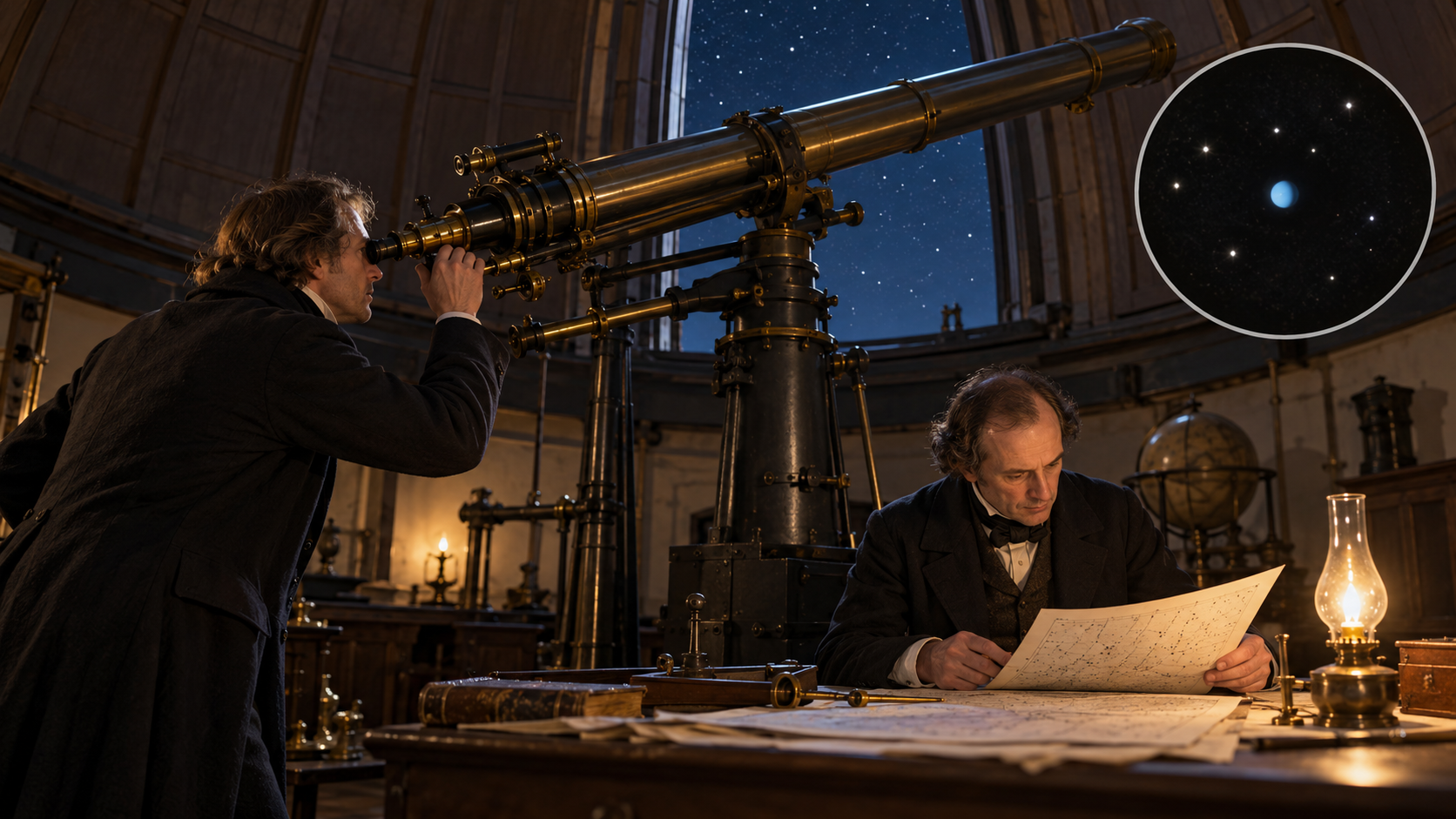
On September 23, 1846, astronomer Johann Gottfried Galle and student Heinrich Louis d’Arrest identified Neptune at the Berlin Observatory. They searched near a position calculated by French mathematician Urbain Le Verrier from unexplained deviations in the orbit of Uranus. The observed object was absent from their star chart and showed a small disk.
The discovery is famous as a triumph of celestial mechanics, but its history includes competing calculations and complicated questions of credit. British mathematician John Couch Adams had independently worked on a possible outer planet, while earlier observers had unknowingly recorded Neptune as a star. Le Verrier’s published prediction and Galle’s prompt observation produced the decisive match.
Neptune takes about 165 years to orbit the Sun and lies roughly thirty times farther from the Sun than Earth. Telescopes gradually revealed its largest moon, Triton, a faint ring system, and atmospheric features. Voyager 2’s 1989 flyby provided the only close spacecraft reconnaissance to date.
The 1846 observation demonstrated how a hidden object could be inferred from its gravitational effects before it was recognized in the sky. That method remains central in astronomy, from finding planets around other stars to mapping unseen mass in galaxies. The anniversary highlights the difference between a first result and a finished understanding. A successful observation can settle one question while opening several harder ones, and even a failed objective can reshape later designs. Preserved data, specimens, photographs, and hardware allow new generations to revisit the work with better tools. Science advances through that continuity rather than stopping on a memorable date. Its calendar date is an entry point, not an endpoint. The people involved worked with the instruments, assumptions, and social conditions of their time, and later research has both extended and corrected their conclusions. Separating what was known that day from what became clear afterward protects the history from myth and shows how cumulative evidence turns an episode into lasting scientific knowledge. For science history, the event also shows how evidence moves from an observation or engineered test into a durable body of knowledge. Instruments supplied measurements, specialists debated interpretation, and later work refined what the first result could mean. Archives preserve the early record while new methods let researchers ask different questions of it. That continuing revision is the process through which a dated milestone remains scientifically useful. Seen across a longer timeline, scientific milestones are junctions rather than isolated beginnings. Earlier experiments, tools, and institutions made the work possible, while later teams tested limits and carried the result into new settings. What survives is a traceable chain of evidence, correction, and application that allows one moment to remain relevant as knowledge and technology continue to change.
Le Verrier calculated where an unseen planet should appear from Uranus's orbital deviations.
Galle and d'Arrest searched that region rather than scanning the whole sky.
The candidate was missing from a detailed star chart and appeared slightly extended.
Follow-up observations confirmed that it moved as a planet.
Neptune showed that orbital perturbations can expose an unseen body.
Astronomers still use related reasoning to infer planets and other hidden mass.
Explore more of "On This Day ..."
Discover more events from the same date across news, politics, technology, sports, and other fields. Each link highlights significant moments that shaped history on different fronts.