

How Comets Develop Tails Explainer
A comet’s solid nucleus is a small mixture of ices, dust, rock, and organic material. Far from the Sun it can be dark and inactive. As it approaches, absorbed sunlight warms exposed regions. Ices change directly into gas through sublimation, and escaping gas drags dust away from the weak gravity of the nucleus, creating jets and a broad atmosphere called the coma.
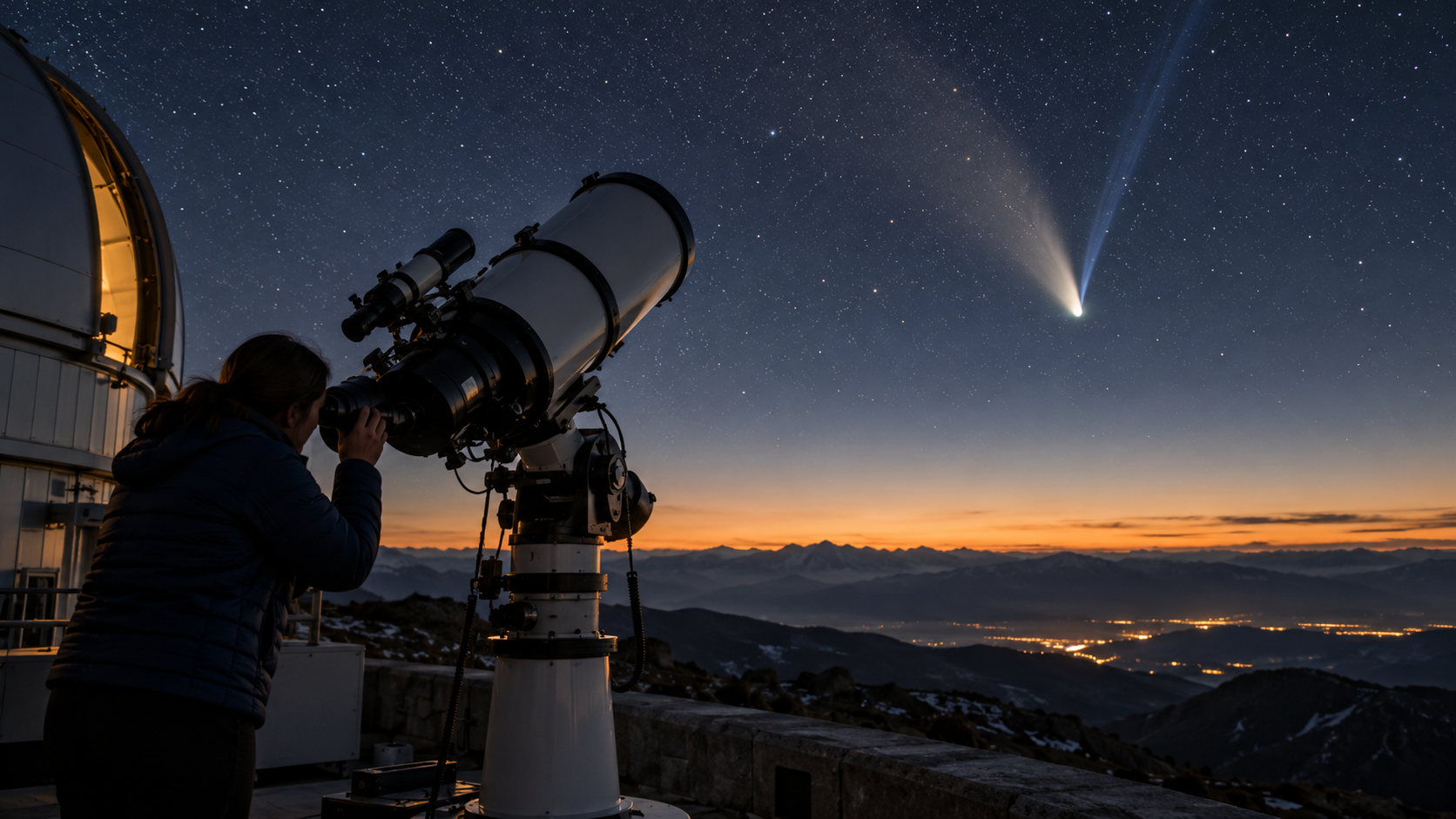
The coma supplies material for more than one tail. Dust grains scatter sunlight and are pushed by solar radiation pressure. Because they retain much of their original orbital motion and respond differently according to size, the dust tail is often broad, bright, and curved. It may look yellowish or white because it reflects sunlight.
Ultraviolet sunlight ionizes some coma molecules. These charged particles become coupled to the magnetic field carried by the solar wind and are swept rapidly away from the Sun. The ion, or plasma, tail is usually straighter, narrower, and fainter, and can appear bluish from fluorescent emission. Magnetic disturbances can create knots, waves, or even temporarily disconnect part of it.
Both major tails point generally away from the Sun, not simply behind the comet along its orbit. After the comet passes the Sun, its direction of travel changes while solar forcing still pushes tail material outward. From Earth, viewing geometry can foreshorten the tails or produce an apparent anti-tail when dust lying near the comet’s orbital plane is seen edge-on.
Activity is uneven because rotation brings different surface areas into sunlight and insulating dust can cover ice. Carbon dioxide or carbon monoxide can drive activity farther from the Sun than water ice. Jets may change the nucleus rotation slightly. Each close solar passage removes material, and some nuclei split, fade, or eventually become largely inactive.
Telescopes, spectroscopy, spacecraft images, and in-situ dust and gas measurements identify composition and dynamics. A photograph records projected brightness, not a direct map of all mass, and tail length does not simply measure nucleus size. Comet tails reveal how sunlight, charged particles, magnetic fields, and fragile ancient material interact across millions of kilometers.
Solar heating makes surface ices sublimate and drag dust into a coma.
Radiation pressure sorts dust grains into a broad, often curved tail.
Solar wind and its magnetic field sweep ions into a straighter plasma tail.
Tails point away from the Sun rather than merely trailing the orbit.
Rotation, volatile composition, surface cover, and fragmentation change activity.
Viewing geometry and brightness can make a tail misleading without physical models.
Explore more "Explainers"
Discover additional explainers across politics, science, business, technology, and other fields. Each explainer breaks down a complex idea into clear, everyday language—helping you better understand how major concepts, systems, and debates shape the world around us.