

On This Day in Science: October 2, 1608
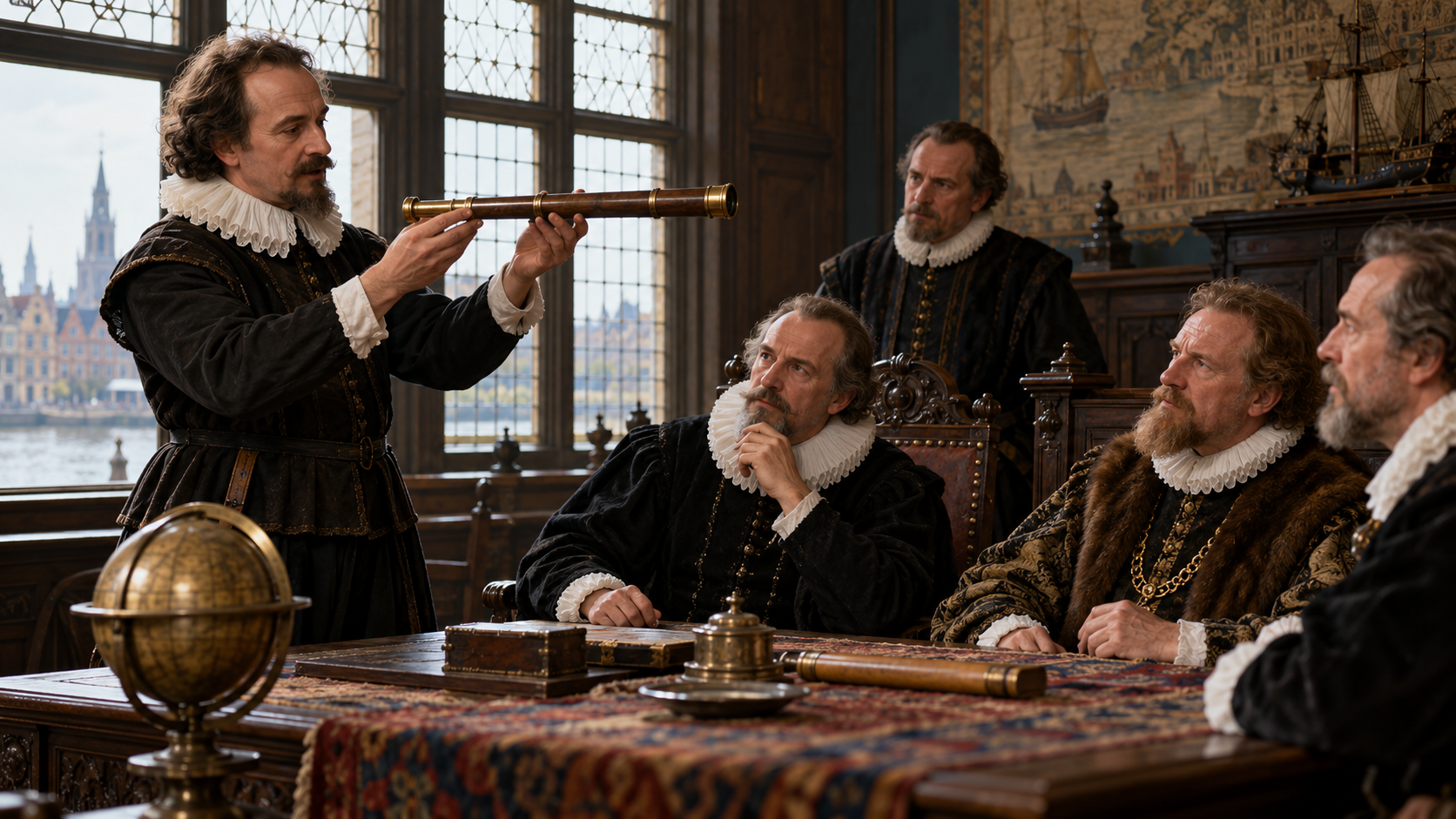
On October 2, 1608, spectacle maker Hans Lippershey of Middelburg presented the States General of the Netherlands with a request to patent an instrument for seeing distant objects as if they were nearby. His device combined glass lenses in a tube and offered roughly threefold magnification.
Lippershey was not the only optical craftsman experimenting with such an arrangement. Jacob Metius filed a similar claim soon afterward, and Zacharias Janssen was later associated with another disputed account. Because the principle appeared easy to reproduce, the Dutch authorities did not grant Lippershey an exclusive patent.
The government nevertheless paid him to make binocular versions, and news of the device spread quickly. Within a year, Galileo Galilei had built improved telescopes and turned them toward the sky, observing the Moon, the Milky Way, Jupiter’s moons, and phases of Venus.
The patent application marks a documented transition from optical craft to a scientific instrument with enormous reach. The telescope did not emerge from one isolated flash of invention, but Lippershey’s public demonstration and surviving application helped accelerate its adoption across Europe. Placed in a longer timeline, the event was a junction rather than a finished answer. Earlier discoveries and technical work made it possible, while later teams tested its limits and applied the result in new settings. That traceable sequence of evidence and revision is what turns one day into a durable part of scientific history. The episode also separates a first demonstration from mature understanding. A successful observation or flight can settle one question while exposing harder problems in reliability, interpretation, safety, and scale. Preserved data allow later generations to revisit the achievement without confusing what was known on the date with what became clear afterward. Its calendar date is an entry point rather than an endpoint. The people involved worked with the tools, assumptions, institutions, and social conditions of their time. Later research has extended some conclusions and corrected others, showing how science advances by keeping evidence open to comparison instead of treating a memorable event as final. What makes the event scientifically important is not only priority, but the ability of others to check, repeat, compare, or build on the result. That process can reveal limitations hidden by the excitement of a first success. It also explains why careful archives and transparent measurements matter as much as the date remembered by the public. Modern interpretations benefit from evidence that the original participants did not possess. New instruments and analytical methods can recover additional detail, while historical scholarship clarifies questions of credit, context, and consequence. Holding the original achievement and those later corrections together produces a more accurate account than either celebration or dismissal alone.
A convex objective and concave eyepiece produced an upright magnified view.
Early instruments were narrow in field and modest in power but immediately useful.
Officials judged that the design could be copied too easily for a monopoly.
Payment for demonstration instruments still gave Lippershey a documented role.
News traveled faster than the original hardware.
Astronomers improved the design and transformed observational science within months.
Explore more of "On This Day ..."
Discover more events from the same date across news, politics, technology, sports, and other fields. Each link highlights significant moments that shaped history on different fronts.