

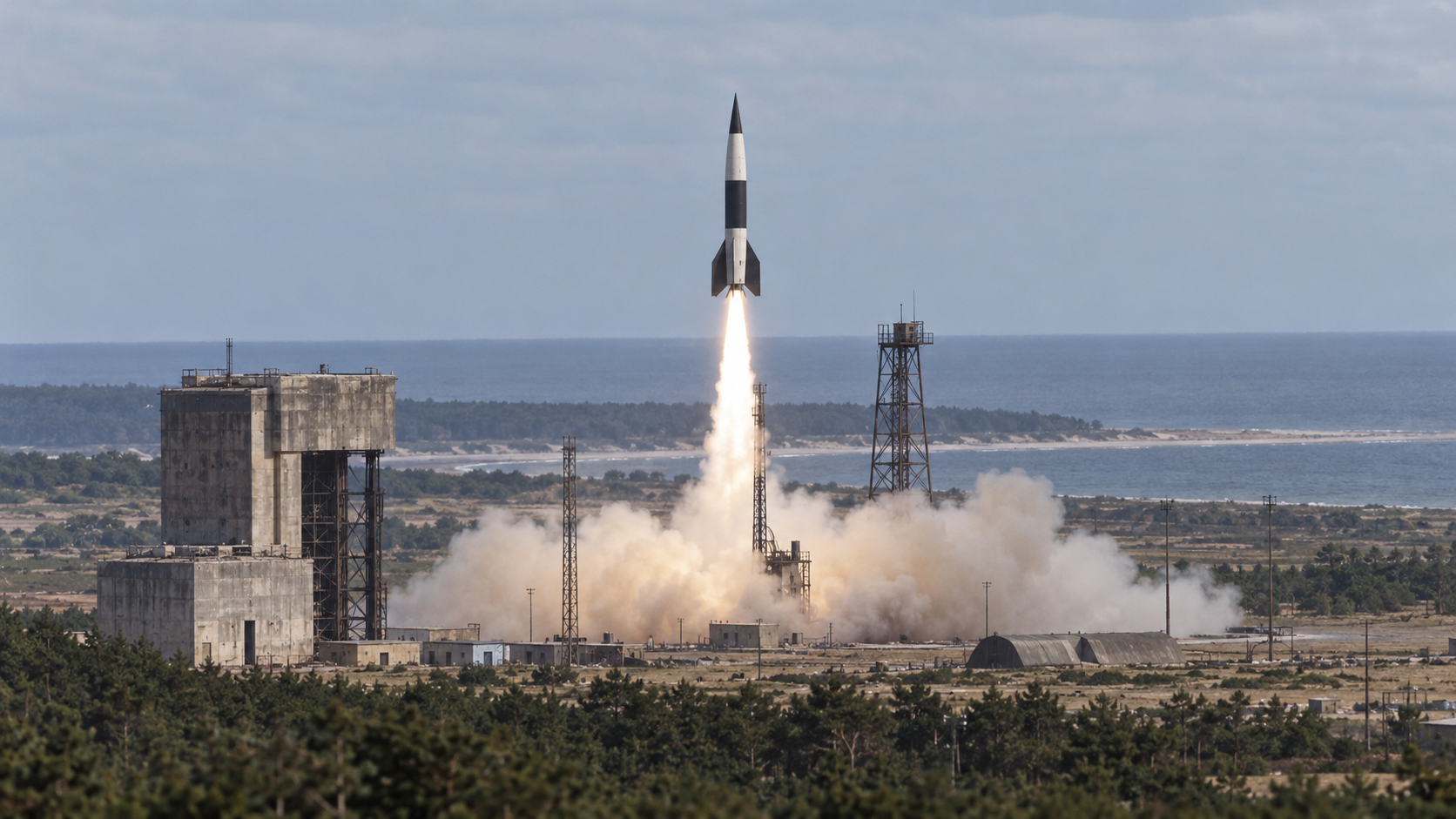
On This Day in Science: October 3, 1942
On October 3, 1942, a German A-4 rocket, later called the V-2, completed its first successful full test flight from Peenemünde on the Baltic coast. The liquid-fueled vehicle rose to roughly 84 kilometers and traveled about 190 kilometers downrange before striking the Baltic.
The test followed several failures and years of work on turbopumps, guidance, aerodynamics, and a large engine burning alcohol and liquid oxygen. The rocket carried no scientific mission; it was developed by Nazi Germany as a weapon during World War II and was later used against cities with devastating consequences.
Its engineering nevertheless demonstrated a package of technologies that became foundational for long-range missiles and postwar launch vehicles. Guidance gyroscopes, high-flow propellant pumps, graphite control vanes, and a regeneratively cooled engine all had to work together during the flight.
The event’s technical legacy cannot be separated from forced labor, wartime violence, and the deaths associated with V-2 production and use. After the war, captured hardware and personnel influenced programs in the United States, Soviet Union, and other countries, making the rocket part of both spaceflight history and a grave history of exploitation. The episode also separates a first demonstration from mature understanding. A successful observation or flight can settle one question while exposing harder problems in reliability, interpretation, safety, and scale. Preserved data allow later generations to revisit the achievement without confusing what was known on the date with what became clear afterward. Its calendar date is an entry point rather than an endpoint. The people involved worked with the tools, assumptions, institutions, and social conditions of their time. Later research has extended some conclusions and corrected others, showing how science advances by keeping evidence open to comparison instead of treating a memorable event as final. What makes the event scientifically important is not only priority, but the ability of others to check, repeat, compare, or build on the result. That process can reveal limitations hidden by the excitement of a first success. It also explains why careful archives and transparent measurements matter as much as the date remembered by the public. Modern interpretations benefit from evidence that the original participants did not possess. New instruments and analytical methods can recover additional detail, while historical scholarship clarifies questions of credit, context, and consequence. Holding the original achievement and those later corrections together produces a more accurate account than either celebration or dismissal alone. The anniversary also illustrates how a scientific milestone becomes useful through records that later researchers can inspect. Instruments, notebooks, images, specimens, and engineering reports preserve more than a celebratory date: they show what was actually measured, what remained uncertain, and how conclusions changed as better methods became available.
Alcohol and liquid oxygen fed a powerful engine through turbine-driven pumps.
The vehicle combined propulsion, control, and guidance at a scale not previously flown successfully.
The A-4 was designed for military bombardment.
Any account of its engineering must include the forced labor and civilian deaths bound to the program.
Captured components and specialists entered several national missile programs.
Later launch vehicles inherited techniques while emerging in very different institutions and purposes.
Explore more of "On This Day ..."
Discover more events from the same date across news, politics, technology, sports, and other fields. Each link highlights significant moments that shaped history on different fronts.