

How Planetary Rings Form and Evolve Explainer
Planetary rings are not solid disks. They contain vast numbers of particles, from dust to house-sized chunks, each following its own orbit. Several origins are possible: a moon or comet may be disrupted by impact or tides, material may fail to assemble into a moon, or small moons may continually shed dust through collisions and micrometeoroid impacts.
Inside a planet’s Roche limit, tidal differences across a loosely bound body can exceed its self-gravity and make accretion difficult. The boundary depends on density, strength, shape, and orbit, so it is not one rigid line. Strong solid fragments can survive within it, while loose particles outside it can sometimes gather into moonlets.
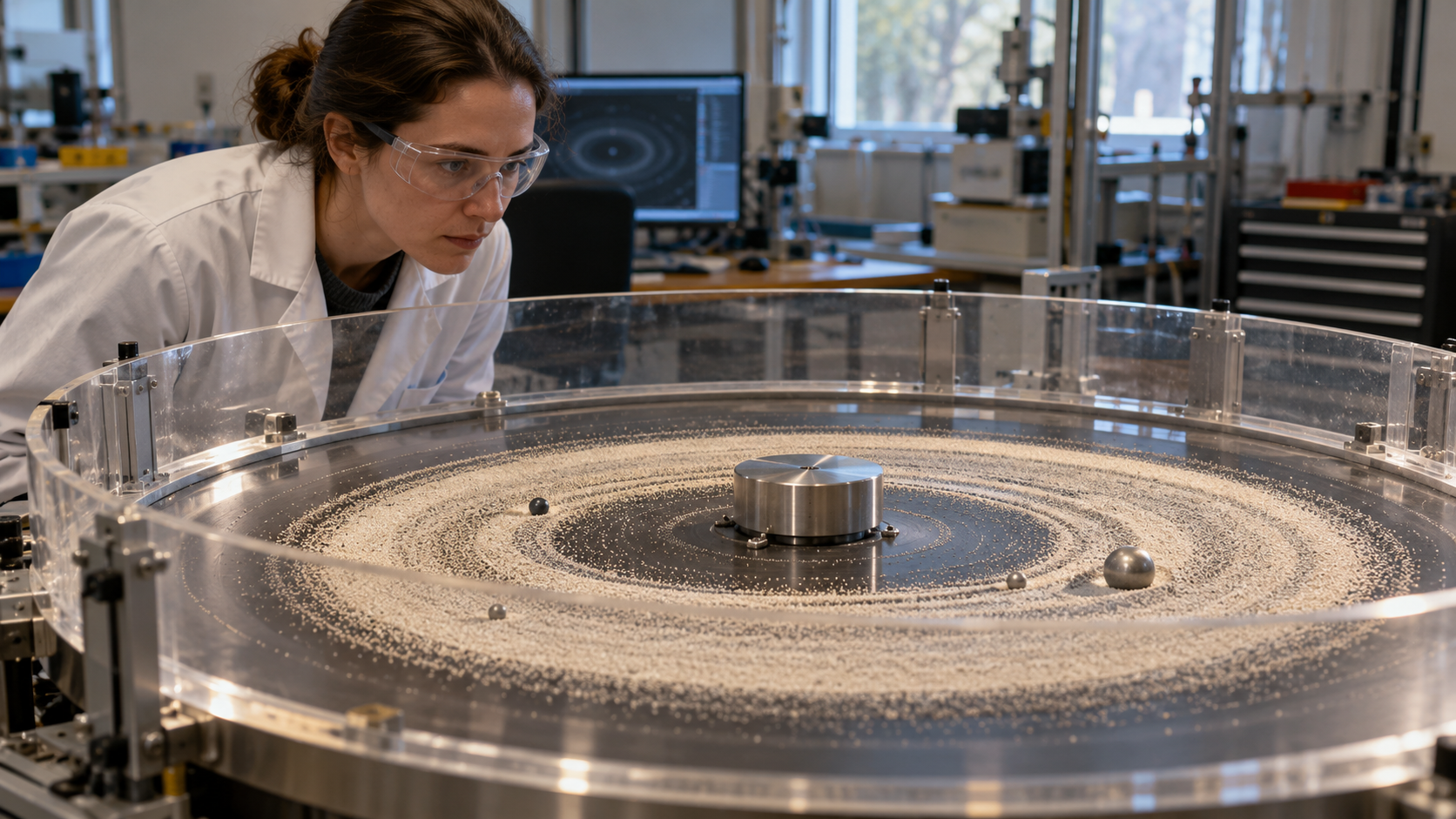
Ring particles collide frequently at low relative speeds. Inelastic collisions dissipate random motion, flattening the system into a thin plane near the planet’s equator. Collisions also exchange angular momentum, causing rings to spread: some material moves inward while other material moves outward. Without replenishment or confinement, a narrow ring does not remain unchanged forever.
Moons sculpt ring structure through gravity. Orbital resonances repeatedly tug particles at particular locations, opening gaps or launching spiral density and bending waves. Small shepherd moons can confine narrow edges by exchanging angular momentum. Embedded moonlets create wakes, propeller-shaped disturbances, and local gaps rather than simply sweeping a perfectly empty track.
Dust responds strongly to sunlight, plasma, and electromagnetic forces, while larger icy particles are governed mainly by gravity and collisions. Micrometeoroids darken or erode material, and charged dust can move along magnetic fields. Some particles fall into the planet or escape; others are supplied from active moons or impacts.
Spacecraft images, radio and stellar occultations, spectroscopy, and gravitational measurements reveal particle sizes and structure. A bright ring’s age is difficult to infer because young appearance may reflect recycling or recent contamination. Ring evolution is a laboratory for disk physics that also applies to protoplanetary systems, but each planet’s rings have a distinct history.
Rings contain independently orbiting particles rather than one solid sheet.
Disruption, failed accretion, impacts, and active moons can supply material.
The Roche limit marks where tides can impede loosely bound moon formation.
Inelastic collisions flatten and slowly spread the particle disk.
Resonances and embedded moons create gaps, waves, edges, and wakes.
Dust, plasma, sunlight, impacts, and recycling change ring appearance over time.
Explore more "Explainers"
Discover additional explainers across politics, science, business, technology, and other fields. Each explainer breaks down a complex idea into clear, everyday language—helping you better understand how major concepts, systems, and debates shape the world around us.