

How Solar Wind Shapes the Heliosphere Explainer
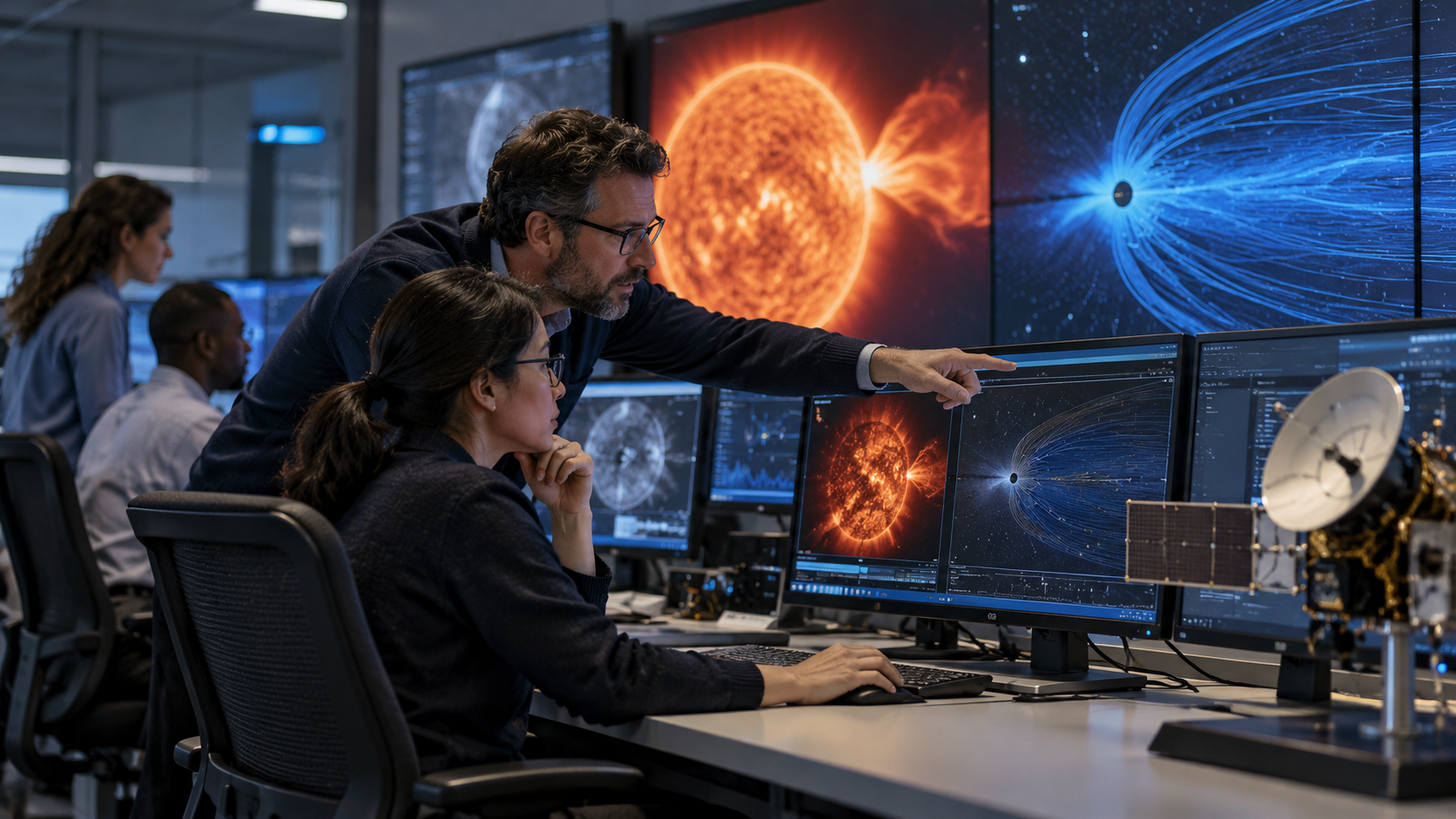
The solar wind is a continual outflow of electrons, protons, and ions from the Sun’s hot corona. It carries the solar magnetic field far beyond the planets and fills the region of space dominated by the Sun’s plasma. The explanation combines gravity, motion, radiation, and plasma behavior across scales far beyond direct laboratory reach.
Near the Sun, thermal pressure and magnetic processes accelerate the flow to supersonic speeds. Solar rotation winds the embedded magnetic field into a broad spiral, while fast and slow streams interact and form compressions and shocks. Initial mass and orbital conditions determine which pathways are available and how quickly the system changes.
Far beyond the planets, pressure from surrounding interstellar gas and magnetic fields slows the solar wind at the termination shock. The flow continues through a disturbed heliosheath until the heliopause marks the boundary where solar and interstellar influences balance. Energy and angular momentum must be conserved even when matter heats, fragments, or changes direction.
The resulting heliosphere is not a rigid shell. Its size and shape respond to the solar cycle, eruptions, interstellar conditions, and magnetic geometry, and energetic neutral atoms reveal interactions that cannot be seen directly in visible light. Astronomers infer the process from light, spectra, timing, and motion rather than watching every stage up close.
Voyager spacecraft sampled boundary regions locally, while missions such as IBEX map neutral atoms arriving from many directions. Nearer the Sun, particle and field instruments measure the wind’s origin, structure, and effects on planets and spacecraft. Computer models are tested against those signals, and competing explanations survive only when they match several observations.
The heliosphere reduces some incoming galactic cosmic rays but is not an impenetrable shield. Understanding its boundaries connects solar activity, space weather, planetary environments, and the way other stars may shape the space around their planetary systems. The broad mechanism is established, while exact shapes, rates, and histories can remain uncertain for an individual object.
The hot corona releases a continuous plasma outflow.
Solar rotation carries magnetic fields into a spiral pattern.
Fast and slow streams create compressed interaction regions.
Interstellar pressure slows the wind at the termination shock.
The heliopause separates dominant solar and interstellar plasma influence.
Spacecraft and neutral-atom maps probe the changing boundary.
Explore more "Explainers"
Discover additional explainers across politics, science, business, technology, and other fields. Each explainer breaks down a complex idea into clear, everyday language—helping you better understand how major concepts, systems, and debates shape the world around us.